
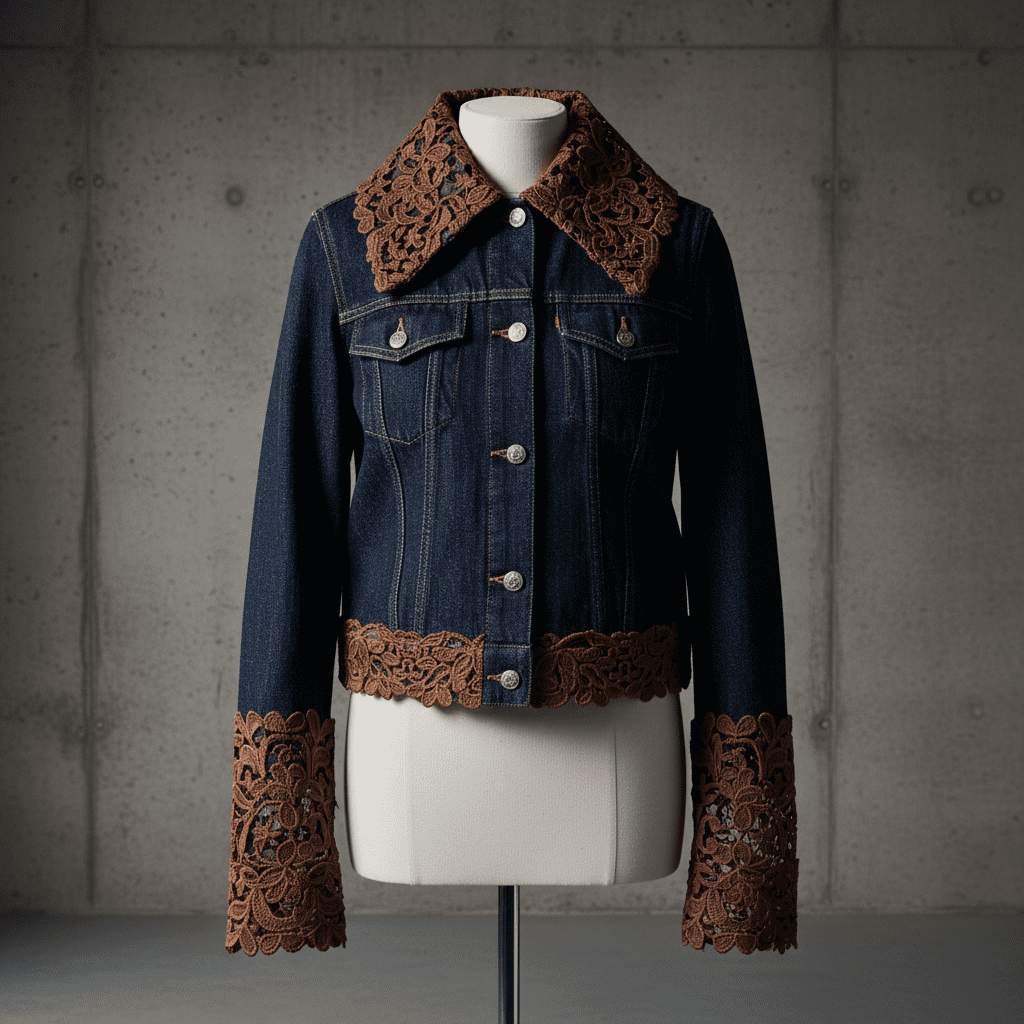
Known as the “Laced Up” trend, modern lace has evolved from fragile decoration into structural, high-contrast elements integrated with denim, leather and tailored fabrics.
As an experienced lace trim manufacturer, we recognize this trend as a key textile engineering challenge that requires improved tensile strength, colorfastness, and shrinkage resistance. This analysis breaks down four core 2026 lace aesthetics and their corresponding manufacturing, material and supply chain requirements.
The Paradigm Shift: From Fragile Ornament to Structural Component
To understand the 2026 lace market, we must first examine the psychological drivers behind the “Laced Up” trend. Modern consumers crave romanticism and visible craftsmanship but refuse to compromise on durability and the edge of modern streetwear.
This psychological shift has birthed the “High-Contrast Concept.” The most successful garments in upcoming collections will pair seemingly contradictory elements. We are seeing a massive influx of manufacturing orders requesting lace trims specifically designed to border rigid textiles.
From a textile engineering perspective, this requires a fundamental change in how we spin, weave, and dye our yarns. For example, if a lace trim is applied to the hem of a heavy denim skirt, it must withstand friction from daily wear and resist the harsh mechanical action of modern washing machines without pilling, tearing, or losing dimensional stability.
The color palette has also evolved. The dominance of stark white and basic black is making way for sophisticated, moody undertones. Our dye houses are currently processing unprecedented volumes of “Chocolate Brown,” “Deep Navy,” and “Dusty Pink” lace trims. These tones allow lace to act as a versatile shadow, seamlessly blending with a range of garments rather than being a glaring focal point.
Deciphering the Four Defining Lace Aesthetics of 2026
Based on proprietary manufacturing data, prototype requests from leading fashion buyers, and global runway analysis, the 2026 lace trim market will be divided into four distinct categories. Each brings unique design appeal and specialized manufacturing challenges.
1. The New Sheer: Romantic Floral & Chantilly-Inspired Trims
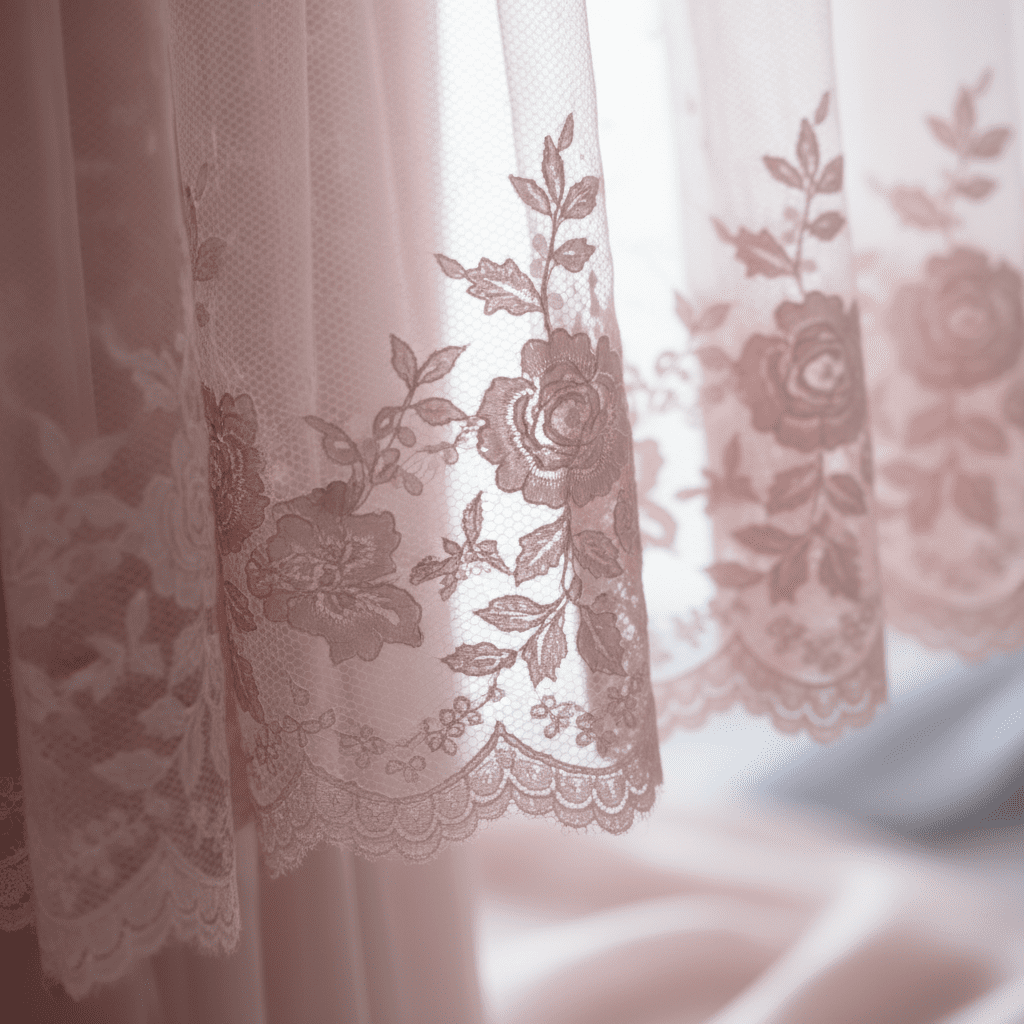
Sheer, romantic floral lace will be the highest-volume lace trend in 2026. This style relies on a highly transparent, lightweight tulle or hexagonal mesh base, boldly contrasted by intricate, opaque floral motifs.
Market Application:
-
Lightweight trims on slip dress hemlines
-
Cuffs on silk blouses
-
Peek-a-boo details beneath oversized knitwear
The goal is to create an illusion of floating—texture that does not weigh the garment down.
Manufacturing Reality:
Producing high-quality sheer lace at commercial volume demands machine precision and careful yarn selection. We utilize advanced warp-knitting jacquard machines for speed and detail accuracy.
Key factors:
-
Micro-denier polyester and nylon blends avoid the scratchiness common in lower-grade yarns.
-
Proprietary softening treatments provide a skin-friendly finish.
-
Proper engineering maintains both tensile strength and aesthetic appearance.

2. Architectural Integrity: Heavy Guipure & 3D Corded Lace
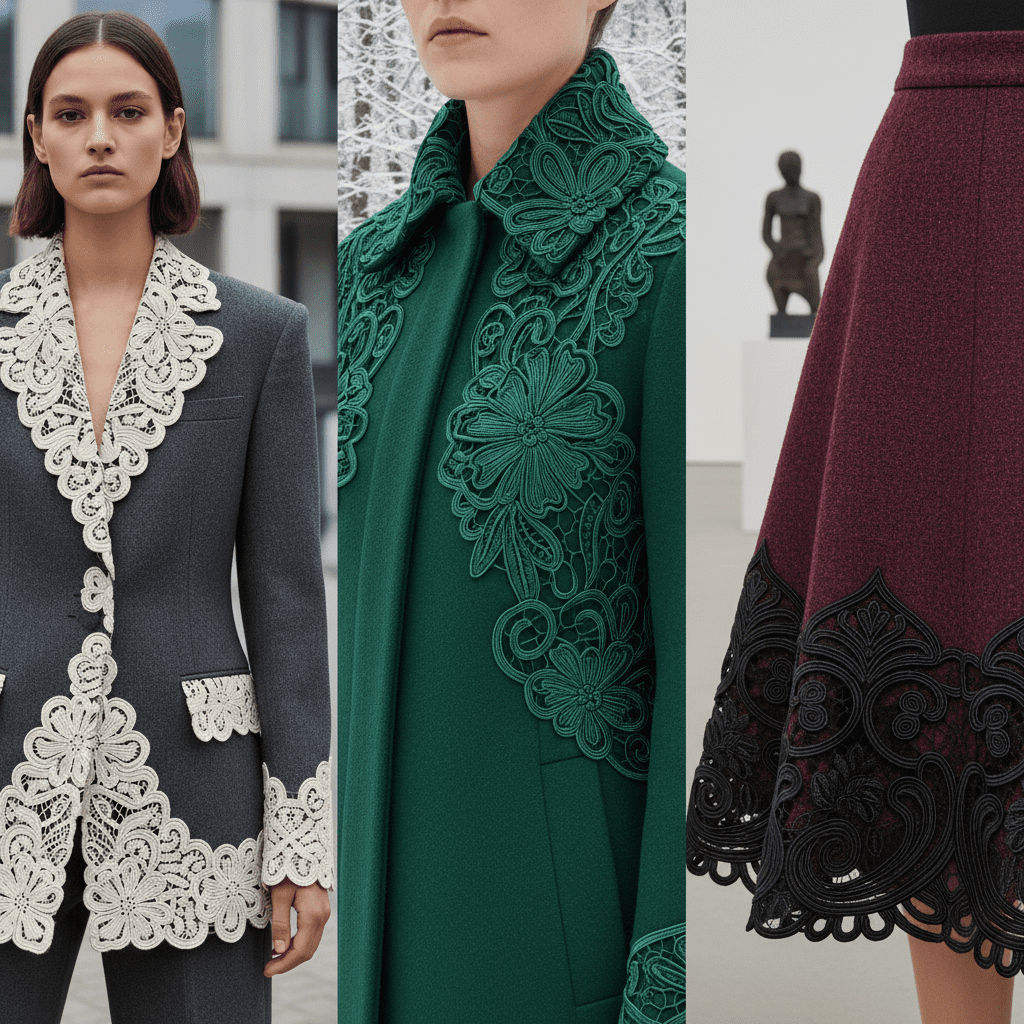
If sheer lace is a whisper, heavy Guipure and corded laces are a statement. Fashion is embracing more structured, tailored silhouettes in 2026 outerwear, and lightweight nets simply cannot provide the needed integrity.
Market Application:
-
Thick, embroidered trims on structured blazers
-
Lapels of winter coats
-
Hems of A-line skirts
These laces are more like flexible architectural details than pure decoration.
Manufacturing Reality:
Guipure (Venetian) lace is embroidered on a dissolvable base. The challenge is achieving dimensional stability.
Key steps:
-
We use high-twist mercerized cotton and heavy-duty polyester cords, ensuring durability.
-
All Guipure trims undergo strict thermal setting and preshrinkage processes. This keeps 3D motifs rigid and guards against post-wash collapse.
3. The Rebellious Silhouette: Asymmetrical & Scalloped Borders
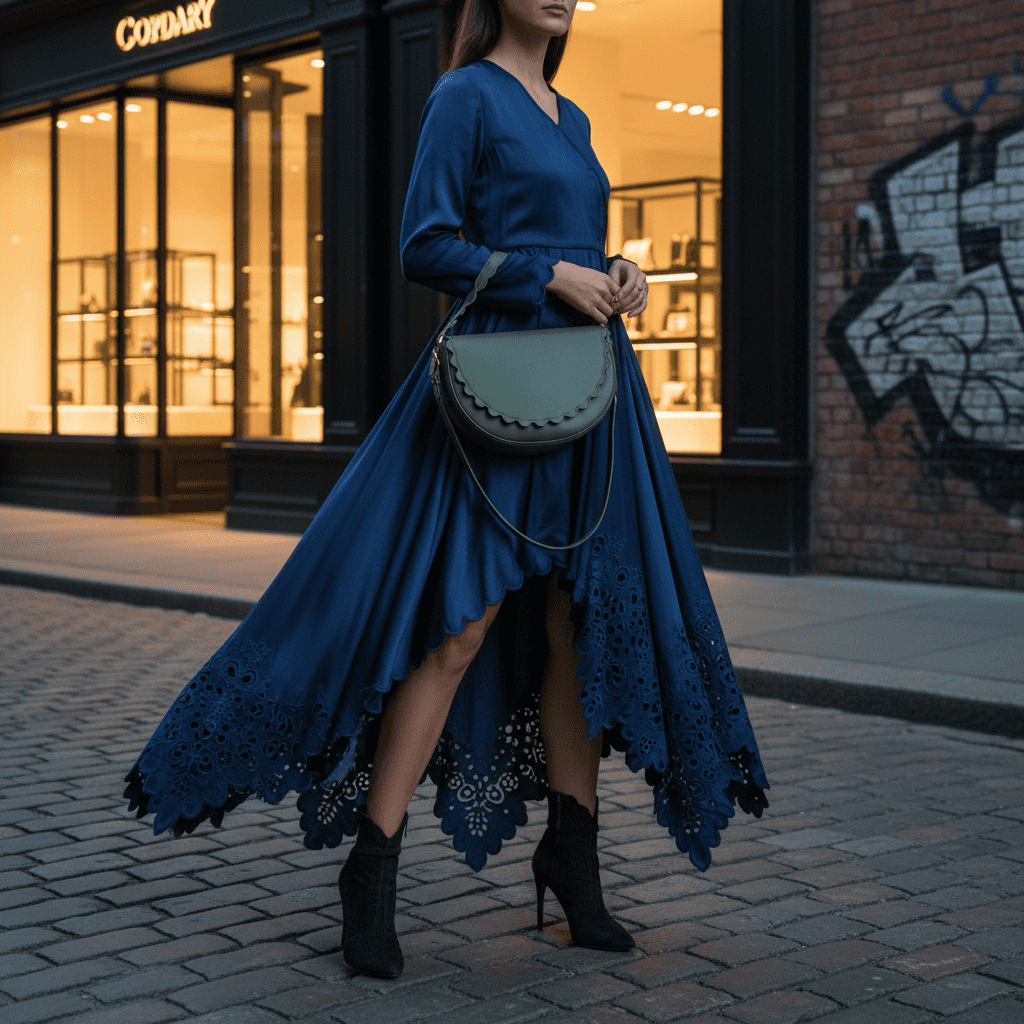
The 2026 consumer gravitates toward the “undone” and irregular. Straight hems are being replaced by deliberately disruptive borders.
Market Application:
-
Deep scalloped edges
-
Asymmetrical drops
-
Handkerchief cuts and aggressive cutwork (broderie anglaise styles)
-
Borders for bias-cut dresses and luxury accessories
This delivers a bespoke, deconstructed effect popular with avant-garde and boutique labels.
Manufacturing Reality:
-
Creating fray-proof, irregular borders on delicate lace is complex.
-
Traditional blade cutting isn’t sufficient.
-
We use CAD-driven laser cutting to shape and simultaneously seal synthetic fibers, preventing unraveling.
-
This approach enables fully bespoke and brand-protected borders.
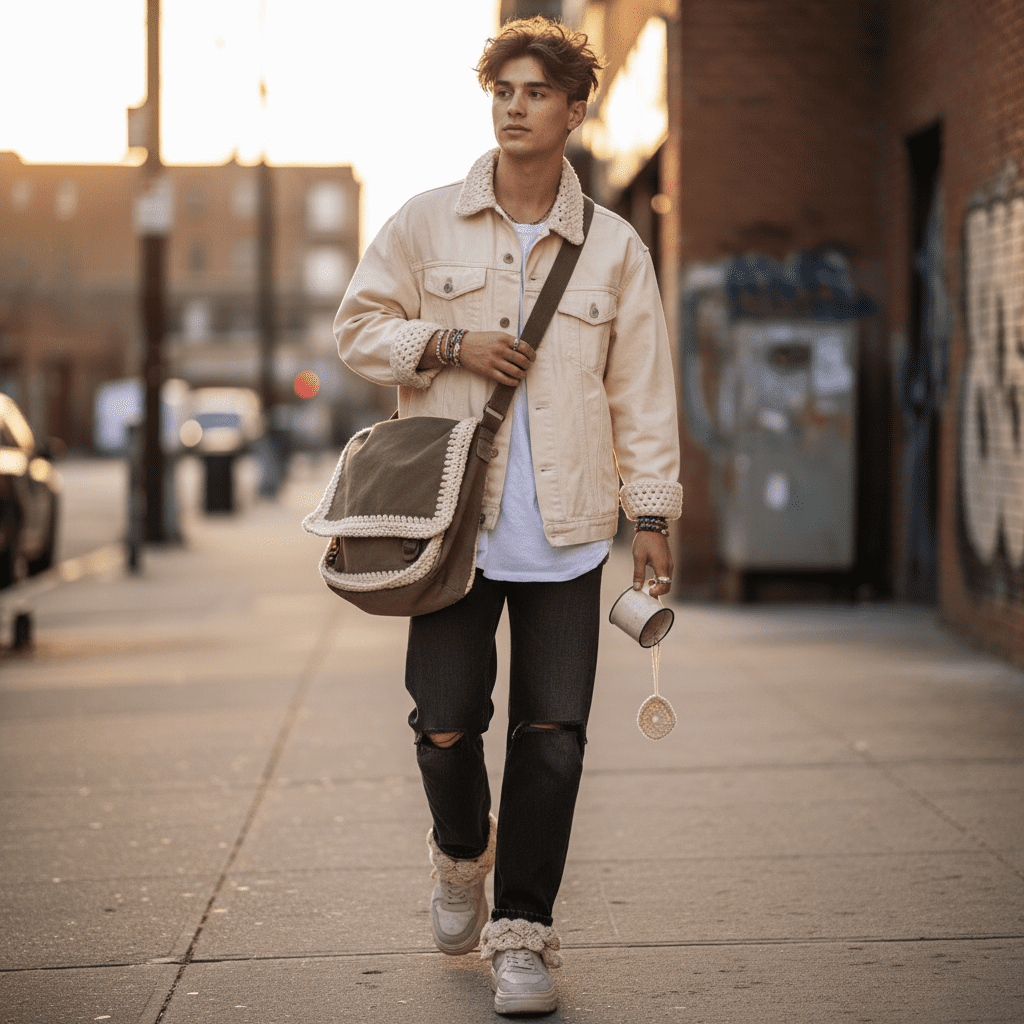
4. Tactile Nostalgia: The Crochet & Doily Revival
Gen Z’s influence in 2026 brings chunky, hand-crafted aesthetics to the mainstream.
Market Application:
-
Creamy crochet trims on denim collars
-
Borders on rugged canvas bags
-
Decorative edges on thick knit socks
These trims express a “crafted” streetwear vibe, distancing lace from its formal reputation.
Manufacturing Reality:
Hand-crochet isn’t viable for large-scale production. Our solution is:
-
Machine knitting with thick gauge needles and controlled tension
-
Blends of premium cotton and polyester for comfort and commercial viability
-
Production processes that mimic the texture and warmth of hand-hooked lace
The Supply Chain Reality: Sourcing for the Future
Making these advanced styles commercially viable requires a shift away from trading middlemen, who do not manage looms or dyes directly.
Why Direct Manufacturer Partnerships Matter
Key benefits:
-
Colorfastness
-
The trend for high-contrast pairings (e.g., dark navy on white silk) makes dye migration a risk.
-
We use advanced reactive dyes and rigorous wash-testing to guarantee maximum colorfastness and prevent bleeding.
-
-
Sustainability and Compliance (OEKO-TEX)
-
By 2026, sustainable sourcing is a must.
-
Our trims utilize GRS-certified recycled polyester (rPET) and organic cotton.
-
All dyeing meets OEKO-TEX Standard 100 for chemical safety.
-
-
Rapid Prototyping (OEM/ODM)
-
Design cycles are shorter than ever.
-
Our R&D turns mood boards into physical prototypes within 48–72 hours, supporting accelerated launches.
-
Conclusion: Engineering the Future of Fashion
The 2026 “Laced Up” trend underscores lace’s evolution from a historical textile to a dynamic, engineered component.
From airy sheer Chantilly, structural heavy Guipure, rebellious scalloped borders, to tactile machine-crochet—the future of fashion is textured. To succeed, brands must collaborate with factories that combine design understanding and technological expertise. Prioritizing quality control, sustainability, and innovation turns trend forecasts into lasting market success.
Frequently Asked Questions (FAQ): Manufacturer Insights
Q: How does the shrinkage rate of Heavy Guipure lace compare to standard warp-knitted lace trims? A: Heavy Guipure’s dense structure and use of cotton means higher natural shrinkage, but we control this through industrial pre-shrinking and thermal setting for shrinkage below 3%.
Q: Can sheer lace trims be reliably color-matched to custom Pantone shades for 2026? A: Yes, thanks to nylon/polyester’s excellent dye affinity and in-house spectral color analysis. We deliver precise lab-dipped samples in days for total palette control.
Q: What is the best lace trim for high-friction garment zones? A: Avoid sheer tulle; opt for heavy corded laces or dense machine-crochet (polyester blends), engineered for tensile & abrasion resistance.
Q: Are sustainable lace options available for eco-conscious brands? A: Absolutely. Our full range, from sheer to geometric patterns, is offered in GRS-certified recycled polyester. All dyeing adheres to strict water/waste protocols and CSR standards.