
Whether you’re sourcing custom laces for lingerie, elegant custom lace trim for bridal wear, or durable custom shoe laces for footwear, understanding the manufacturing process is key to achieving the best results. It helps you plan efficiently, communicate clearly, avoid delays, and ensure your custom lace matches your vision.
For designers and product developers, the production process can often seem complex. This guide breaks down each key stage of a professional custom lace order—from initial consultation to final delivery.
Step 1: Design Brief and Requirements Gathering
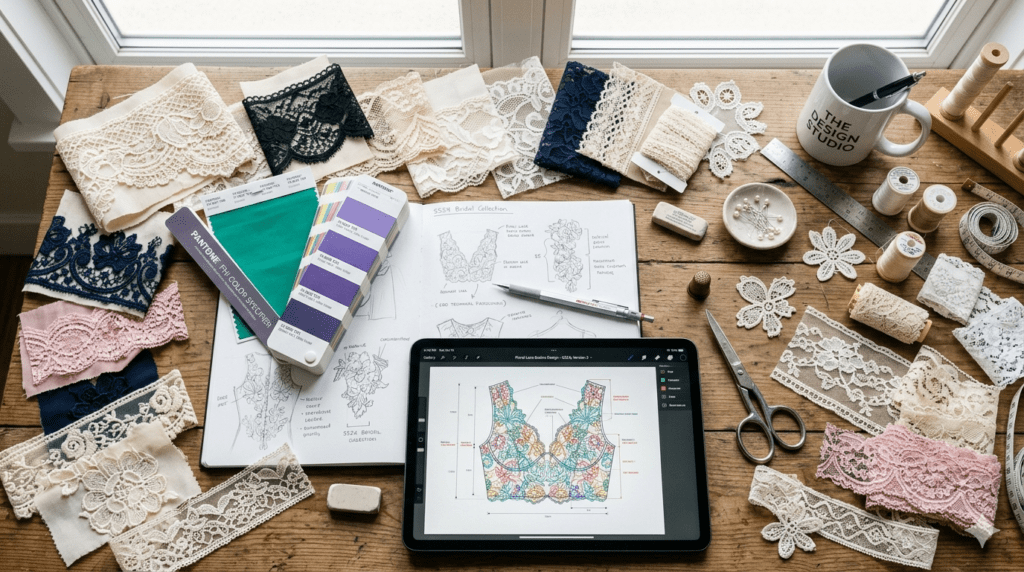
Every successful lace customization project begins with a clear, detailed, and unambiguous brief. This foundational stage is the most critical for aligning expectations and minimizing revisions down the line. Before any machines are programmed or yarns are selected, the manufacturer will work with you to collect and confirm all essential details.
A thorough brief should include:
- Design Inspiration: This can be a digital sketch, a CAD drawing, a photograph, or even a physical sample of a vintage lace you wish to replicate or adapt. The more visual information you provide, the better.
- Fabric Composition: Specify the desired fibers. Are you looking for the strength and sheen of nylon, the versatility of polyester, the soft touch of cotton, or a specific blend that offers unique performance characteristics like spandex for stretch?
- Technical Specifications: Provide precise details on the required width, weight (GSM), and the degree of stretch or elasticity needed.
- Color Standards: The industry standard for color communication is the Pantone Matching System (PMS). Providing a specific Pantone code is far more accurate than relying on screen colors.
- End-Use Application: Lace for lingerie requires softness and stretch, while custom lace trim may prioritize durability and structure. Custom shoe laces require excellent tensile strength and abrasion resistance.
The more detail you provide at this stage, the smoother the entire process will be. Most reputable manufacturers assign a dedicated account manager or technical consultant to help buyers structure their brief correctly, ensuring no detail is overlooked.
Step 2: Pattern Development
Once the brief is finalized and approved, the factory’s technical team translates your design into a machine-ready digital pattern. This specialized process bridges the gap between creative design and industrial production.
For modern, complex laces made on Raschel or Jacquard looms, manufacturers create a sophisticated digital file that programs thousands of needles to reproduce intricate details, repeats, and textures.
For narrower products—such as custom shoe laces or decorative trims—the process may involve braiding, weaving, or knitting machinery selected specifically for your design requirements.
This digital pattern is typically a one-time development process and can be reused for future production runs. Standard development time is usually around 1 week, though highly complex designs may take longer.
Step 3: Obtaining and Approving Lace Samples
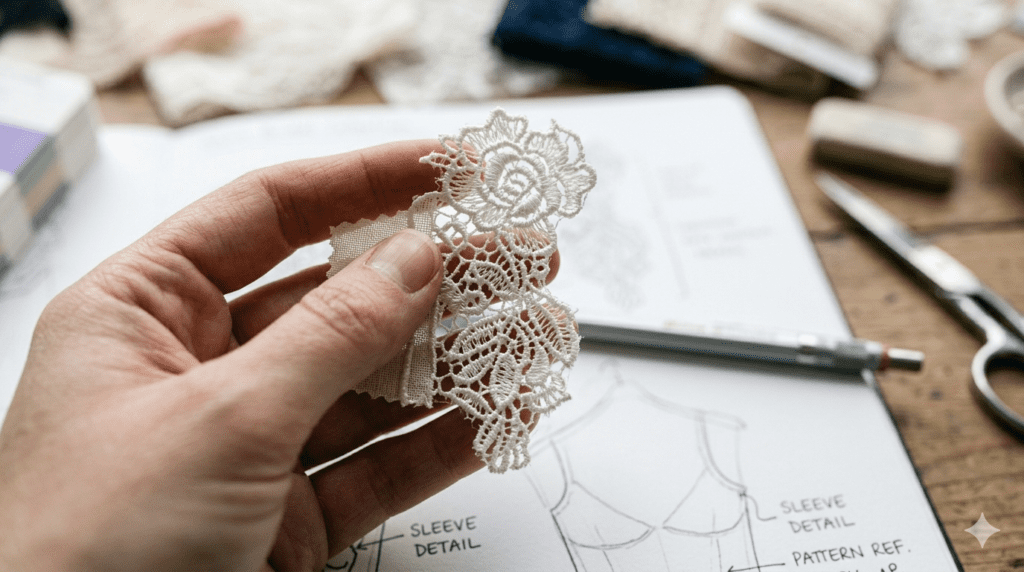
Before moving into bulk production, manufacturers create physical samples for approval. This stage allows buyers to verify design accuracy, texture, weight, drape, and color before committing to large quantities.
- Strike-Off Sample (Pattern & Texture Approval):
A physical sample produced on the actual production machine, typically in white or Ready-for-Dyeing (RFD) form, used to evaluate pattern quality, hand-feel, and structure. - Lab Dip Samples (Color Approval):
Small dyed sample swatches matched to your Pantone code or reference sample, allowing you to approve the exact final shade.
Physical sample approval is essential, as digital photos cannot accurately represent texture, drape, or true color. This stage typically takes 2–4 weeks, excluding shipping time.
Step 4: Color Matching and Material Customization
Once color approval is complete, the manufacturer develops a precise dye formula for bulk production. Professional lace factories often use in-house dyeing systems to maintain consistency and quality.
- Receiving Your Standard: The approved lab dip or Pantone code becomes the reference.
- Formulating the Recipe: Dye technicians create a precise dye formula.
- Spectrophotometer Analysis: Color difference is measured using Delta E (ΔE) for precision matching.
- Adjustment and Approval: The formula is refined until it falls within the approved tolerance range.
For specialty custom lace, additional finishes such as metallic yarns, embroidery overlays, or unique coatings may also be added during this stage.
Step 5: Minimum Order Quantities (MOQs)
Because lace customization requires machine setup, yarn sourcing, and dye lot preparation, most factories apply Minimum Order Quantities (MOQs) for custom production.
| Product Type | Typical MOQ |
|---|---|
| Custom fabric lace | 1,000–3,000 meters per colorway |
| Custom lace trim | 2,000–5,000 meters per colorway |
| Custom shoe laces | 2,000–5,000 pairs per style |
For smaller orders, manufacturers may offer lower MOQs through development fees or small-batch surcharges.
Step 6: Bulk Production and Quality Control
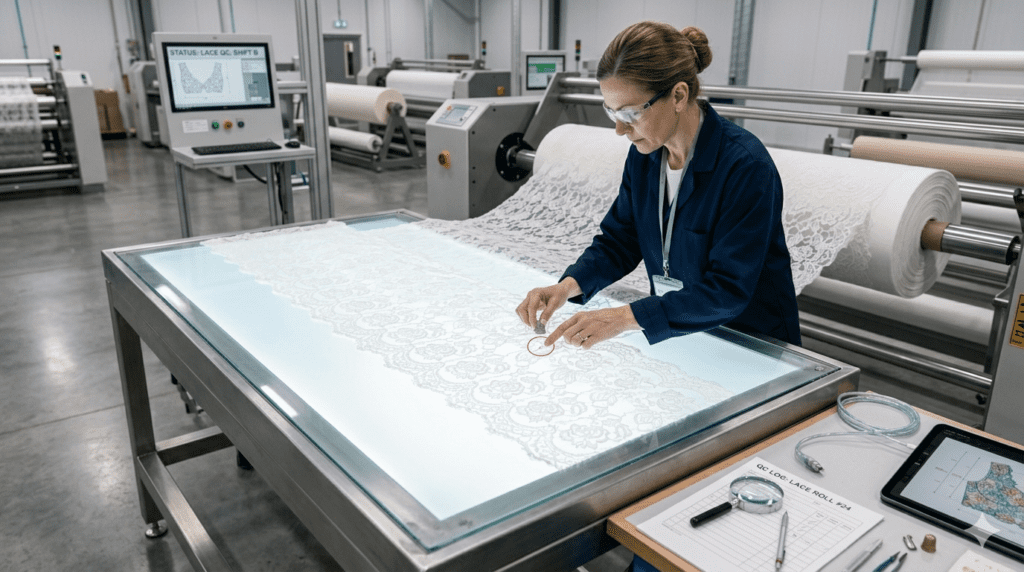
After approvals are finalized, production begins. Quality-focused manufacturers implement multiple checkpoints throughout the manufacturing process.
Quality Control for Custom Lace Fabric
- Width and Weight Consistency: Ensuring stable width and GSM.
- Defect Scanning: Detecting snags, holes, broken yarns, and streaks.
- Pattern Alignment: Verifying repeat consistency across the fabric width.
Quality Control for Custom Lace Trim
- Edge and Scallop Inspection: Clean decorative edge finishing.
- Repeat Accuracy: Consistent motif spacing and repetition.
- Width Uniformity: Maintaining narrow trim width tolerance.
A final AQL inspection is commonly performed before packing to confirm overall product quality.
Step 7: Packing and Delivery
Custom lace orders are packed according to product type and buyer requirements.
- Lace Fabric: Packed on rolls or folded bolts.
- Lace Trim: Wound on spools or packed on flat cards.
- Custom Shoe Laces: Packed in pairs with custom branding if required.
Proper moisture protection, dust prevention, and crush-resistant packaging help ensure safe delivery. Standard lead times after approval are typically 6–10 weeks.
Choosing the Right Partner for Lace Customization
When selecting a supplier for lace customization, look beyond price and evaluate:
- In-House Capabilities
- Specialized Experience
- Transparent MOQ & Pricing
- Industry Certifications
- Responsive Communication
A capable manufacturing partner provides technical guidance, efficient sampling, reliable quality control, and smoother project execution from concept to shipment.
Frequently Asked Questions (FAQ)
1. What if my order is smaller than the MOQ?
Many manufacturers offer small-batch options with surcharge fees or flexible production arrangements.
2. What file formats are best for custom lace designs?
Vector formats such as .ai, .eps, and .dxf are ideal for production-ready artwork.
3. How much does custom lace development cost?
Costs vary by complexity, usually including pattern development and sample fees.
4. Can I use sustainable materials?
Yes. Many factories now offer recycled nylon, recycled polyester, and other eco-friendly yarn options.
5. What is the difference between Raschel and Jacquard lace?
Raschel lace is lighter and more open in structure, while Jacquard lace allows more detailed and complex pattern designs.