
Strategic Sourcing Guide for Premium Lace Trims: Portfolio Diversification, Agile Customization, and Supply Chain Stability
A B2B Buyer’s Blueprint for Portfolio Diversification, Cost Optimization, and Agile Customization
For global apparel brands, procurement directors, and high-volume fashion retailers, sourcing the ideal lace trim is a balance of aesthetic precision, structural integrity, and supply chain reliability. As a core decorative component in bridalwear, lingerie, evening gowns, and contemporary ready-to-wear, lace trims directly impact both the perceived retail value and the technical performance of the final garment.
This strategic sourcing guide delineates key commercial lace categories, technical customization frameworks, and critical supply chain metrics—including cost structures and volume stability—designed to streamline corporate procurement workflows.
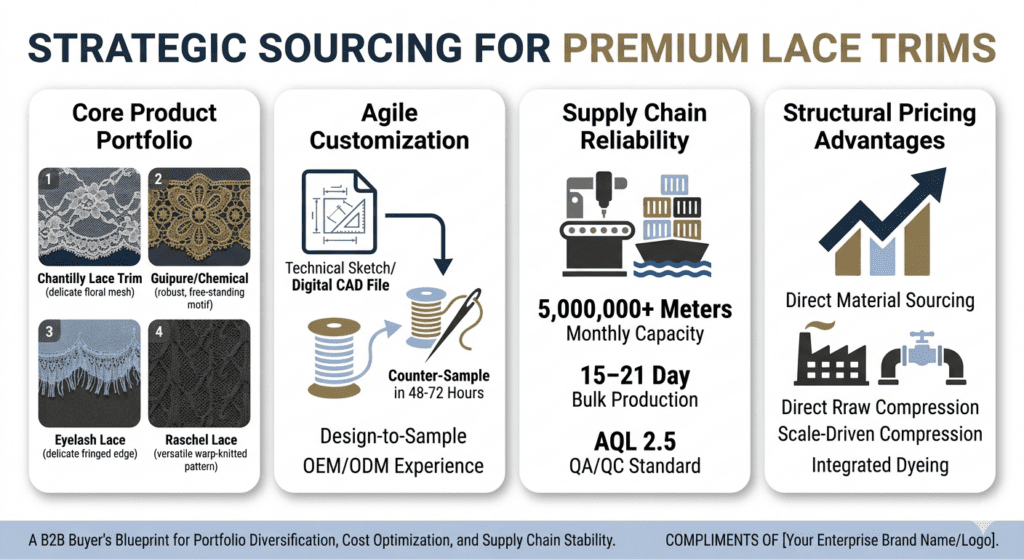
1. Core Product Taxonomy & Material Specifications
Navigating commercial lace manufacturing requires an exact understanding of category parameters to ensure alignment with design specifications and functional requirements:
| Lace Trim Type | Technical Attributes & Machine Profiles | Primary Target Applications |
|---|---|---|
| Chantilly Lace Trim | Characterized by intricate, fine floral patterns woven onto a delicate mesh background, traditionally outlined with flat or micro-corded threads. Excellent drape and softness. | Premium Bridalwear, Luxury Lingerie, High-End Evening Gowns |
| Guipure / Chemical Lace | A continuous, robust lace pattern connected by discrete motifs rather than a mesh base. Created by embroidering patterns onto a sacrificial fabric that is subsequently dissolved in a chemical bath. High dimensional stability. | Contemporary Ready-to-Wear, Haute Couture, Outerwear Accents |
| Eyelash Lace Trim | Features deliberate, delicate fringe or thread ends along the scalloped edges, mimicking eyelashes. Requires meticulous post-weaving shear-finishing. | Intimate Apparel, Hemlines, Necklines, Delicate Overlays |
| Raschel Lace Trim | Produced via high-speed warp-knitting technology. Offers exceptional versatility in pattern complexity, elasticity variations, and highly competitive cost-per-meter scaling. | Mass-Market Apparel, Athleisure Accents, High-Volume Commercial Fashion |
2. End-to-End Customization & OEM/ODM Capabilities
Modern fashion supply chains demand extreme agility. To mitigate development risks and accelerate time-to-market, our production infrastructure supports two distinct product development tracks:
Design-to-Sample Counter-Development
Buyers can submit high-resolution technical sketches, original physical swatches, or digital CAD files. Our in-house textile engineering team utilizes advanced digital pattern-mapping software to convert your conceptual concepts into machine-readable stitching matrices within 48 to 72 hours, ensuring exact replication of pitch, density, and width parameters.
OEM/ODM Manufacturing Experience
With over a decade of deep-tier manufacturing experience for global tier-1 fashion brands, our factories operate under rigorous international compliance frameworks. We possess a deep understanding of standard garment allowances, shrinkage tolerances (under 3% post-wash), and precise color-matching protocols utilizing the Pantone Matching System (PMS) and spectrophotometric analysis.
💡 Free Sampling Program: To validate quality, hand-feel, and colorfastness prior to capital allocation, we provide complimentary quality swatches from our running stock portfolio. For custom-developed counter-samples, initial sample yardage fees are fully refundable upon bulk purchase order (PO) confirmation.
3. Supply Chain Reliability: Volume Stability & Monthly Capacity
Capacity bottlenecks present significant financial risks to global apparel rollouts. Our manufacturing facilities provide structural stability against seasonal demand surges through diversified, automated production machinery:
- Consistent Monthly Capacity: Equipped with advanced multi-bar Raschel knitting machines, high-speed chemical embroidery units, and precision finishing lines, our aggregate monthly output exceeds 5,000,000 meters of finished lace trim.
- Lead Time Standardization: Standard bulk production cycles are maintained at 15–21 days. Automated production scheduling ensures a >98.5% On-Time In-Full (OTIF) delivery metric.
- Rigorous Quality Assurance (QA/QC): Every production lot undergoes multi-point inspection protocols adhering to AQL 2.5 standards, encompassing tensile strength tests, seam-slippage resistance, and strict OEKO-TEX Standard 100 compliance for chemical safety.
4. Cost Architecture & Structural Pricing Advantages
Our operation is engineered to deliver institutional-grade pricing without sacrificing material performance, achieved through comprehensive upstream integration and lean manufacturing:
- Direct Raw Material Sourcing: By maintaining long-term, high-volume raw yarn contracts (Nylon, Polyester, Cotton, and Spandex) directly with chemical synthesis plants, we bypass secondary trade markups, securing a 5-8% baseline material cost advantage.
- Scale-Driven Overhead Compression: High-throughput, fully automated machinery distributes fixed operational expenses across massive volume outputs, driving down the unit cost per meter significantly below regional competitors.
- In-House Dyeing & Eco-Efficiency: Utilizing centralized, integrated dye houses optimizes water and energy utilization while eliminating external logistics expenses. This guarantees exceptional batch-to-batch color consistency (Grade 4+ colorfastness to washing and light) while mitigating environmental compliance overheads.