
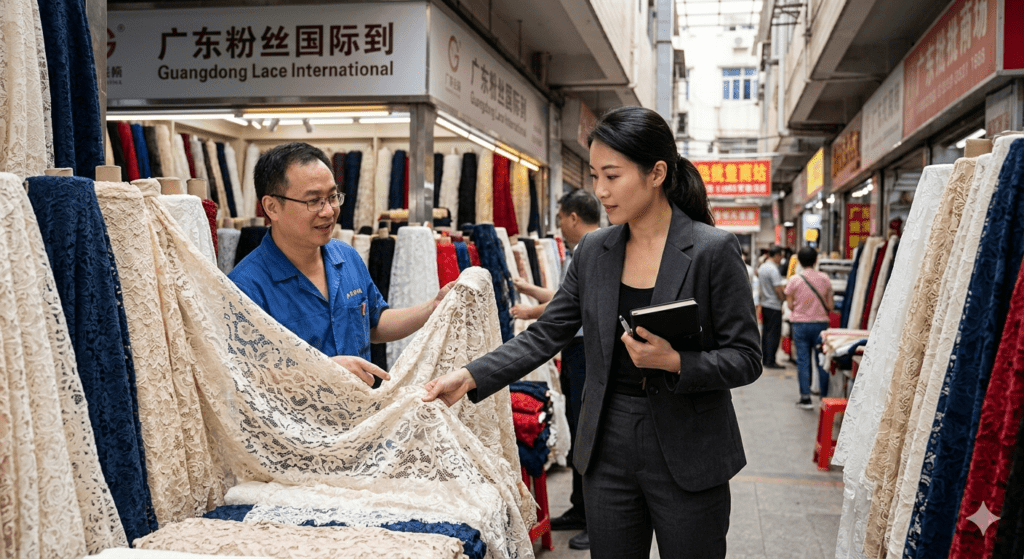
A professional B2B sourcing guide for fashion brands, garment manufacturers, bridal designers, and textile importers looking to source premium wholesale lace trim from China’s 1688 marketplace.
What Is Wholesale Lace Trim?
Wholesale lace trim refers to decorative lace materials sold in bulk quantities for apparel manufacturing, bridal fashion, lingerie, home textiles, accessories, and luxury garment production. In global B2B textile sourcing, lace trim is commonly purchased by fashion brands, wholesalers, importers, and private label manufacturers seeking cost-effective yet premium embellishment solutions.
Today, China remains the world’s largest lace production hub, and 1688 has become one of the most important domestic sourcing platforms for overseas buyers. However, navigating factories, evaluating quality consistency, and verifying manufacturing capabilities can be challenging without industry expertise.
Working with an experienced lace trim supplier helps buyers avoid issues such as inconsistent dye lots, unstable embroidery density, delayed production timelines, and poor export packaging standards.
Why Source Lace Fabrics from 1688?
Compared with Alibaba International, 1688 offers significantly lower factory-direct pricing because the platform primarily serves China’s domestic wholesale market. Many exporters and garment manufacturers source directly from 1688 factories to reduce procurement costs.
- Lower MOQ pricing for bulk lace orders
- Access to factory-direct embroidery production
- Faster sampling cycles
- Wide variety of bridal and fashion lace patterns
- Customization opportunities for exclusive collections
However, sourcing directly from 1688 also presents several challenges:
- Most suppliers communicate only in Chinese
- Quality standards vary dramatically between factories
- Export compliance may not meet international requirements
- Fabric testing documentation is often unavailable
- Shipping coordination can become complex for overseas buyers
This is why many international buyers partner with professional factories offering integrated export support and custom lace trim development services.
Popular Types of Wholesale Lace Trim
| Lace Type | Applications | Key Features |
|---|---|---|
| Embroidery Lace | Fashion garments, dresses | High-detail stitching, elegant texture |
| Eyelash Lace | Lingerie, luxury fashion | Soft fringed edges, premium appearance |
| Bridal Lace | Wedding gowns, veils | Delicate floral patterns and premium embroidery |
| Stretch Lace | Sportswear, lingerie | Elasticity and comfort |
| Guipure Lace | Luxury dresses, couture | Heavy embroidery without net backing |
Among these categories, bridal lace trim continues to dominate premium export demand, especially in North America and European wedding markets.
Professional Lace Quality Inspection Standards
For B2B buyers, lace sourcing is not only about aesthetics. Consistent production quality directly affects garment yield, customer satisfaction, and brand reputation.
Key Inspection Criteria
- Embroidery Density: Ensure stitches are uniform without skipped threads.
- Color Consistency: Dye lots should match across production batches.
- Fabric Stability: Lace should maintain shape after washing and cutting.
- Edge Precision: Scalloped edges must remain symmetrical.
- Tensile Strength: Net backing should resist tearing during sewing.
- Shrinkage Testing: Standard tolerance should remain below 3%.
- Needle Detection Compliance: Essential for export garments.
Professional buyers also request pre-production approvals and free lace trim samples before confirming mass production.
Technical Parameter Comparison
| Parameter | Economy Lace | Premium Lace |
|---|---|---|
| Embroidery Thread | Polyester | Rayon / Cotton Blend |
| Color Fastness | Grade 3-4 | Grade 4-5 |
| Shrinkage Rate | 4-6% | Below 3% |
| Production Precision | Standard | High Precision Multi-Head Embroidery |
| Recommended Usage | Fast Fashion | Bridal & Luxury Fashion |
2026 Lace Industry Trends
The global lace market continues evolving as fashion brands prioritize sustainability, customization, and innovative visual textures. Several trends are expected to dominate the 2026 wholesale lace industry:
1. 3D Embroidery Lace
Three-dimensional floral embroidery with layered petals and raised textures is becoming increasingly popular in couture bridal collections and luxury eveningwear.
2. Sustainable Lace Materials
Eco-friendly yarns such as recycled polyester, organic cotton, and biodegradable fibers are gaining traction among global fashion retailers seeking ESG compliance.
3. Metallic & Shimmer Lace
Metallic thread integration creates reflective luxury aesthetics that appeal to high-end fashion markets and premium bridal collections.
4. Digital Customization
More brands are requesting digitally engineered embroidery patterns and exclusive lace designs to strengthen product differentiation.
Lace Fabric Maintenance & Storage Guide
- Store lace rolls in dry, temperature-controlled environments.
- Avoid prolonged direct sunlight exposure to prevent discoloration.
- Use acid-free packaging materials for bridal lace storage.
- Inspect humidity levels regularly during ocean freight shipment.
- Roll delicate embroidery lace instead of folding to prevent creasing.
- Conduct pre-cutting shrinkage tests before garment production.
Proper maintenance significantly reduces production waste and helps preserve the premium appearance of luxury lace fabrics.
Frequently Asked Questions
1. What is the typical MOQ for wholesale lace trim?
Most factories on 1688 require MOQ ranging from 100 to 1000 yards depending on lace complexity and customization requirements.
2. How can overseas buyers verify lace quality before bulk production?
Buyers should request production swatches, laboratory testing reports, and free sampling services before confirming orders.
3. Can lace factories provide exclusive custom patterns?
Yes. Many professional suppliers offer OEM and ODM embroidery development for fashion brands and bridal designers.
4. What is the average production lead time?
Standard lace orders typically require 7-15 days, while custom embroidery development may take 20-35 days depending on design complexity.
Source Premium Lace Directly from Yituo Lace
Yituo Lace specializes in factory-direct wholesale lace trim manufacturing with competitive pricing, stable quality control, rapid sampling, and full OEM customization support for global fashion brands, bridal designers, garment factories, and textile importers.
- Factory-direct pricing advantages
- Professional custom embroidery development
- Fast production turnaround
- Global export experience
- Free sampling support available