
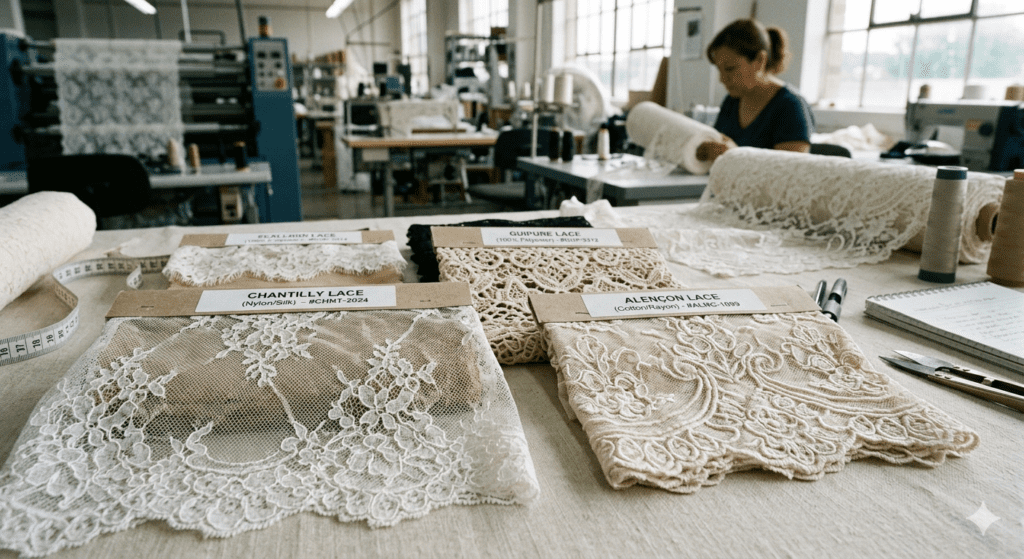
In the global garment manufacturing sector, selecting the appropriate commercial types of lace fabric carries profound implications for product line positioning, target demographics, and gross profit margins. From high-volume fast fashion trims to premium haute couture components, lace serves as a fundamental decorative and structural textile fabric. For global procurement managers, apparel supply chain directors, and fashion house production heads, mastering the industrial taxonomy of lace is essential to maintaining strict quality standards and optimizing factory floor efficiency.Modern commercial lace production is dictated by automated efficiency and mechanical precision, utilizing advanced Raschel, Leavers, and Schiffli machinery to replicate complex historical weaves at scale. Unlike retail sourcing, bulk industrial procurement requires an acute understanding of how different yarn inputs—such as high-tenacity polyester, flexible nylons, and premium cotton blends—interact with automated cutting tables and high-speed industrial sewing accessories.
B2B Sourcing Insight: This commercial-grade manual focuses heavily on the production mechanics, wholesale pricing frameworks, and supply chain variables across 15 high-demand commercial lace varieties. This resource is engineered to support professional volume buyers in optimizing factory procurement.
Table of Contents
- 1. The Evolution of Lace Manufacturing: Handcrafted to Industrialization
- 2. Material Compositions: Synthetic vs. Natural Fibers
- 3. Deep Dive: 15 Essential Commercial Types of Lace Fabric
- 4. Structural and Technical Comparison Matrix
- 5. How to Identify High-Quality vs. Low-Quality Lace in Bulk QC
- 6. B2B Industry Applications and Sourcing Considerations
- 7. Frequently Asked Questions (FAQ)
- 8. Partner with Shaoxing Yituo Clothing Accessories
1. The Evolution of Lace Manufacturing: Handcrafted to Industrialization
The history of lace production is a testament to technological evolution within the textile sector. Originating in the late 15th and early 16th centuries in European textile hubs like Flanders and Northern Italy, lace was initially divided into two primary handcrafted categories: needle lace (constructed using a single needle and thread over a grounded pattern) and bobbin lace (formed by twisting and braiding multiple threads wound on wooden bobbins over a pillow cushion).
The Industrial Revolution marked a permanent shift in lace accessibility. The invention of the Bobbinet machine by John Heathcoat in 1808 laid the foundation for machine-made netting. This was followed by the development of the Leavers machine, which replicated the complex, organic movements of bobbin lace weavers, allowing for incredibly intricate and multi-tonal openwork motifs. In the mid-20th century, the introduction of the Raschel knitting machine—a warp-knitting technology—revolutionized mass production. Raschel machines allowed manufacturers to produce durable, elastic, and highly cost-effective lace fabrics at high speeds, transforming lace from an exclusive luxury commodity into a versatile, globally accessible textile fabric.
2. Material Compositions: Synthetic vs. Natural Fibers
The performance, drape, hand-feel, and cost structure of lace fabric are heavily dictated by its fiber content. Modern textile manufacturing categorizes lace materials into three primary groups:
Natural Fibers
- Cotton: Renowned for its exceptional softness, breathability, and matte finish. Cotton yarns are predominantly utilized in eyelet (Schiffli), Torchon, and Alençon laces. Cotton lace is highly absorbent, skin-friendly, and ideal for casual resort wear, children’s clothing, and heritage aesthetics.
- Silk: The pinnacle of luxury textile fabrics. Silk threads yield an ultra-fine, lightweight lace with a subtle, natural luster and a fluid drape. Silk is highly delicate, expensive, and reserved almost exclusively for haute couture, premium bridal wear, and luxury lingerie.
- Linen: Characterized by its crisp hand-feel, structural rigidity, and distinctive slub texture. Linen yarns are traditionally used in rustic, bohemian, or vintage-style bobbin laces and trims.
Synthetic Fibers
- Polyester: The absolute workhorse of the modern garment manufacturing industry. Polyester lace offers superior tensile strength, exceptional resistance to abrasion and chemical laundering, colorfastness, and low production costs. It can be easily engineered into various finishes, mimicking both matte cotton and high-shine silk.
- Nylon (Polyamide): Highly favored for its elasticity, soft hand-feel, and lightweight characteristics. Nylon is the standard choice for stretch laces used in intimate apparel, sportswear, and body-con fashion, providing excellent recovery and comfort against the skin.
- Rayon / Viscose: A semi-synthetic fiber derived from regenerated cellulose. Rayon threads are frequently used for embroidery motifs on lace fabrics due to their silk-like sheen, high color absorption, and beautiful, heavy drape.
Hybrid Blends
Many commercial lace fabrics combine natural and synthetic fibers to achieve optimal performance metrics. For example, a nylon-cotton blend combines the softness and aesthetic of cotton with the structural durability and stretch recovery of nylon. The addition of Spandex (Elastane) yarns creates true stretch lace, a prerequisite for form-fitting contemporary apparel.
3. Deep Dive: 15 Essential Commercial Types of Lace Fabric
3.1 Chantilly Lace
Named after the Chantilly region in France, this classic fabric is recognized by its fine ground net, detailed floral motifs, and characteristic scalloped edges. Chantilly lace is traditionally produced using a flat untwisted strand to outline the pattern, creating a delicate shadow effect. It is a lightweight, highly fluid fabric heavily utilized in premium bridal lace trim, overlays, and elegant evening gowns.
3.2 Alençon Lace
Often referred to as the “Queen of Lace,” Alençon is a needle lace characterized by a distinct heavy cord or raised thread (cordonnet) outlining the floral contours. This creates a striking three-dimensional, textured appearance against a sheer hexagonal mesh background. Its structural integrity makes it highly resilient to cutting and appliqué work in premium bridal couture.
3.3 Guipure Lace (Chemical Lace)
Unlike traditional laces, Guipure lace completely lacks a backing net or ground mesh. Instead, the continuous embroidery motifs are linked together by thick, structural bars or brides. It is manufactured using a “chemical lace” process, where patterns are embroidered onto a sacrificial fabric substrate (such as water-soluble PVA or heat-disintegrating material) which is subsequently dissolved, leaving only the free-standing embroidered structure. Guipure features a heavy weight, distinct texture, and high dimensional stability, making it ideal for structured dresses, statement sleeves, and overlays.
3.4 Raschel Lace
Produced on high-speed warp knitting machines, Raschel lace represents the dominant commercial standard for mass-market fashion. It can emulate almost any handmade lace style, from Chantilly to geometric patterns. Raschel lace can be produced in high volumes with complex designs, offering variable elasticity, flat surfaces, and high fray resistance at an accessible price point.
3.5 Schiffli Lace (Eyelet / Broderie Anglaise)
Schiffli lace is a mechanical embroidery lace produced on a specialized multi-needle Schiffli machine. The process involves embroidering dense, intricate patterns onto a base fabric (frequently cotton lawn or poplin) followed by a mechanical punching or chemical cutting process that creates precise perforations (eyelets) bound by satin stitching. It is highly durable and a staple for spring/summer apparel, casual blouses, and children’s wear.
3.6 Venetian Lace (Point de Venise)
A historical needlepoint style, modern Venetian lace is a heavy, structured fabric featuring dense, scrolling floral designs, foliage, and geometric patterns connected by brides. Similar to Guipure, it has no mesh backing. Its substantial weight and opulence make it highly suitable for collar pieces, jackets, and luxury home furnishings.
3.7 Cluny Lace
Originating from Cluny, France, this style is a variant of bobbin lace. It features a heavy, geometric design, often incorporating wheel, paddle, or star-shaped motifs woven with thick cotton or linen threads. Cluny lace possesses a distinctly rustic, vintage appearance and is widely used as an edging trim for casual garments, linen table runners, and curtains.
3.8 Torchon Lace (Beggar’s Lace)
Historically one of the most durable bobbin laces, Torchon is characterized by coarse, strong threads and simple, clear geometric patterns (often lozenges or fan shapes). It is highly resilient, easy to wash, and commonly applied as edge trims, sewing accessories, and functional borders for household textiles.
3.9 Stretch Lace
Engineered by incorporating elastane (Spandex) fibers into a warp-knitted nylon or polyester base, stretch lace provides excellent multi-directional elasticity and shape recovery. It ranges from narrow elastic trim bands to full-width yardage. Working with a verified lace trim supplier ensures that this functional textile delivers maximum durability for intimate apparel, lingerie, body-con athleisure, and comfortable apparel panels.
3.10 Mesh/Net Lace
This category comprises very fine, lightweight openwork fabrics where the background grid dominates the design, featuring minimal or sparsely distributed motifs. Common variations include tulle and point d’esprit (dotted net). It acts as a base layer for further custom embroidery or is layered to add volume and ethereal transparency to bridal skirts and evening attire.
3.11 Valenciennes Lace
A traditional French bobbin lace style, Valenciennes features a flat, continuous weave where the pattern and the diamond-shaped mesh background are braided simultaneously using the same threads. There is no outlining cord, resulting in an exceptionally smooth, uniform, and soft hand-feel. It is heavily favored for high-end heirloom sewing, baby garments, and delicate nightwear.
3.12 Tatting Lace
Characterized by a series of durable knots and loops forming rings and chains, tatting is historically a shuttle-crafted lace. Modern machine tatting emulates this technique, producing narrow, highly stable trim laces with distinctive picot (small loop) edges. It is primarily used as a decorative border or insert for collars, handkerchiefs, and pillowcases.
3.13 Knit Lace
Produced via weft-knitting or traditional openwork knitting techniques, knit lace features looping structures that offer natural mechanical stretch, elasticity, and softness. Unlike rigid woven or embroidered laces, knit lace conforms closely to body contours, making it highly suitable for ready-to-wear sweaters, cardigans, and contemporary knitwear collections.
3.14 Crochet Lace
Machine-manufactured to replicate traditional hand-crochet work, this lace features thicker yarn loops (often cotton or heavy synthetic acrylics) interlocked to form dense, openwork geometric or floral patterns. It possesses a heavy weight, distinct texture, and bohemian aesthetic, making it popular for beach cover-ups, casual outerwear, and home decor trims.
3.15 Corded Lace
Corded lace is a premium variation where the motifs of a base lace (such as Chantilly or Raschel) are systematically outlined with a thick, raised cord or soutache thread. This enhances the contrast between the sheer background mesh and the solid pattern, giving the fabric a pronounced three-dimensional profile, structural weight, and luxurious tactile quality for evening wear.
4. Structural and Technical Comparison Matrix
The following technical table provides an objective comparison of key lace varieties to assist procurement managers in selecting the correct fabric based on physical properties and application needs.
| Lace Type | Primary Composition | Structural Background | Durability Rating | Optimal Commercial Application |
|---|---|---|---|---|
| Chantilly Lace | Nylon, Silk, Polyester | Fine hexagonal net | Low to Medium | Bridal veils, luxury lingerie |
| Alençon Lace | Nylon, Cotton, Rayon | Mesh with raised cord | Medium to High | Bridal gowns, bodice appliqués |
| Guipure Lace | 100% Polyester, Cotton | None (Connected by bars) | High Stability | Structured dresses, heavy trims |
| Raschel Lace | Poly, Nylon, Spandex | Warp-knitted grid | High Tear-Resist | Mass-market fashion, panels |
| Schiffli (Eyelet) | 100% Cotton, Blends | Solid woven base | Very High | Summer dresses, children’s wear |
| Stretch Lace | Nylon + Spandex | Elastic warp-knit mesh | High Recovery | Intimate apparel, lingerie |
| Torchon / Cluny | 100% Cotton, Linen | Coarse geometric braid | Very High | Home textiles, table linens |
5. How to Identify High-Quality vs. Low-Quality Lace in Bulk QC
In high-volume B2B manufacturing, stringently evaluating textile batches during Quality Control (QC) is paramount to preventing post-cutting disruptions and costly garment recalls. While our foundational style manual highlights the historical morphology of 17 types of lace fabric and how to identify them, industrial volume procurement requires strict adherence to automated manufacturing tolerances across four physical parameters:
5.1 Edge Construction and Fray Stability
Examine the raw cut edges and scalloped selvages of the lace. High-quality lace features clean, tightly bound border stitching (such as dense satin stitching or reinforced picots) that prevents yarn separation. Low-quality lace often exhibits loose loops, inconsistent thread tension, and loose filaments that quickly fray under light tension or during cutting phases.
5.2 Thread Tension and Motif Definition
Hold the fabric against a high-contrast light source. Premium lace demonstrates consistent, uniform thread tension throughout the entire pattern. The borders of motifs should be sharp and clearly defined, without erratic gaps or overlaps. Low-quality variants frequently display tension irregularities, causing the mesh backing to sag, pucker, or distort the geometric precision of the design.
5.3 Hand-Feel (Tactile Softness vs. Chemical Stiffness)
While synthetic fibers like polyester and nylon are naturally firm, high-quality manufacturing utilizes advanced textile softening agents and post-weaving finishes to ensure a smooth, comfortable hand-feel against the skin. Inferior lace products often bypass extensive finishing processes, leaving excessive resin or starch chemical residues that cause a harsh, scratchy, and stiff tactile profile.
5.4 Color Fastness and Structural Uniformity
Inspect the lace across a wide yardage span for uniformity in color density and motif consistency. High-quality lace guarantees a delta-E color variance within strict commercial tolerances and exhibits no missing embroidery segments or broken structural bars. Low-quality batches regularly show visible shade variations between the central pattern and selvage, alongside frequent knot errors and skipped machine stitches.
6. B2B Industry Applications and Sourcing Considerations
When sourcing lace fabrics for commercial production, procurement agents must align the technical specifications of the lace with the performance demands of the end product.
- Apparel Manufacturing: For high-volume fashion lines, optimizing production efficiency requires selecting lace yardage with excellent roll-to-roll consistency and compatibility with automated cutting tables. Raschel and Schiffli laces are standard choices due to their predictability and cost efficiency.
- Bridal and Evening Couture: Aesthetics, weight, and detail take precedence. Sourcing managers focus on specialty fabrics such as Alençon, corded Chantilly, and heavy Guipure, evaluating the clarity of the cordonnet and the stability of motifs for intricate hand-appliqué work.
- Intimate Apparel: The priority shifts entirely to skin comfort, tactile softness, and functional recovery. Stretch nylon laces must undergo rigorous elongation and recovery testing to ensure garments retain their shape over extended wash-and-wear cycles without causing skin irritation.
- Home Textiles: Durability and laundering resistance are critical. Thicker cotton and polyester-blend Torchon, Cluny, or Venetian laces are selected for their ability to withstand industrial washing processes and resist abrasion when used on curtains, tablecloths, and upholstery.
7. Frequently Asked Questions (FAQ)
Q1: What is the primary difference between Raschel lace and Leavers lace?
A: The primary differences lie in production speed, cost, and complexity. Leavers lace is produced on slow, traditional machines that replicate hand-twisting bobbin methods, yielding highly detailed, textured, and premium-priced lace. Raschel lace is produced on high-speed warp-knitting machines, offering rapid mass production, flat structures, and high cost-efficiency.
Q2: Can Guipure lace be customized with elastic properties?
A: Standard Guipure lace is fundamentally non-stretch due to its dense, embroidered composition and lack of a mesh backing. However, limited mechanical elasticity or multi-directional stretch can be engineered by incorporating specialized elastane core-spun yarns into the embroidery patterns during the manufacturing process.
Q3: How do you prevent chemical/Guipure lace from distorting during production?
A: Guipure lace must be handled with appropriate tension controls during garment assembly. Because it lacks a ground net, using stabilized stay-stitching, backing tapes, or lightweight water-soluble stabilizers during the sewing process ensures the structural bars do not stretch or pucker.
Q4: Are polyester laces suitable for children’s intimate apparel?
A: Yes, provided they undergo premium finishing washes to eliminate stiff chemical residues and meet international safety certifications (such as OEKO-TEX Standard 100). For direct skin contact in children’s wear, soft nylon or long-staple cotton laces are also highly recommended to minimize friction.
Q5: What is the standard MOQ (Minimum Order Quantity) for custom lace manufacturing?
A: Standard MOQs vary widely by type. For stock-supported Raschel or Schiffli trims, MOQs can be as low as 500 to 1,000 meters per color from a qualified wholesale lace trim supplier. For entirely custom-engineered patterns or specialized dyed-to-match (DTM) Guipure and corded laces, MOQs typically range from 1,500 to 3,000 meters per run.
Q6: How does fiber content affect the dyeing process of lace fabrics?
A: Fiber content determines the dye type and temperature required. 100% Polyester requires high-temperature disperse dyeing, while Nylon utilizes acid dyes at lower temperatures. Hybrid blends can be subjected to cross-dyeing to produce striking two-tone multi-colored effects in a single dye bath.
Partner with Shaoxing Yituo Clothing Accessories Co., Ltd.
In the competitive global marketplace, securing a reliable, high-capacity supply chain partner for textile components is essential to operational success. Shaoxing Yituo delivers an extensive catalog of premium lace products tailored to meet the rigorous quality standards of global garment brands.
Ready to elevate your brand identity? Explore our tailored engineering options for custom lace trim to seamlessly fit your specific seasonal collections.