
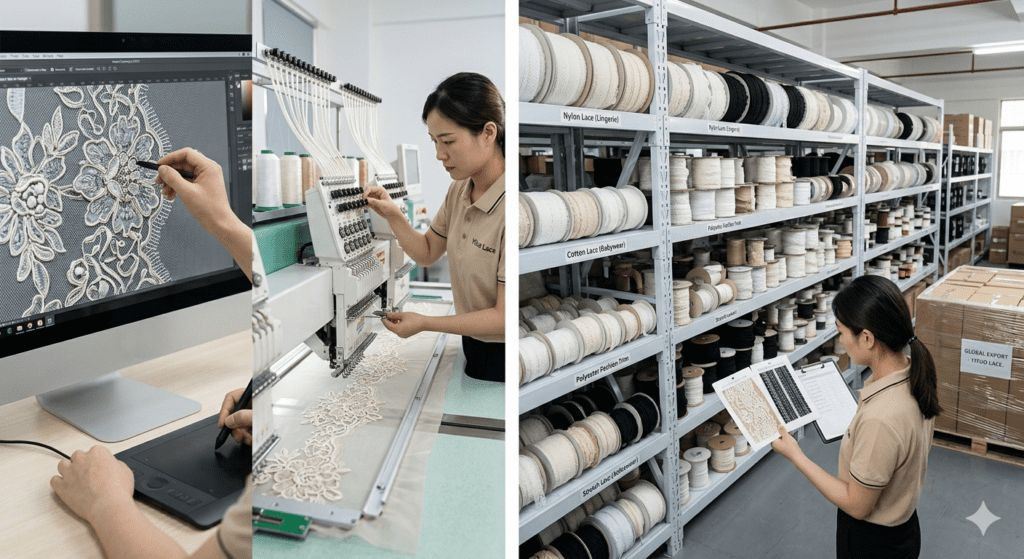
Discover how small fashion brands, bridal studios, lingerie labels, and handmade product businesses can scale efficiently with a professional custom lace trim manufacturing partner.
What is Custom Lace Trim?
Custom lace trim refers to specially designed decorative lace materials manufactured according to unique client requirements, including pattern design, width, yarn composition, embroidery style, color matching, elasticity, and finishing techniques.
For small fashion brands seeking exclusive product differentiation, partnering with a professional
custom lace trim
manufacturer enables faster product development, flexible MOQ options, and personalized embroidery solutions.
Unlike generic mass-market lace products, customized lace trims are tailored for niche fashion brands, bridal wear labels, lingerie companies, accessories manufacturers, and DIY craft businesses seeking exclusive aesthetics and superior material consistency.
Modern small businesses increasingly rely on experienced
lace trim supplier
networks to reduce sourcing risks while maintaining premium product identity in competitive markets.
Why Small Businesses Need a Reliable Lace Trim Manufacturer
Low MOQ Production
Small brands often cannot afford container-level purchasing quantities. A specialized manufacturer offers flexible order volumes while maintaining stable production quality.
Exclusive Pattern Development
Custom lace helps businesses avoid market duplication and create unique fashion collections with stronger retail margins.
Faster Sampling
Quick sample turnaround enables designers to launch seasonal collections faster and respond to social media fashion trends efficiently.
Consistent Supply Chain
Reliable production planning minimizes delivery delays and protects inventory stability for growing businesses.
Businesses sourcing
wholesale lace trim
should prioritize suppliers with in-house embroidery facilities, quality control systems, and export experience to ensure long-term scalability.
Technical Lace Material Comparison
Premium
bridal lace trim
often combines delicate embroidery, sequins, beads, or corded lace structures for luxurious visual depth and elegant garment finishing.
Professional B2B Lace Quality Inspection Standards
- Embroidery Precision: Patterns should remain symmetrical with clean edge finishing and no loose threads.
- Color Consistency: Batch dyeing must maintain stable Pantone color accuracy across production lots.
- Fabric Strength: Lace backing should withstand industrial garment sewing without tearing.
- Elastic Recovery: Stretch lace products should maintain elasticity after repeated extension testing.
- Wash Durability: Professional suppliers perform washing and abrasion tests to ensure long-term product performance.
- Dimensional Stability: Shrinkage control is critical for export-quality apparel manufacturing.
2026 Lace Industry Trends
1. 3D Embroidered Lace
Three-dimensional floral embroidery with layered textures is becoming increasingly popular in bridal and luxury fashion collections. Designers favor raised appliqué effects for premium visual impact.
2. Sustainable Lace Materials
Recycled polyester yarns, biodegradable fibers, and eco-friendly dyeing technologies are gaining momentum among European and North American fashion brands.
3. Metallic and Shimmer Finishes
Metallic thread integration, glitter embroidery, and reflective surfaces are trending in eveningwear and high-fashion streetwear.
4. Smart Digital Customization
AI-assisted design simulation and digital embroidery mapping allow manufacturers to accelerate custom sampling and reduce development costs for small businesses.
Care & Maintenance Recommendations
- Store lace materials in cool, dry environments to prevent moisture damage.
- Avoid excessive direct sunlight exposure to preserve dye stability.
- Use low-temperature washing for delicate embroidered lace trims.
- Roll premium lace instead of folding to minimize crease marks.
- Perform pre-production compatibility testing before mass garment manufacturing.
Frequently Asked Questions
What is the typical MOQ for custom lace trim orders?
Most professional manufacturers offer flexible MOQ options depending on lace complexity, yarn type, and embroidery technique. Small businesses can often start with relatively low trial quantities.
How long does custom lace sample development take?
Standard sampling generally takes 5-14 days based on design complexity and material sourcing requirements.
Can manufacturers match my existing lace design?
Yes. Experienced factories can reproduce designs from physical samples, technical drawings, or digital artwork while optimizing embroidery efficiency.
How can I evaluate lace quality before bulk purchasing?
Requesting production swatches, wash test reports, and sample verification is the most effective method for quality evaluation.
Work with Yituo Lace — Factory Direct Custom Lace Solutions
Yituo Lace specializes in factory-direct lace trim manufacturing for global fashion brands, bridal designers, garment factories, and small businesses. From low MOQ custom development to large-scale wholesale production, Yituo offers fast sampling, stable quality control, competitive pricing, and international export expertise.
Whether you need elegant bridal lace, stretch lace, embroidered lace, or fully customized solutions, our team is ready to support your business growth.