
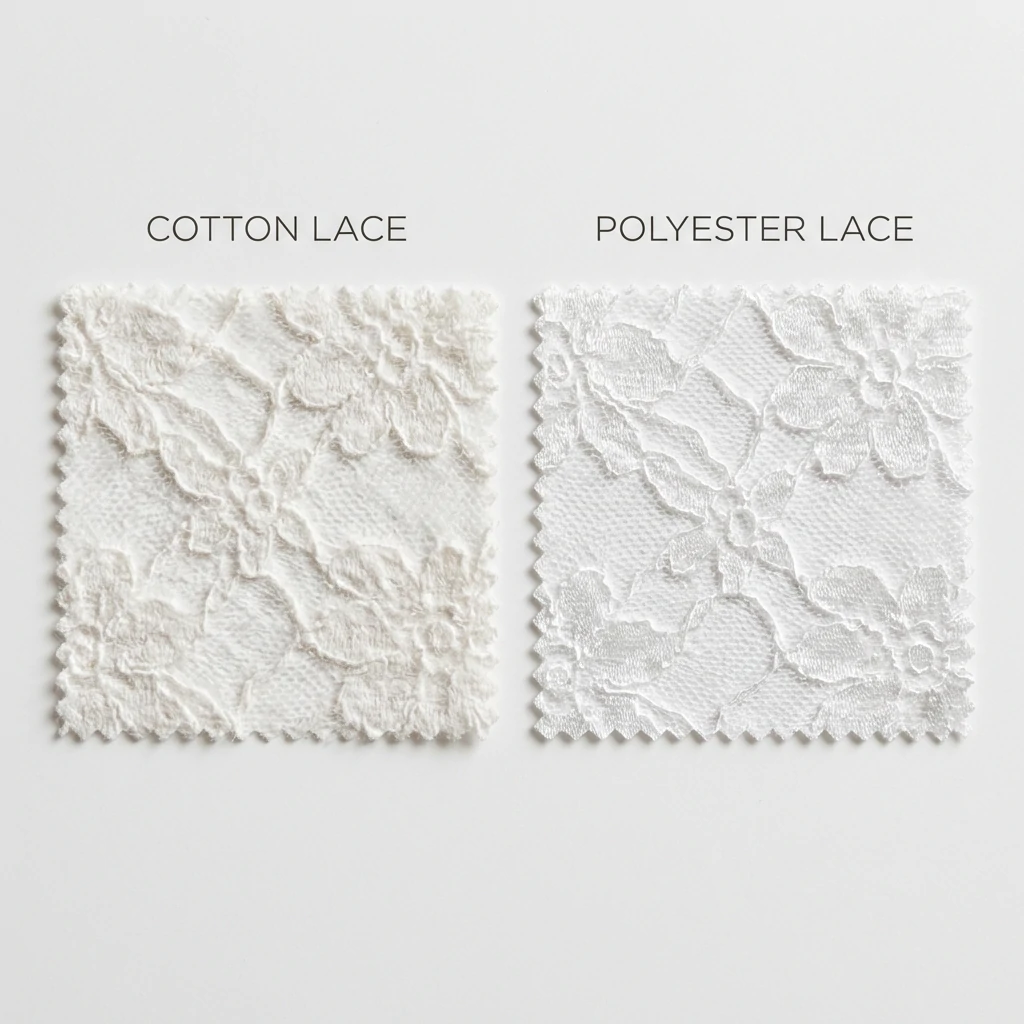
Cotton lace and polyester lace look similar at first glance, but they behave very differently in production, wear, and care. One is a natural fiber with a matte, vintage charm. The other is a synthetic workhorse built for durability and cost efficiency.
Choosing between them affects everything — from how your garment feels on skin to how it holds up after 50 washes. This guide covers the real differences so you can pick the right lace for your project.
Quick Comparison: Cotton Lace vs Polyester Lace
| Property | Cotton Lace | Polyester Lace |
|---|---|---|
| Fiber Type | Natural (plant-based) | Synthetic (petroleum-based) |
| Feel | Soft, matte, organic | Smooth, slightly shiny |
| Breathability | Excellent | Poor |
| Shrinkage | Yes (3-5%) | Minimal |
| UV Resistance | Moderate | Excellent |
| Wrinkle | Wrinkles easily | Wrinkle-resistant |
| Dye Options | Natural/reactive dyes | Wide color range |
| Price | Higher | Lower |
| Best For | Baby wear, bridal, eco-friendly | Décor, everyday garments, bulk |
What is Cotton Lace?
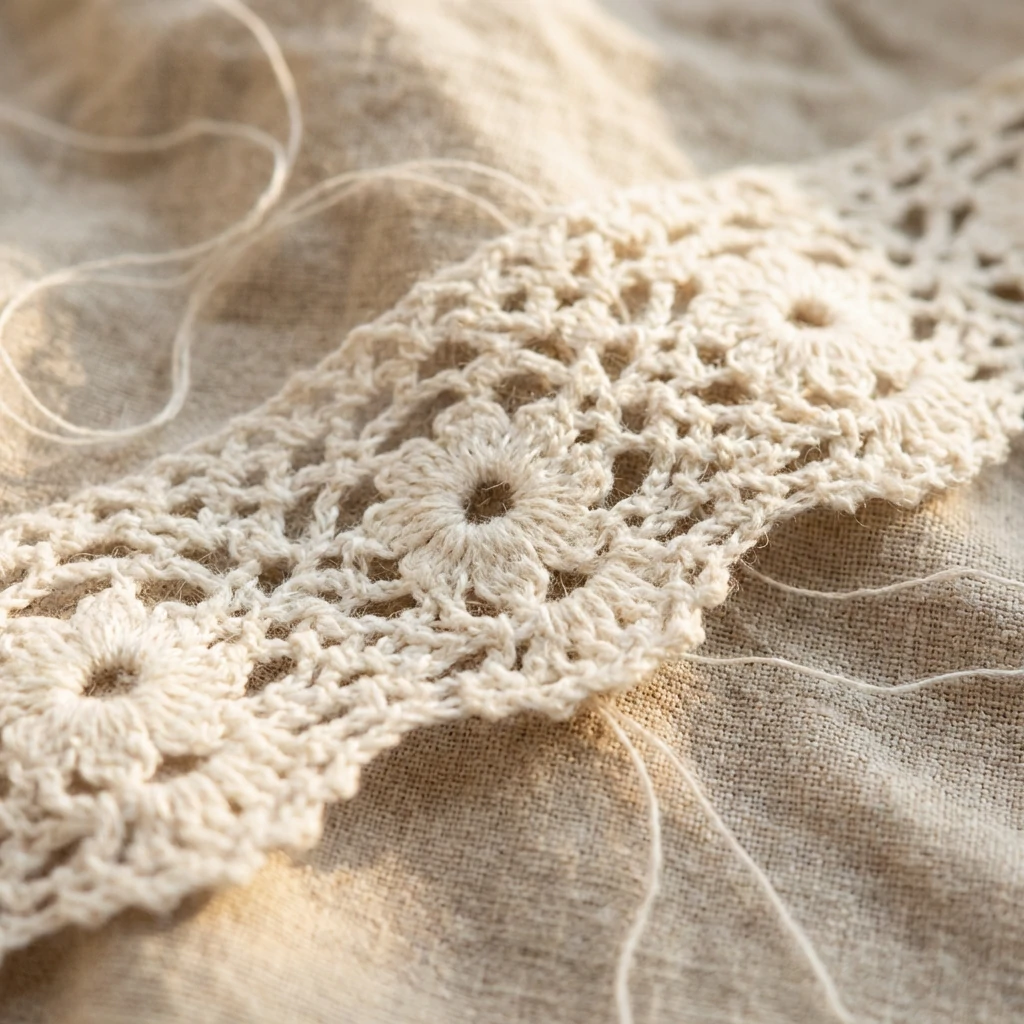
Cotton lace is made from natural cotton fibers — the same plant-based material used in your favorite t-shirt, but spun and woven into intricate decorative patterns. It has been a cornerstone of lacemaking for centuries, and its appeal remains strong today for good reason.
The defining quality of cotton lace is its natural hand feel. When you touch cotton lace, you immediately notice the soft, slightly textured surface that feels organic and breathable. There’s no synthetic sheen, no plasticky smoothness — just the honest texture of natural fiber. This quality makes cotton lace the preferred choice for any application where the fabric touches sensitive skin directly.
Cotton lace also absorbs moisture effectively. The fibers naturally wick perspiration away from skin, allowing air to circulate. This breathability is something synthetic laces simply cannot replicate at the same level.
Common types of cotton lace include:
Cotton crochet lace — Thick, textured, handcrafted aesthetic
Cotton embroidery lace — Delicate patterns stitched onto cotton base
Cotton guipure lace — Bold motifs without mesh background
Cotton eyelet lace — Punched hole patterns with embroidered edges
However, cotton lace comes with trade-offs. It wrinkles more easily than synthetics, can shrink 3-5% in the first wash if not pre-treated, and tends to yellow over time when exposed to prolonged sunlight or improper storage. It’s also more expensive to produce, which makes it a premium option rather than a budget-friendly one.
What is Polyester Lace?

Polyester lace is manufactured from synthetic polymer fibers derived from petroleum. It’s the most widely used lace material in global textile production today, and its dominance comes down to one thing: practical versatility at low cost.
The most notable characteristic of polyester lace is its dimensional stability. It resists shrinking, stretching, and wrinkling — which means what you cut and sew stays exactly the shape you intended, wash after wash. For manufacturers producing at scale, this consistency is incredibly valuable.
Polyester also excels in color performance. The fibers accept a wide range of dyes and retain color vibrancy far longer than natural alternatives. You can achieve bold, saturated reds, deep blacks, and bright whites that hold up through repeated washing and sun exposure. This is why polyester lace dominates the home décor market, where curtains and tablecloths face daily UV exposure.
Common types of polyester lace include:
Water-soluble lace (chemical lace) — Created by dissolving a base fabric to leave freestanding patterns
Polyester embroidery lace — Machine-embroidered patterns on polyester mesh
Polyester stretch lace — Blended with spandex for form-fitting applications
Polyester Venice-style lace — Dense, raised patterns mimicking traditional Venice lace
The drawbacks? Polyester lace doesn’t breathe well. It can feel warm and slightly plasticky against skin, especially in humid conditions. And while it’s durable, it lacks the organic warmth that cotton provides. In high-end fashion, polyester lace can sometimes read as “cheap” if the quality isn’t carefully selected — a perception that cotton lace rarely faces.
Cotton vs Polyester Lace: Key Differences Explained
Let’s go deeper into the factors that actually matter when choosing between these two materials.
Hand Feel and Comfort
This is where cotton lace has a clear and undeniable advantage. Cotton fibers are naturally soft with a matte finish that feels gentle against skin. The texture has depth and character — you can feel the organic quality immediately.
Polyester lace is smoother but often carries a slight synthetic sheen. On lower-quality polyester laces, this can translate to a plasticky or scratchy feel. Higher-quality polyester laces minimize this issue but still can’t fully match cotton’s natural softness.
For garments worn directly against skin — lingerie, baby clothes, summer tops — cotton lace delivers superior comfort. For outerwear or decorative applications where skin contact is minimal, the difference matters less.
Breathability and Moisture
Cotton absorbs 7-8% of its weight in moisture and allows excellent air circulation through its fiber structure. This makes cotton lace comfortable in warm weather and suitable for garments where breathability matters.
Polyester absorbs less than 0.5% moisture. While it dries faster than cotton, it doesn’t manage perspiration well. In humid conditions, polyester lace can feel clammy and uncomfortable against skin.
| Factor | Cotton Lace | Polyester Lace |
|---|---|---|
| Moisture absorption | 7-8% | < 0.5% |
| Air circulation | Excellent | Poor |
| Drying speed | Slower | Fast |
| Warm weather comfort | Very good | Fair |
Durability and Shape Retention
This is polyester’s strong suit. Polyester lace maintains its shape through hundreds of wash cycles without significant change. It doesn’t shrink, doesn’t stretch out, and resists abrasion well.
Cotton lace requires more careful handling. The first wash can cause 3-5% shrinkage if the lace hasn’t been pre-shrunk. Over time, cotton fibers can lose some crispness, and the lace may soften and relax — which some people consider a positive (it gets more comfortable) and others see as a drawback (it loses definition).
For curtains, tablecloths, and items washed frequently, polyester’s stability is a practical advantage. For heirloom garments and pieces meant to develop character over time, cotton’s gentle aging is part of its charm.
Color and Dyeing
Polyester wins on color versatility. It accepts a broad spectrum of dyes and maintains color vibrancy through washing and sun exposure. Blacks stay black, reds stay red, whites stay white.
Cotton lace works beautifully with natural and reactive dyes, producing rich but slightly softer colors. The matte fiber surface creates depth that some designers prefer over polyester’s brighter finish. However, cotton is more susceptible to fading over time, particularly whites — which can yellow with age, improper storage, or prolonged UV exposure.
For products requiring exact color matching across production runs, polyester offers more consistency. For artisanal or natural-aesthetic products, cotton’s color character adds authenticity.
Environmental Impact
Cotton is a natural, biodegradable fiber. At end of life, cotton lace breaks down naturally. However, conventional cotton farming uses significant water and pesticides. Organic cotton addresses this but costs more.
Polyester is petroleum-derived and not biodegradable. It persists in landfills for hundreds of years and can release microplastics during washing. On the positive side, recycled polyester (rPET) lace is increasingly available, reducing virgin material consumption.
Neither option is perfectly sustainable, but cotton has the biodegradability advantage while polyester offers the recycling pathway.
Price Comparison
Polyester lace typically costs 30-50% less than comparable cotton lace. The reasons:
Lower raw material costs
Faster, more efficient manufacturing processes
Higher production yields with less waste
Global production scale
For budget-sensitive projects or high-volume production, polyester’s cost advantage is significant. For premium positioning where material quality justifies higher pricing, cotton supports that value proposition.
Which Lace is Better for Your Project?
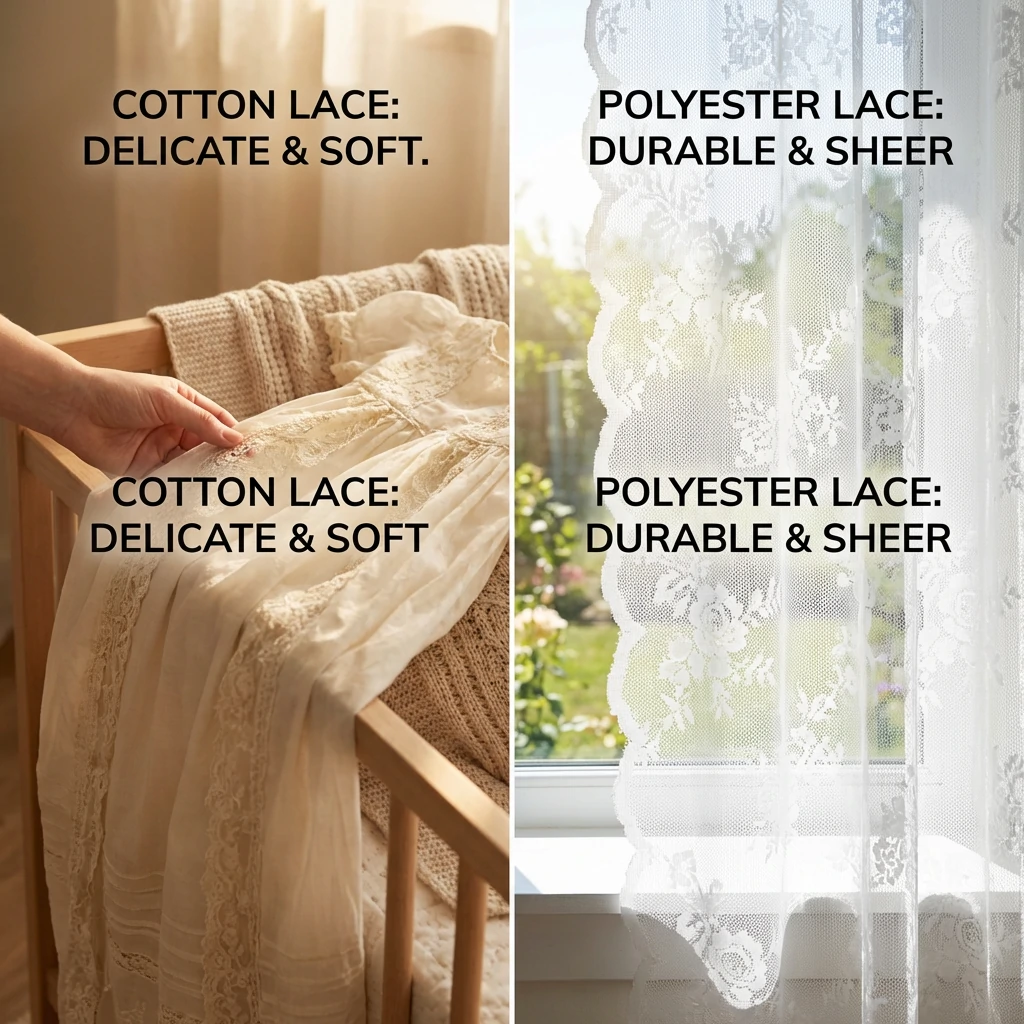
The right choice depends entirely on your application and priorities.
Choose Cotton Lace For:
Baby and children’s clothing. Skin sensitivity makes breathability and softness non-negotiable. Cotton lace is the standard for infant garments, christening gowns, and children’s wear where comfort comes first.
Bridal and heirloom pieces. Cotton lace carries tradition. Its natural texture and aging characteristics suit pieces meant to be treasured and passed down. Many bridal designers specifically request cotton for its authentic, timeless quality.
Summer and warm-weather garments. Breathability matters when temperatures rise. Cotton lace in tops, dresses, and trim details keeps wearers comfortable during hot months.
Eco-conscious brands. If sustainability is part of your brand story, cotton lace — especially organic cotton — aligns with environmental values and customer expectations.
Choose Polyester Lace For:
Home décor and soft furnishings. Curtains, table runners, cushion covers, and decorative items benefit from polyester’s UV resistance, washability, and color retention.
Everyday fashion at accessible price points. When cost matters more than premium feel, polyester lace delivers attractive designs at lower manufacturing cost.
Products requiring wash durability. Uniforms, workwear embellishments, and frequently laundered items need lace that maintains shape and color without special care.
Vivid or unusual colors. If your design requires bold, saturated colors that stay consistent, polyester’s dye performance delivers.
High-volume production. Lower cost per meter and consistent quality make polyester the practical choice for large manufacturing runs.
Consider a Blend
Cotton-polyester blended lace combines advantages from both fibers:
Better breathability than pure polyester
Better shape retention than pure cotton
Moderate price point
Reduced shrinkage compared to pure cotton
Blends typically range from 60/40 to 80/20 in either direction, with properties shifting based on the dominant fiber.
Frequently Asked Questions
Does cotton lace shrink?
Yes. Cotton lace can shrink 3-5% in the first wash, especially in hot water. Pre-washing or selecting pre-shrunk cotton lace before cutting and sewing prevents this issue. Always account for potential shrinkage in your pattern layout.
Is polyester lace breathable?
Not significantly. Polyester fibers absorb very little moisture and don’t allow much air circulation compared to natural fibers. For garments worn in warm conditions or directly against skin for extended periods, cotton or cotton-blend lace is more comfortable.
Which lace is more eco-friendly?
Cotton lace is biodegradable, which gives it an environmental advantage at end of life. However, conventional cotton farming has its own environmental costs. Polyester isn’t biodegradable but can be recycled. The most sustainable choice depends on the full lifecycle — organic cotton lace or recycled polyester lace both represent better options than their conventional counterparts.
What makes lace look cheap?
Regardless of material, lace looks cheap when it has stiff or plasticky hand feel, inconsistent pattern alignment, visible rough edges, or an overly synthetic sheen. Quality matters more than fiber type. A well-made polyester lace looks better than a poorly made cotton lace. Focus on construction quality, pattern clarity, and edge finishing when evaluating any lace.
Can I mix cotton and polyester lace in one garment?
Yes, but be aware of care differences. Cotton components may shrink while polyester parts don’t, creating tension in the garment. If mixing, pre-wash the cotton lace before sewing, and plan care instructions around the more delicate fiber.
Conclusion
Cotton lace and polyester lace each have genuine strengths that make them ideal for different applications.
Cotton delivers natural softness, breathability, and an authentic aesthetic that synthetic lace can’t replicate. It’s the right choice when skin comfort, premium positioning, and traditional craft matter.
Polyester delivers durability, color stability, and cost efficiency that cotton can’t match. It’s the right choice when practical performance, budget, and production scale are priorities.