
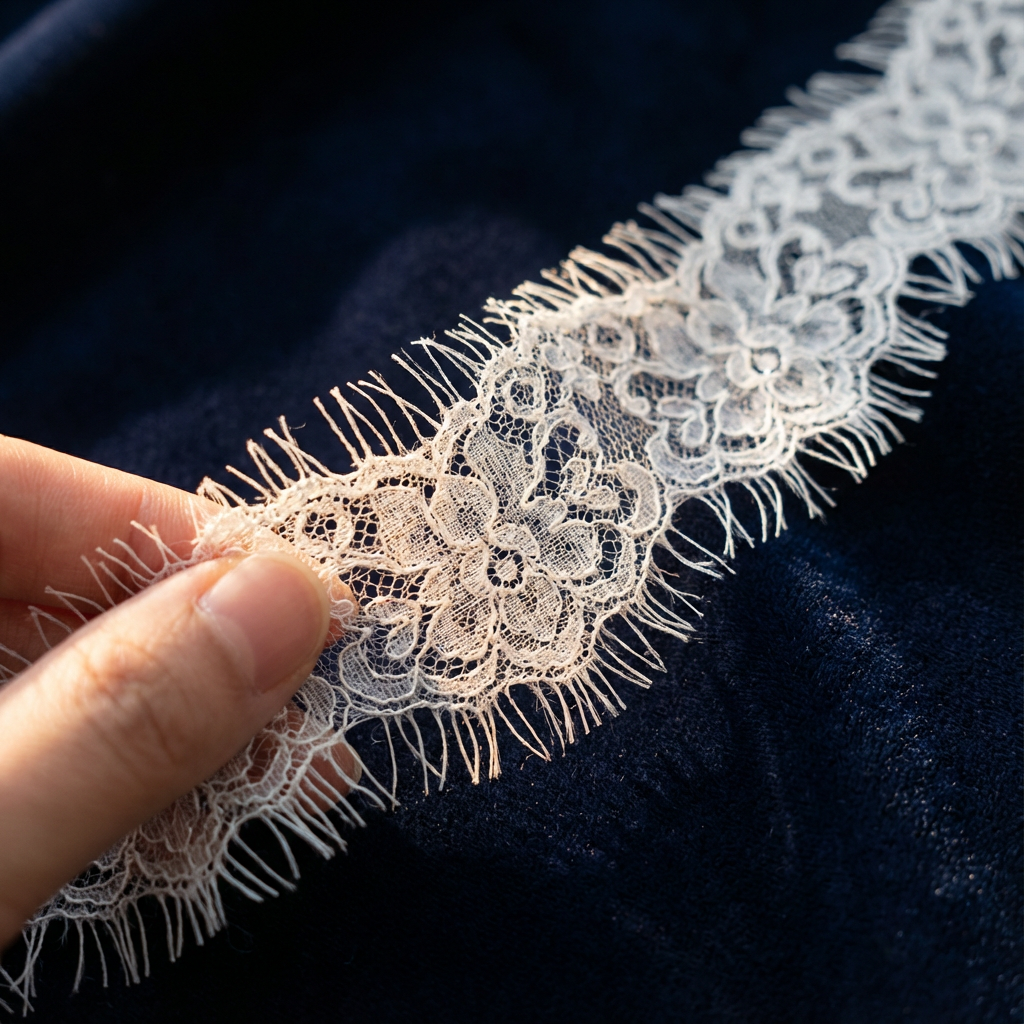
Those soft, feathery edges on eyelash lace don’t happen by accident. And they’re not cut or trimmed into shape afterward.
The fringe is actually formed during the knitting process itself. It’s a specific technique that only certain machines can achieve—and getting it right requires precision at every stage.
I’ve been manufacturing eyelash lace for years. Let me show you exactly how we create those delicate fringes, from the raw yarn to the finished trim.
What Is Eyelash Lace?
The Definition
Eyelash lace is a type of lace characterized by soft, hair-like fringes extending from one or both edges. These fringes resemble eyelashes—hence the name.
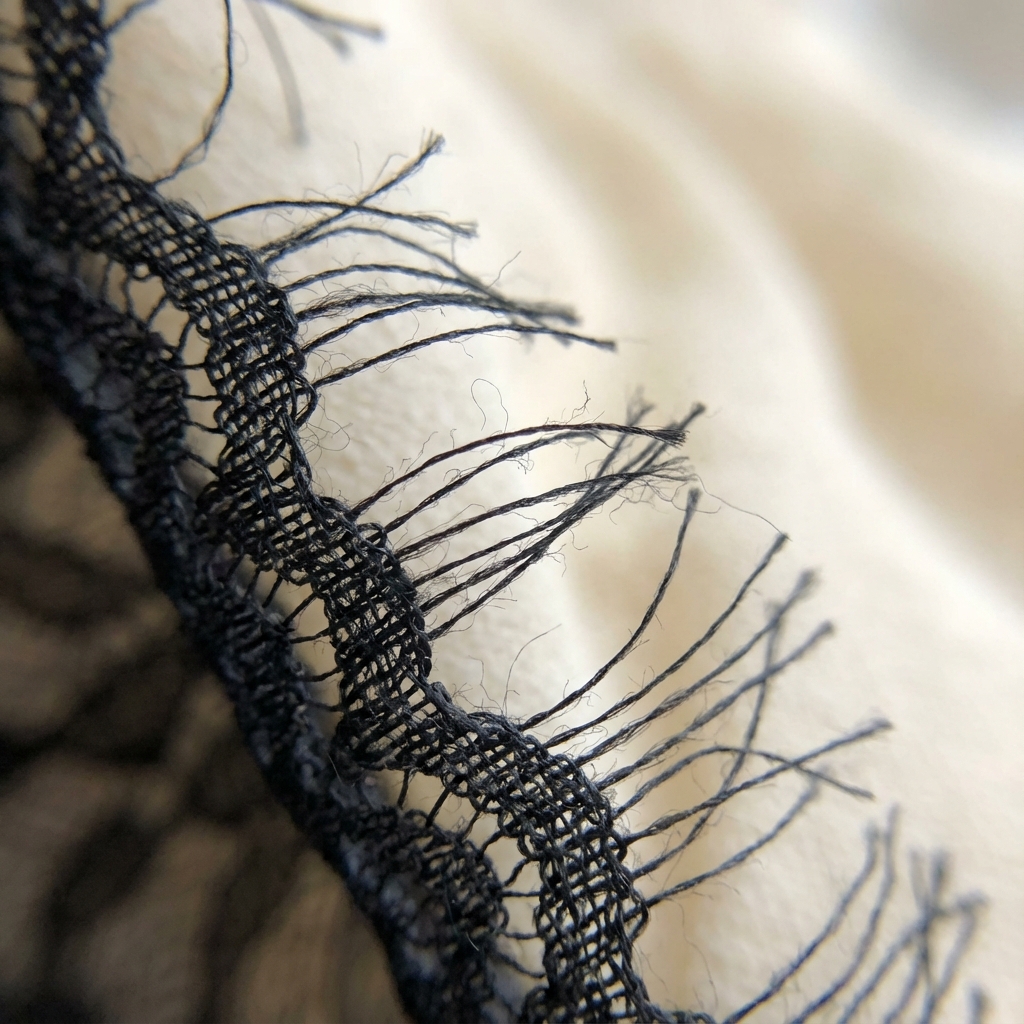
Unlike regular lace that requires hemming or binding at the edges, eyelash lace has a naturally finished border. The fringe IS the edge.
Why It’s Called “Eyelash”
Look closely at the trim. The fine threads extending outward mimic the way natural eyelashes fan out—soft, slightly irregular, and delicate.
This organic look is what makes it popular for lingerie, bridal wear, and anywhere you want a romantic, feminine finish.
Key Characteristics
| Feature | Description |
|---|---|
| Edge type | Soft fringe, no binding needed |
| Fringe length | Typically 5-15mm |
| Base construction | Raschel warp knit |
| Common materials | Nylon, polyester, cotton blends |
| Stretch | Usually yes (2-way or 4-way) |
How Eyelash Lace Is Made
The manufacturing process is where the magic happens. Here’s what goes on in our factory.
Step 1: The Raschel Warp Knitting Machine
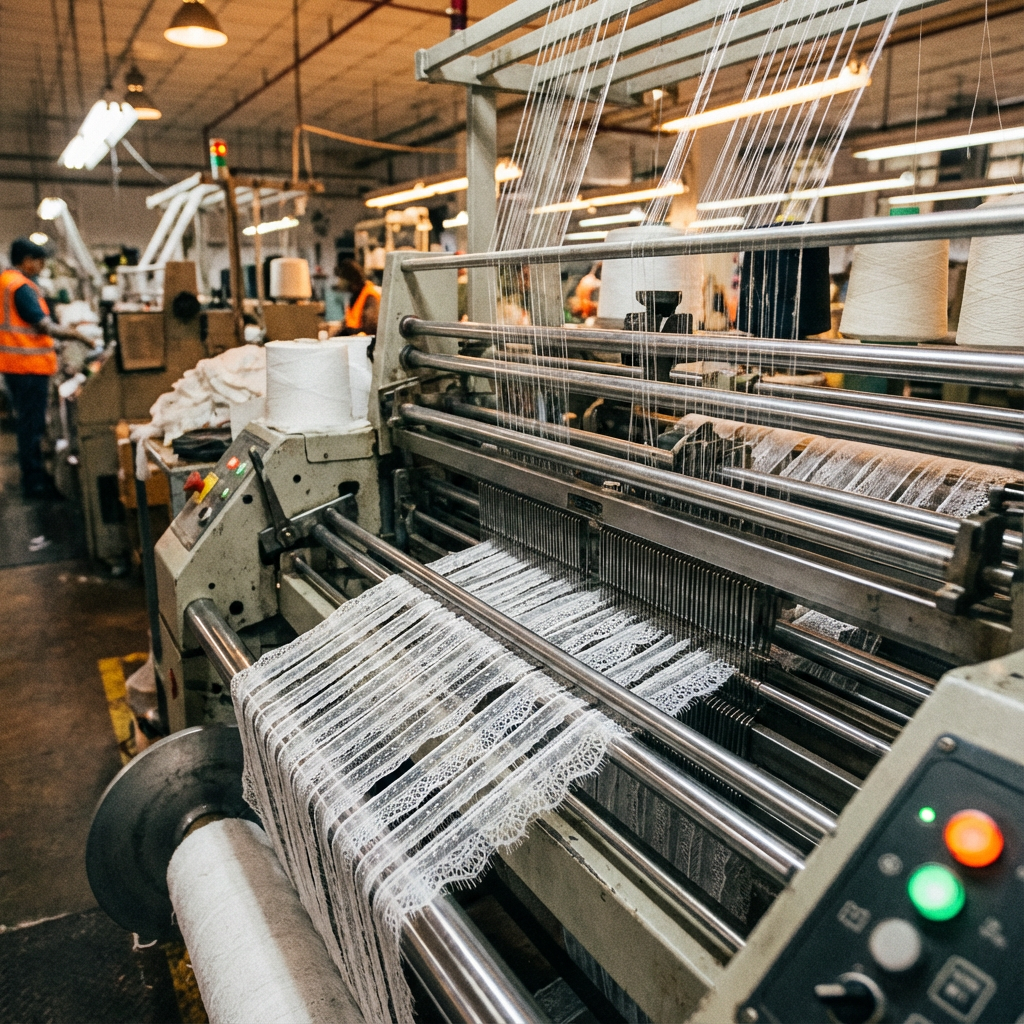
Eyelash lace can only be made on raschel warp knitting machines. Regular looms can’t create the fringe effect.
These machines use multiple sets of needles working simultaneously. One set creates the lace body. Another set forms the eyelash fringe along the edge.
The machine setup is critical. Wrong tension or timing produces uneven fringes that look cheap.
Step 2: Yarn Selection & Threading
We use different yarns for different parts of the lace.
For the lace body: Usually nylon or polyester for structure and stretch.
For the fringe: Often a finer, softer yarn—sometimes with a slight sheen for a silky look.
Threading the machine takes hours. Each yarn must follow a precise path through hundreds of guide bars and needles.
Step 3: Creating the Lace Body
The main pattern forms first. The needles interlock loops of yarn to create the decorative design—flowers, geometric shapes, or abstract patterns.
This is standard warp knitting. Nothing unusual yet.
Step 4: Forming the Eyelash Fringe
Here’s where eyelash lace becomes eyelash lace.
At the edge of the pattern, specific yarns are left as extended loops instead of being locked into the structure. The machine then cuts these loops at precise intervals.
The result: Individual strands hanging freely from the edge—the “eyelashes.”
Fringe length depends on how far the loops extend before cutting. We can adjust this for different products: shorter for subtle trims, longer for dramatic effect.
Step 5: Heat Setting
After knitting, the lace goes through a heat-setting process.
This stabilizes the structure, sets the stretch recovery, and gives the fringe its final texture. Without proper heat setting, the fringe might curl or become stiff.
Temperature and timing vary by material. Nylon and polyester have different requirements.
Step 6: Dyeing & Finishing
Most eyelash lace is knitted in raw (greige) state, then dyed to order.
Dyeing happens in large vats. The lace must be handled carefully—aggressive processing damages the delicate fringes.
Final finishing might include softening treatments for better hand feel.
Eyelash Lace vs Regular Lace
Understanding the differences helps you choose the right type.
| Feature | Eyelash Lace | Regular Lace |
|---|---|---|
| Edge finish | Soft fringe | Cut edge (needs binding) |
| Production method | Raschel warp knit | Various (Leavers, raschel, etc.) |
| Edge treatment needed | None | Usually yes |
| Visual effect | Romantic, soft | Depends on type |
| Typical use | Lingerie, bridal | Multiple applications |
| Handling difficulty | Requires care (fringe is delicate) | Varies |
What Makes Quality Eyelash Lace
Not all eyelash lace is equal. Here’s what separates good from bad.
Thread Quality
Cheap yarn produces cheap-looking fringe. It might be too stiff, too shiny in a plastic way, or prone to tangling.
Quality yarn creates soft, flowing fringes that move naturally and feel good against skin.
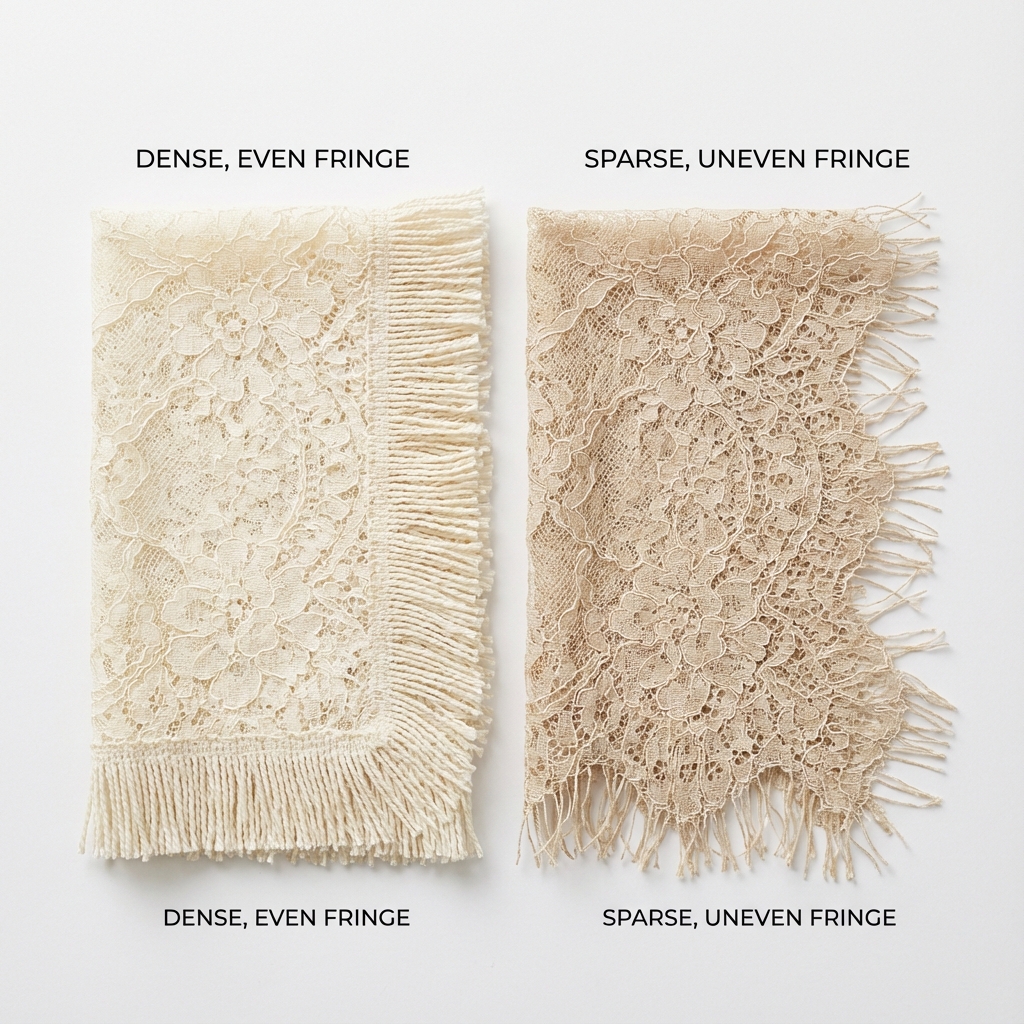
Fringe Density
Count the fringes per inch. Quality eyelash lace has consistent, evenly-spaced fringes throughout the roll.
Inconsistent density signals machine issues or poor quality control.
Fringe Retention
This is critical. Do the fringes stay attached during handling and sewing?
Test by gently pulling a few strands. They should resist—not slide out easily.
Weak fringe attachment means the lace will shed during production, ruining your garments.
Base Structure Integrity
The lace body should be even and consistent. Holes, thin spots, or irregular patterns indicate problems.
Check by holding the lace up to light. You’ll see any structural issues immediately.
Common Uses of Eyelash Lace
Lingerie
Eyelash lace dominates the lingerie market. The soft fringe flatters the body and feels comfortable against skin.
Common applications: bra cups, band edges, panty trims, bodysuit details.
Bridal Wear
Wedding dresses use eyelash lace for veils, sleeve edges, and hem accents. The romantic look suits the occasion perfectly.
Evening Wear
Cocktail dresses and gowns use eyelash lace for necklines, back details, and overlay panels.
Sleep & Loungewear
Nightgowns, robes, and camisoles frequently feature eyelash lace trim for an elevated look.
FAQs
What is eyelash lace?
Eyelash lace is a type of lace with soft, hair-like fringes extending from one or both edges. The fringes resemble eyelashes and are formed during the knitting process—not cut or added afterward. It’s popular for lingerie, bridal wear, and feminine garments.
How is eyelash lace made?
Eyelash lace is made on raschel warp knitting machines. During knitting, specific yarns are left as extended loops at the edges, then cut to form individual fringes. The lace then undergoes heat setting and dyeing to achieve its final look.
What is eyelash lace used for?
Primary uses include lingerie (bras, panties, bodysuits), bridal wear (veils, dress trims), evening wear (necklines, overlays), and sleepwear (nightgowns, robes). The soft fringe edge creates a romantic, feminine effect.
Is eyelash lace stretchy?
Most eyelash lace has stretch because it’s made on warp knitting machines. However, stretch levels vary. Some styles offer 2-way stretch (horizontal only), while others provide 4-way stretch. Always check specifications before ordering.
How do I sew eyelash lace without damaging the fringe?