
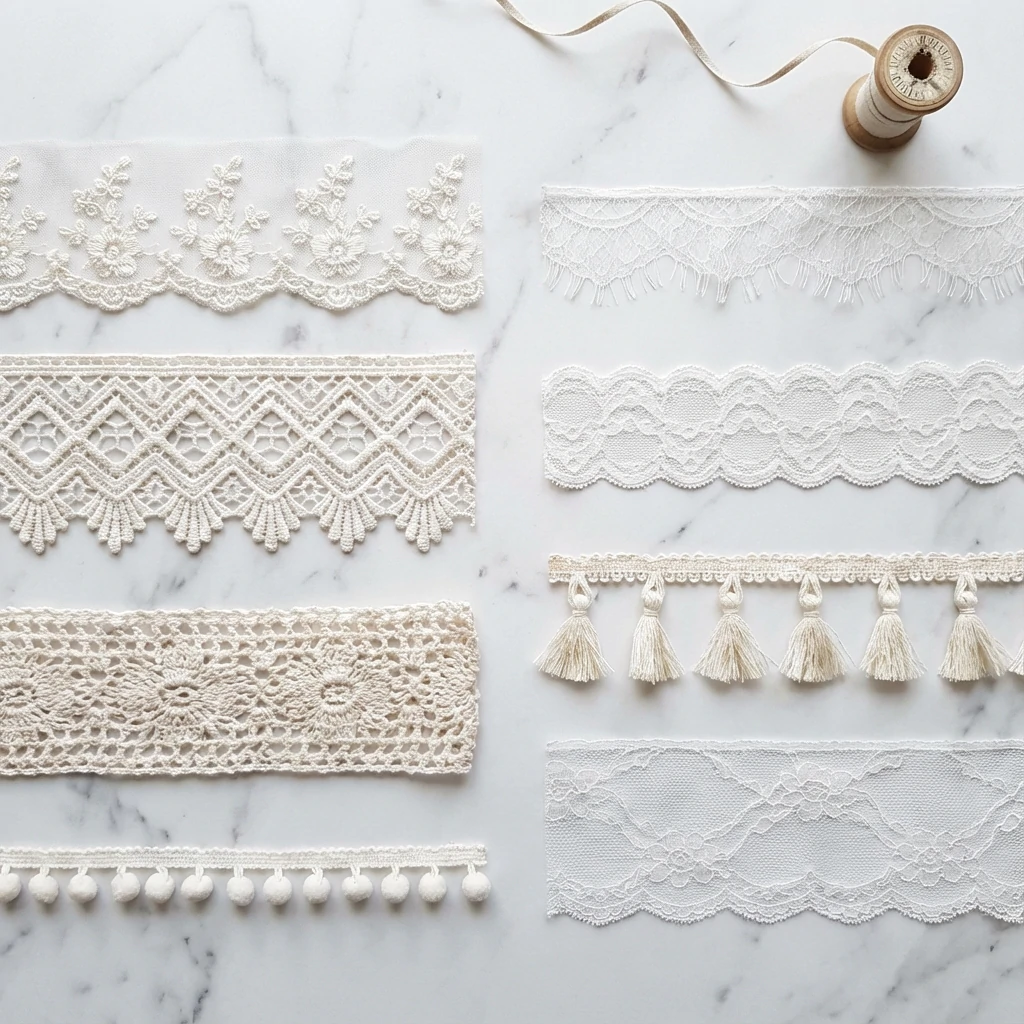
“Lace” covers everything from dollar-store craft trim to couture bridal fabric. Same word, wildly different products. If you’ve ever sourced lace and been confused by the price gaps, you’re not alone.
The key to understanding lace is knowing two dimensions: craft (how it’s made) and material (what it’s made from). Craft determines the look and feel. Material determines durability, cost, and performance.
This guide breaks down 9 common lace types by craft, compares the main materials, and gives you the sourcing questions that separate good suppliers from bad ones.
Quick Reference: 9 Lace Types at a Glance
| Lace Type | Key Feature | Common Use |
|---|---|---|
| Embroidered Lace | Stitched patterns on fabric base | Bridal, evening wear |
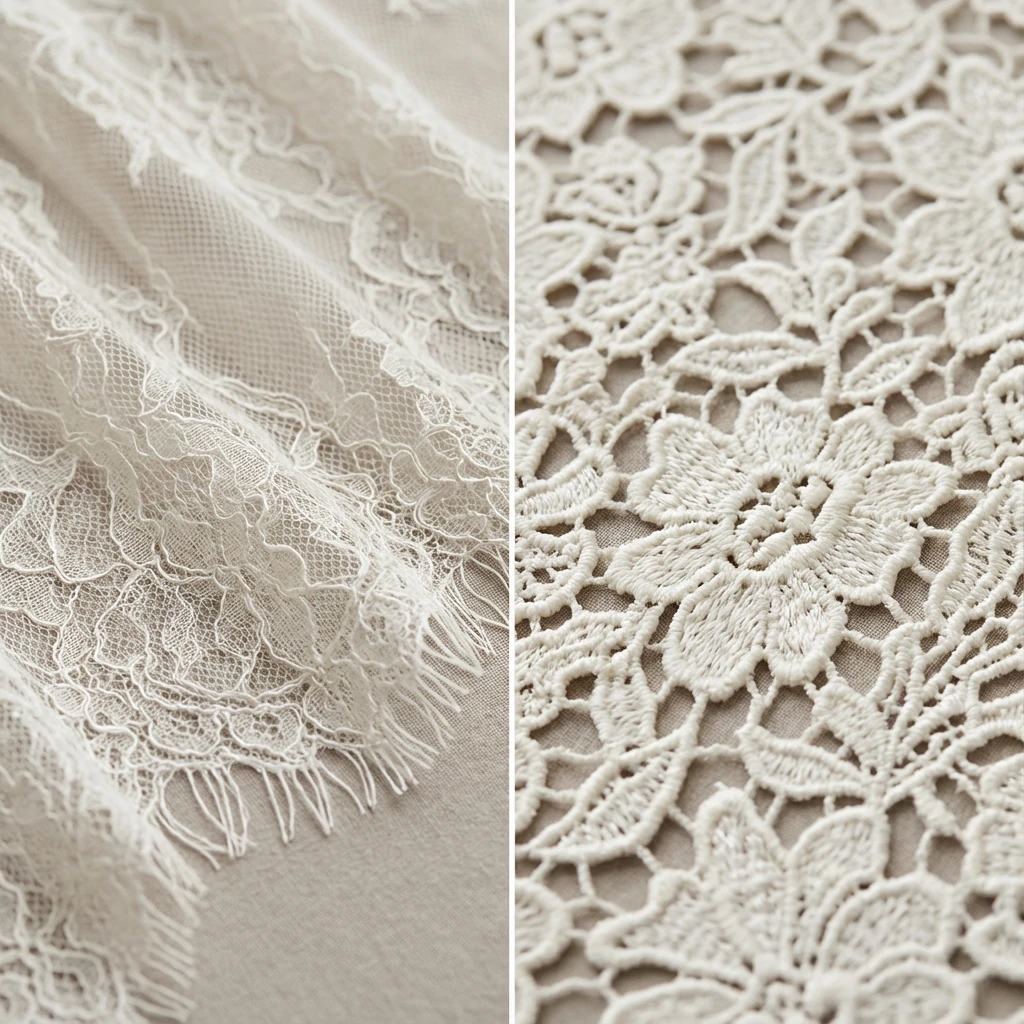
| Eyelash Lace | Delicate fringe along edges | Lingerie, sleepwear |
| Guipure Lace | No mesh background, raised motifs | Wedding gowns, appliqués |
| Stretch Lace | Contains spandex, flexible | Lingerie, shapewear |
| Crochet Lace | Looped, handmade texture | Boho fashion, home decor |
| Tassel Lace | Hanging fringe trim | Curtains, stage costumes |
| Pompom Lace | Small decorative balls | Childrenswear, crafts |
| Chantilly Lace | Fine floral, scalloped edges | Bridal veils, haute couture |
Lace Types by Craft
1. Embroidered Lace
Embroidered lace features patterns stitched onto a base fabric. The base can be cotton voile or nylon mesh—each creates a completely different look.
Cotton-base embroidery feels substantial and opaque. It works for structured garments where you want the lace to hold its shape. Mesh-base embroidery is sheer and delicate, ideal for overlays and lingerie panels.
Here’s what most buyers miss: stitch count determines quality. More stitches per centimeter means denser patterns, better definition, and higher cost. When comparing suppliers, always ask for stitch density specs.
2. Eyelash Lace
Eyelash lace gets its name from the fine, hair-like threads extending from the edges. These “lashes” create a soft, romantic border that works beautifully on lingerie, sleepwear, and evening gown hems.
The quality difference shows in the lash consistency. Cheap eyelash lace has uneven, sparse lashes that shed after a few washes. Quality versions have dense, uniform lashes that stay put.
Sourcing tip: Ask about lash density and pull a few threads during sampling. If they release easily, that lace won’t survive production or consumer use.
3. Guipure Lace (Water-Soluble Lace)
Guipure lace—also called chemical lace or water-soluble lace—has no mesh background. The pattern appears to float, connected only by thread bars between motifs.
This is premium territory. Guipure dominates high-end bridal and couture because nothing else looks as elegant. The production process involves embroidering onto water-soluble fabric, then dissolving the base to leave only the pattern.
What to check: Connection points between motifs. Weak bars mean the lace falls apart under stress. Quality guipure has reinforced connections that hold through cutting, sewing, and years of wear.
4. Stretch Lace
Stretch lace contains spandex or Lycra woven into the structure. It expands with body movement and snaps back without losing shape.
Two types exist: 2-way stretch (horizontal only) and 4-way stretch (horizontal and vertical). Most bra bands need 2-way. Full body panels need 4-way. Getting this wrong means garments that sag or restrict movement.
The detail most buyers overlook: modulus—how much force it takes to stretch the lace. Low-modulus stretch feels soft but loses support on plus-size applications. High-modulus provides structure but feels firmer. Match modulus to your target sizing.
5. Crochet Lace
Crochet lace has a distinctive looped texture that reads as handmade and artisanal. Traditional versions were literally hand-crocheted; modern production uses machines that replicate the look.
The aesthetic is casual and bohemian. You’ll find crochet lace on summer dresses, beach cover-ups, table linens, and home décor trim.
Material matters here: Cotton crochet has authentic texture but wrinkles easily. Polyester crochet holds its shape better but can look plastic in cheap versions. Cotton-poly blends often hit the sweet spot.
6. Tassel Lace
Tassel lace features hanging fringe attached to a header tape. The tassels create movement and visual drama—perfect for curtain edges, stage costumes, and statement garments.
Quality varies enormously. Budget tassel lace uses thin thread that tangles and sheds. Premium versions use twisted cords or even metallic bullion that maintains shape and catches light.
Key spec: tassel density and length. Higher density costs more but creates a fuller, more luxurious effect. Length typically ranges from 3 to 30 centimeters depending on application.
7. Pompom Lace
Pompom lace adds small decorative balls along the edge or surface. The effect is playful and whimsical, making it popular for childrenswear, casual apparel, and craft projects.
The construction challenge is attachment. Poorly made pompom lace loses balls after minimal handling. Quality versions have reinforced attachment points that survive washing and wear.
Before ordering: Pull a few pompoms firmly during sampling. If they detach easily, expect production headaches and customer complaints.
8. Chantilly Lace
Chantilly is the classic. Named after a French town, this lace features fine floral patterns on delicate mesh with distinctive scalloped edges.
True Chantilly uses silk threads and commands premium prices. Modern versions use nylon or polyester at lower cost points while maintaining the visual character.
This is the default choice for bridal veils and haute couture bodices. The fine mesh creates beautiful drape, and the floral patterns photograph exceptionally well.
Lace Materials Compared
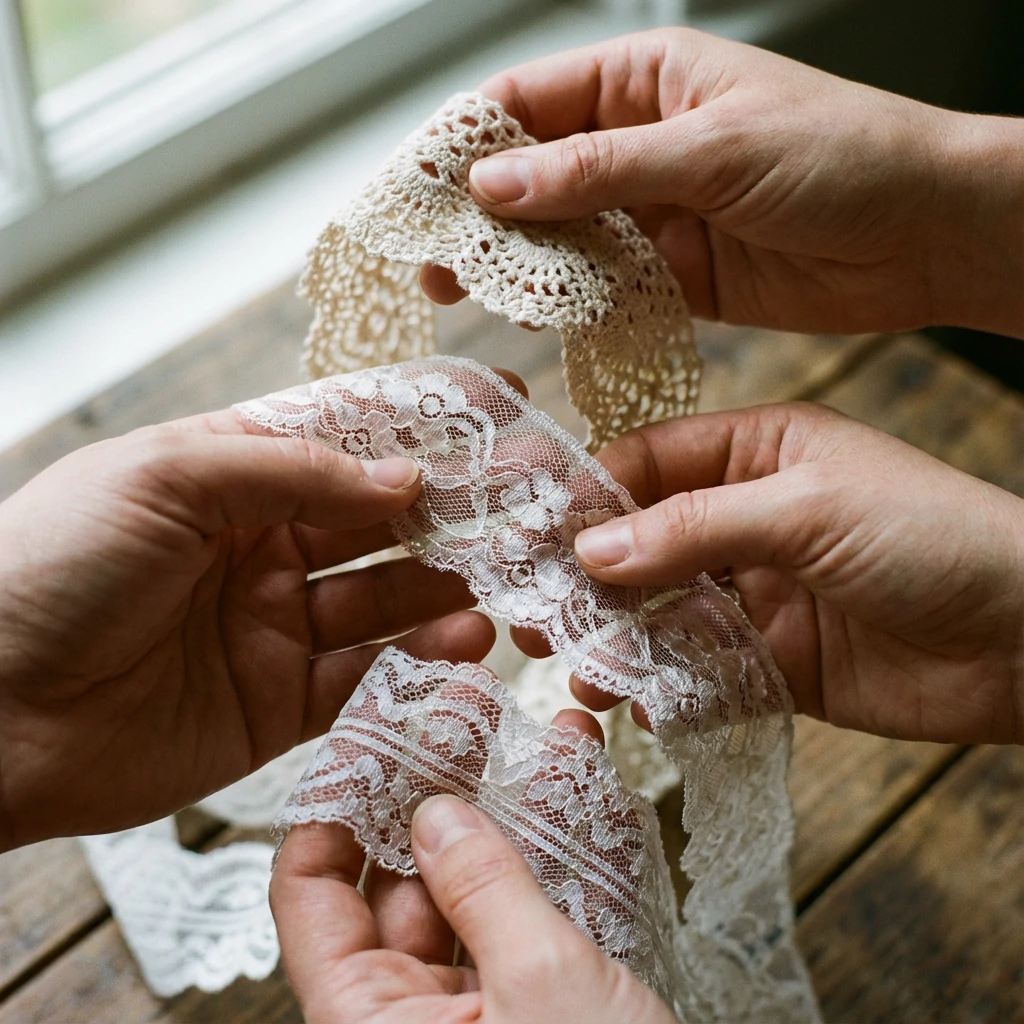
The craft determines what lace looks like. The material determines how it performs.
| Material | Feel | Durability | Price | Best For |
|---|---|---|---|---|
| Cotton | Soft, breathable, natural | Moderate (wrinkles, can shrink) | $$ | Childrenswear, casual, sensitive skin |
| Nylon | Smooth, silky, lightweight | High (strong, resilient) | $$ | Lingerie, evening wear, bridal |
| Polyester | Crisp, holds shape | Very high (wash-resistant) | $ | Volume production, everyday wear |
| Cotton-Poly Blend | Balanced hand feel | Good (reduced wrinkling) | $$ | General purpose |
| Nylon-Cotton Blend | Soft with subtle sheen | Good (breathable + durable) | $$$ | Premium lingerie, special occasion |
Here’s what I tell first-time buyers: Start with the end product, then work backward. A wedding gown needs drape and photography appeal—nylon or silk. A baby dress needs softness and breathability—cotton. A dance costume needs durability—polyester or nylon.
How to Choose the Right Lace
Match Craft to Application
| Application | Recommended Lace Types |
|---|---|
| Bridal gowns | Guipure, Chantilly, Embroidered |
| Lingerie | Stretch, Eyelash, Embroidered mesh |
| Childrenswear | Pompom, Cotton crochet, Cotton embroidered |
| Evening wear | Chantilly, Eyelash, Guipure |
| Home textiles | Tassel, Crochet, Embroidered |
| Stage costumes | Tassel, Stretch, Embroidered |
Match Material to Requirements
High wash frequency? Choose polyester or nylon.
Sensitive skin contact? Choose cotton or cotton blends.
Drape and movement? Choose nylon or silk.
Budget constraints? Polyester delivers the most value.
Three Questions to Ask Every Supplier
What’s the stitch count / density spec? — Quantifies quality
Can I get a swatch for wash testing? — Reveals durability
What’s your MOQ for this style? — Determines feasibility
Suppliers who answer these clearly are suppliers who understand their product. Vague responses signal potential quality control issues.
FAQs
How many types of lace are there?
Dozens, depending on how you classify them. By craft, the major categories include embroidered, guipure, crochet, knitted, and bobbin lace. By material, lace can be cotton, nylon, polyester, silk, or blends. Most commercial buyers focus on 8-10 common types that cover the majority of applications.
What is the difference between guipure and embroidered lace?
Embroidered lace has patterns stitched onto a fabric base—either cotton or mesh. Guipure lace has no base; the pattern floats with only thread bars connecting motifs. Guipure looks more delicate and costs more to produce.
What type of lace is best for wedding dresses?
Chantilly, guipure, and embroidered lace dominate bridal. Chantilly offers classic romance with fine florals. Guipure provides dramatic dimension with raised motifs. Embroidered mesh delivers intricate patterns with subtle sheerness.
What is the most durable lace material?