
Lace is the fabric that transforms a wedding dress from beautiful to breathtaking. It adds texture, dimension, and romance that no other material can match. Whether you’re drawn to delicate floral patterns or bold geometric designs, the lace you choose defines your entire bridal look.
But with so many types of lace available — Chantilly, Alençon, guipure, Venice, eyelash — how do you know which one is right for your dress? And what makes some lace cost thousands while others remain affordable?
This guide covers everything you need to know about wedding dress lace: where the world’s best bridal lace comes from, the major types and their characteristics, how to choose the right one for your style, and the trends shaping 2025-2026 weddings.
Where Does the World’s Best Wedding Dress Lace Come From?
Most brides never think about where their wedding dress lace originates. But understanding the global supply chain reveals fascinating industry dynamics — and explains why some lace costs more than others.
Chaozhou: The World’s Wedding Dress Lace Capital
Ask anyone in the bridal industry where most wedding dress lace comes from, and the answer is almost always the same: Chaozhou, China.
This city in eastern Guangdong province produces an estimated 60% of the world’s wedding and evening dress output. Over 1,000 lace and garment enterprises operate here, employing more than 100,000 workers and generating ¥8.69 billion (approximately $1.2 billion USD) in annual exports — representing 67% of the entire city’s garment export value.
But Chaozhou’s dominance isn’t about cheap labor. It’s about irreplaceable expertise and infrastructure.
Centuries of embroidery tradition. Chaozhou embroidery (潮绣) is recognized as a national intangible cultural heritage. The region’s artisans have perfected hand-embroidery techniques over generations. This expertise transferred naturally into lace production when the industry developed in the 1980s and 1990s.
Complete supply chain concentration. Everything needed to produce wedding dress lace exists within a small geographic area: silk suppliers, mesh base fabric mills, embroidery thread manufacturers, bead and sequin suppliers, and finished lace producers. This concentration reduces costs, speeds production, and enables rapid design iteration.
Specialized machinery and skills. Chaozhou factories operate advanced embroidery machines configured specifically for bridal lace production. More importantly, the machine operators have accumulated expertise that factories elsewhere simply don’t possess. Replicating this knowledge takes decades.
Scale and quality range. Whether a brand needs 50 meters of premium hand-finished Alençon-style lace or 50,000 meters of standard eyelash trim, Chaozhou can deliver. This flexibility serves everyone from couture houses to mass-market retailers.
| Chaozhou By the Numbers | |
|---|---|
| Global market share | ~60% of wedding/evening dresses |
| Annual export value | ¥8.69 billion ($1.2B USD) |
| Share of city’s garment exports | 67% |
| Number of enterprises | 1,000+ |
| Industry workforce | 100,000+ |
Why Global Brands Source from Chaozhou
![Wedding Dress Lace Types, Trends & How to Choose the Best [2026]](https://www.yituolace.com/wp-content/uploads/2026/01/Wedding-Dress-Lace-Types-Trends-How-to-Choose-the-Best-2026-576x1024.webp)
Every major bridal brand — from Vera Wang to David’s Bridal — sources lace components from Chaozhou. The reasons extend beyond cost:
Design capability. Chaozhou lace factories don’t just manufacture — they design. Many develop seasonal collections that brands can customize, dramatically shortening development timelines.
Quality consistency. Decades of export experience have instilled quality control standards that meet Western brand requirements. Factories understand the inspection protocols and documentation expectations.
Flexibility. Unlike factories locked into single product categories, Chaozhou producers pivot between wedding, evening, and ready-to-wear lace depending on market demand.
Other Lace Production Centers
While Chaozhou dominates volume production, other regions serve specific market segments:
France — Calais and Lyon remain centers for ultra-premium laces. French Chantilly and Alençon command the highest prices and appear in top-tier couture.
Italy — Italian lace mills produce refined options for European luxury brands. Quality is exceptional; volumes and flexibility are limited.
India — Hand-embroidered lace and beadwork serves brands seeking artisanal, handcrafted aesthetics at moderate price points.
Turkey — A growing lace manufacturing hub, particularly for European markets seeking alternatives to Asian production.
Popular Types of Lace for Wedding Dresses
Not all lace is created equal. Each type has distinct characteristics that create different moods and suit different dress styles.
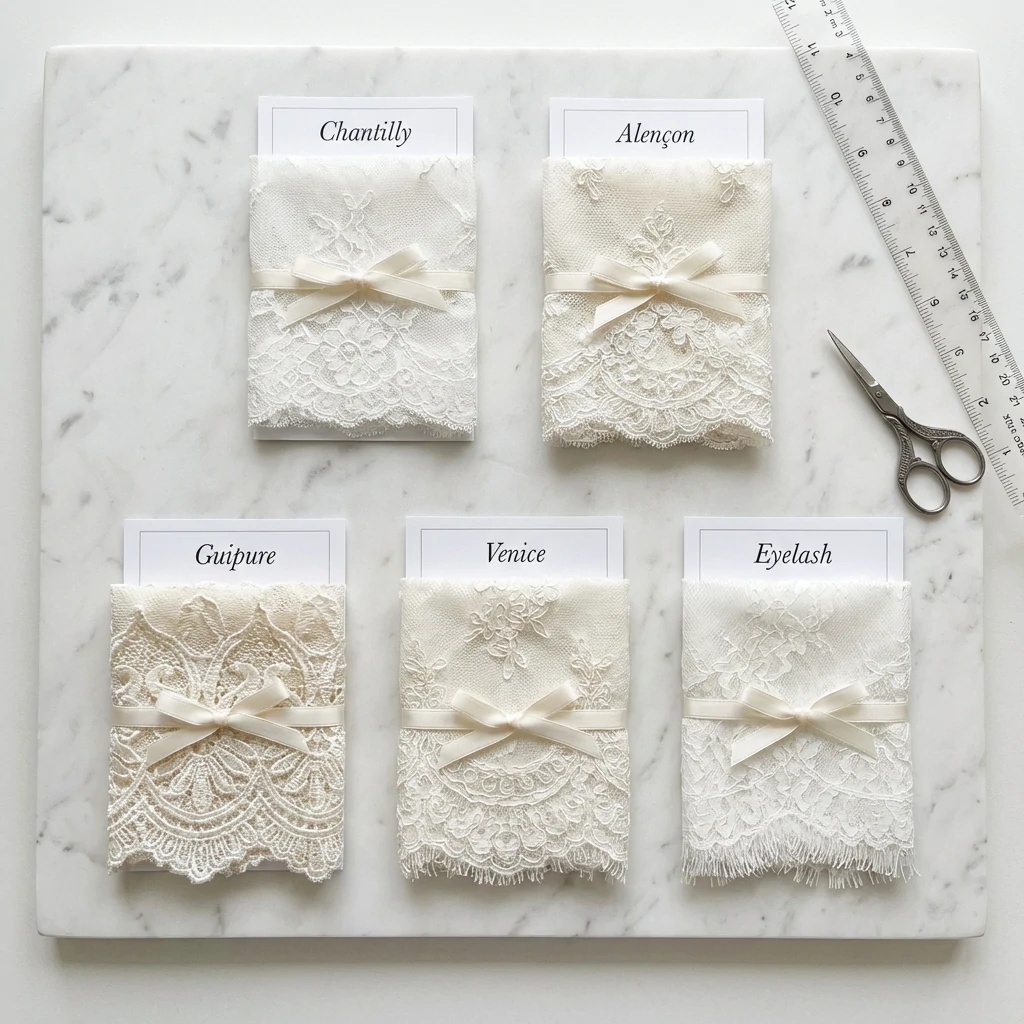
Chantilly Lace
Chantilly lace is the most romantic and delicate of all bridal laces. Named after the town in France where it originated, this lace features fine floral patterns outlined with silk thread against a soft mesh background.
The defining quality of Chantilly is its ethereal, almost weightless feel. The patterns are intricate but subtle, creating an effect that’s elegant without being heavy. This makes it ideal for overlay panels, sleeves, and veils where you want delicate beauty without bulk.
Chantilly works beautifully on:
A-line and flowing silhouettes
Illusion necklines and backs
Cathedral veils
Bohemian and garden wedding styles
The drawback is fragility. Chantilly lace requires careful handling during construction and wear, and it’s among the more expensive options due to its fine craftsmanship.
Alençon Lace
Often called the “Queen of Lace,” Alençon lace features raised floral patterns outlined with fine cord, giving it a dimensional, almost sculptural quality. The motifs are typically re-embroidered onto a sheer net background and finished with delicate picot edges.
What sets Alençon apart is its refined elegance. The corded outlines catch light beautifully, and the raised patterns add texture that photographs exceptionally well. This lace has graced royal wedding gowns for generations.
Alençon is ideal for:
Formal ballgown silhouettes
Classic, traditional wedding styles
Bodice appliqués and trim details
Heirloom-quality dresses meant to be preserved
Expect to pay premium prices for genuine Alençon — the hand-finishing required makes it one of the most labor-intensive laces to produce.
Guipure Lace
Guipure lace stands apart from other bridal laces because it has no mesh background. The motifs connect directly to each other, creating bold positive-negative effects where skin or underlining shows through the pattern gaps.
This gives guipure a more modern, graphic quality compared to traditional laces. The patterns tend to be larger and bolder — florals, leaves, geometric shapes — making strong visual statements.
Guipure works well for:
Modern minimalist gowns with statement lace panels
High-neck or mock-neck bodices
Structured mermaid or sheath silhouettes
Brides who want lace impact without allover coverage
The heavier weight of guipure means it holds its shape well, making it suitable for structured bodices and fitted skirts. However, this same weight makes it less ideal for flowing, ethereal looks.
Venice Lace
Venice lace (also called Venetian lace) is a heavy, highly textured lace made with raised, three-dimensional motifs. The patterns often include florals, scrollwork, and ornate designs that stand prominently from the surface.
The drama of Venice lace is its defining characteristic. This is not subtle — it’s statement lace that demands attention. The dense construction and raised texture create shadow and depth that photographs dramatically.
Venice lace suits:
Statement sleeves and cuffs
Dramatic trains and hemlines
Bold bodice designs
Formal cathedral weddings
The weight and stiffness of Venice lace means it doesn’t drape fluidly. It’s best used as accent pieces rather than allover coverage.
Eyelash Lace
Eyelash lace gets its name from the delicate, fringe-like threads that extend from the scalloped edges — resembling eyelashes. This soft, feathery edge creates a romantic, feminine finish that’s become incredibly popular in modern bridal design.
The softness of eyelash lace makes it comfortable against skin and flattering in photographs. The wispy edges blur the line between lace and skin, creating seamless, organic-looking designs.
Eyelash lace is perfect for:
Plunging necklines and low backs
Off-shoulder and cap sleeve designs
Bodice edges and hem details
Romantic, soft wedding aesthetics
This lace type offers excellent value — it delivers high visual impact at moderate price points, making it a favorite for brides and designers alike.
Comparison Table: Wedding Dress Lace Types
| Lace Type | Weight | Feel | Best For | Price Range |
|---|---|---|---|---|
| Chantilly | Light | Delicate, soft | Overlays, veils, sleeves | High |
| Alençon | Medium | Refined, dimensional | Formal gowns, appliqués | Premium |
| Guipure | Heavy | Bold, modern | Structured bodices, panels | Mid-high |
| Venice | Heavy | Dramatic, textured | Statement details, trains | Mid-high |
| Eyelash | Light | Soft, romantic | Necklines, edges, backs | Moderate |
How to Choose the Right Lace for Your Wedding Dress
Selecting lace isn’t just about which pattern you like — it’s about matching the lace characteristics to your overall vision.
Match Lace to Your Wedding Style
Your venue and formality level should guide lace selection. A cathedral wedding calls for refined Alençon or dramatic Venice lace. A beach ceremony suits lightweight Chantilly or soft eyelash lace. A modern urban celebration might feature bold guipure panels.
Consider also whether lace will cover most of the dress or appear as accent details. Allover lace coverage requires lighter-weight options that won’t overwhelm the silhouette. Statement lace accents can handle heavier, bolder varieties.
Consider Your Body and Comfort
Lace weight affects how a dress feels throughout your wedding day. Lighter laces like Chantilly and eyelash remain comfortable over hours of wear. Heavier guipure and Venice can feel warm and restrictive, especially in summer weddings.
Pattern scale matters too. Smaller, delicate patterns tend to be more universally flattering. Larger patterns make stronger statements but can overwhelm petite frames. Try different scales against your body to see what works.
Think About Photography
Wedding photos are forever, and lace photographs differently than it appears in person. Dimensional laces (Alençon, Venice) catch light and shadow, creating depth in photos. Flat laces (Chantilly, eyelash) appear softer and more romantic on camera.
White lace on white fabric can disappear in photographs. Consider ivory or champagne undertones that provide subtle contrast, or choose lace with enough dimension to create visual interest.
Budget Realities
Lace quality varies enormously, and price reflects that variation. Hand-finished French Alençon costs many times more than machine-made alternatives. However, skilled designers can create stunning dresses with moderate-priced laces by using them strategically.
If budget is a concern, consider lace accents rather than allover coverage. A beautiful eyelash lace bodice with a plain skirt delivers lace impact at lower cost than a full lace gown.
Wedding Dress Lace Trends 2025-2026
Bridal fashion evolves constantly, and lace trends shift with it. Here’s what’s defining wedding dress lace right now.
3D Floral Appliqués
Dimensional flowers and leaves applied to dresses — rather than flat lace patterns — dominate current bridal fashion. These appliqués create depth and shadow that photograph dramatically. Expect to see roses, peonies, and abstract botanical motifs cascading down skirts and climbing bodices.
Sheer Lace Panels
The “barely there” aesthetic continues to gain momentum. Designers use sheer lace panels to create illusion effects — see-through sections that reveal skin strategically while maintaining structure. This appears in plunging backs, side panels, and even bodice inserts.
Colored and Tinted Lace
While white and ivory remain dominant, brides increasingly embrace subtle color in lace. Blush undertones soften the overall look. Champagne adds warmth. Some designers even incorporate pale blue or lavender lace accents for something unexpected.
Mixed Lace Combinations
Rather than using a single lace throughout, current designs combine multiple lace types in one gown. A Chantilly overlay might pair with guipure appliqués. Eyelash trim might edge an Alençon bodice. These combinations add visual complexity and depth.
Sustainable and Recycled Lace
Environmental consciousness is reaching bridal fashion. Some designers now offer vintage or recycled lace options. Others partner with mills producing lace from recycled materials. This trend will accelerate as sustainability becomes a mainstream wedding priority.
Caring for Lace Wedding Dresses
Your lace wedding dress deserves proper care before, during, and after your wedding day.
Before the Wedding
Store your dress in a breathable garment bag, away from direct sunlight which can yellow delicate lace over time. Avoid plastic bags that trap moisture and promote mildew. If possible, hang the dress rather than folding it — lace creases can be difficult to remove.
On Your Wedding Day
Lace catches on rough surfaces, jewelry, and even fingernails. When dressing, handle the gown carefully and have someone assist with zippers and buttons. Consider a protective layer when sitting on rough surfaces.
After the Wedding
Professional cleaning is essential for lace gowns. Body oils, makeup, and environmental soils can set into lace fibers and become permanent if not properly treated. Choose a cleaner experienced with bridal gowns and delicate laces.
For long-term storage, acid-free tissue paper and archival boxes protect lace from yellowing and deterioration. Avoid vacuum-sealed storage, which can crush dimensional lace details.
Conclusion
Wedding dress lace is both an art and an industry — one that spans from French ateliers to massive Chaozhou factories, from centuries-old hand techniques to computer-guided embroidery machines.
Behind every beautiful bridal lace lies a global supply chain concentrated remarkably in one Chinese city — where traditional embroidery expertise meets industrial scale to dress brides worldwide. Chaozhou’s 60% global market share isn’t an accident; it’s the result of generations of craftsmanship meeting modern manufacturing excellence.
Understanding the different types of lace helps you choose what’s right for your vision and budget. Chantilly offers delicate romance. Alençon delivers timeless elegance. Guipure makes modern statements. Venice brings drama. Eyelash adds soft, feminine edges.