
If you’ve ever searched for lace trim, you’ve probably seen these terms thrown around: chemical lace, guipure lace, water soluble lace, schiffli lace. They sound like completely different products, but here’s what most suppliers won’t clarify upfront—they’re all the same thing.
The confusion costs buyers time and money. You might reject a quote for “chemical lace” thinking it’s inferior, then pay more for “guipure” from another supplier—for the exact same product.
I’ve been manufacturing this type of lace for years. Let me explain what it actually is, why it’s called “chemical,” how we make it, and what separates quality chemical lace from cheap imitations.
What Is Chemical Lace?
The Definition
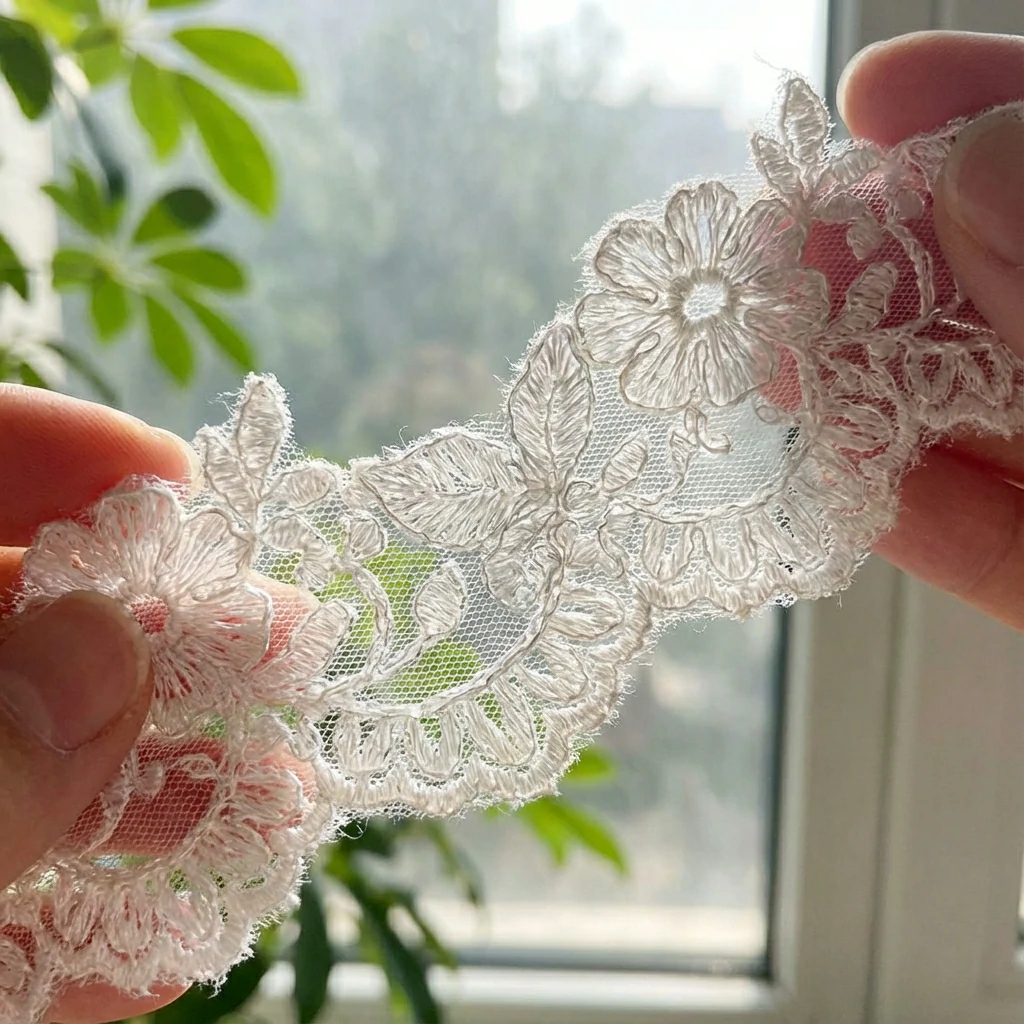
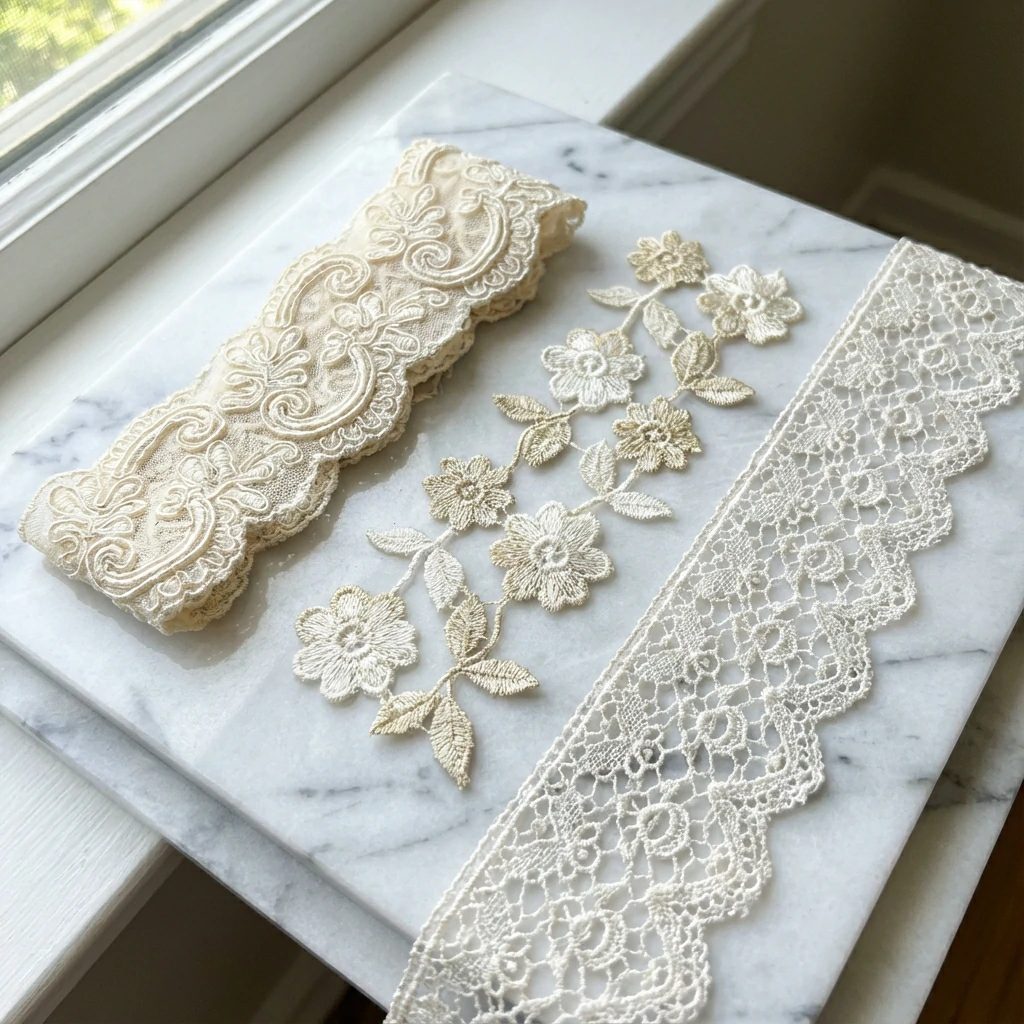
Chemical lace is a type of lace that has no background mesh or net. The pattern appears to float on its own, with designs connected only by thread bars or bridges between motifs.
The name comes from the manufacturing process. We embroider the pattern onto a water-soluble fabric, then dissolve that base fabric using hot water or chemicals—leaving only the embroidered design behind. The base disappears; the lace remains.
This creates that distinctive open, airy look where you can see through the spaces between the pattern elements. Hold chemical lace up to light, and you’ll see the negative space clearly—no sheer fabric behind it, just air.
Other Names for Chemical Lace
The same product goes by different names depending on who’s selling it and where they learned the trade.
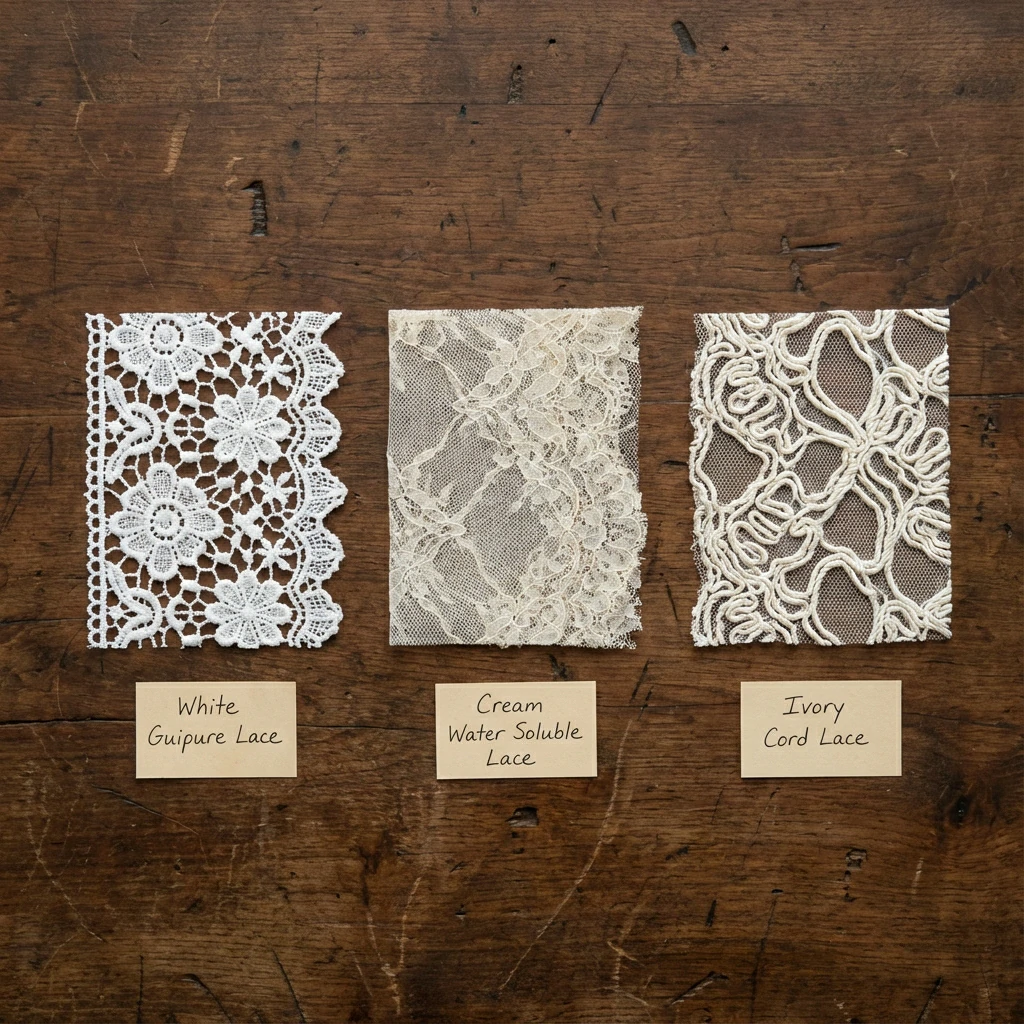
Guipure lace is the French term, popular in European and bridal markets. It sounds more elegant, so high-end suppliers often prefer it.
Water soluble lace describes the process directly—the base fabric dissolves in water. You’ll hear this term more often in manufacturing contexts and from Asian suppliers.
Schiffli lace references the Swiss-invented Schiffli embroidery machine used to create it. Technical buyers and textile engineers tend to use this name.
Cord lace is common in African markets, particularly Nigeria, where this type of lace is extremely popular for traditional clothing.
| Name | Origin | Common Usage |
|---|---|---|
| Chemical lace | Manufacturing process | General trade, B2B |
| Guipure lace | French | Bridal, European markets |
| Water soluble lace | Process description | Manufacturing, Asian suppliers |
| Schiffli lace | Swiss machine name | Technical, engineering |
| Cord lace | Visual description | African markets |
These aren’t different products—they’re different labels for the same thing. When you’re comparing quotes, make sure you’re not paying a premium just for a fancier name.
The History Behind Chemical Lace
Chemical lace traces back to 1863 Switzerland, when Isaak Gröbli invented the Schiffli embroidery machine. The machine revolutionized lace production by automating what had been entirely handmade.
The original Schiffli machines could embroider patterns onto fabric at unprecedented speeds. But the real breakthrough came when manufacturers figured out they could embroider onto a dissolvable base—creating lace without any background fabric at all.
Early versions used silk organza that would dissolve in certain chemicals. Modern production typically uses PVA (polyvinyl alcohol) fabric that dissolves in hot water—safer, cheaper, and more environmentally friendly.
Today, China produces the majority of the world’s chemical lace. The Schiffli machines are still used, though modern computerized versions can create far more complex patterns than Gröbli ever imagined.
Chemical Lace vs Other Lace Types
Understanding what makes chemical lace different helps you choose the right type for your project.
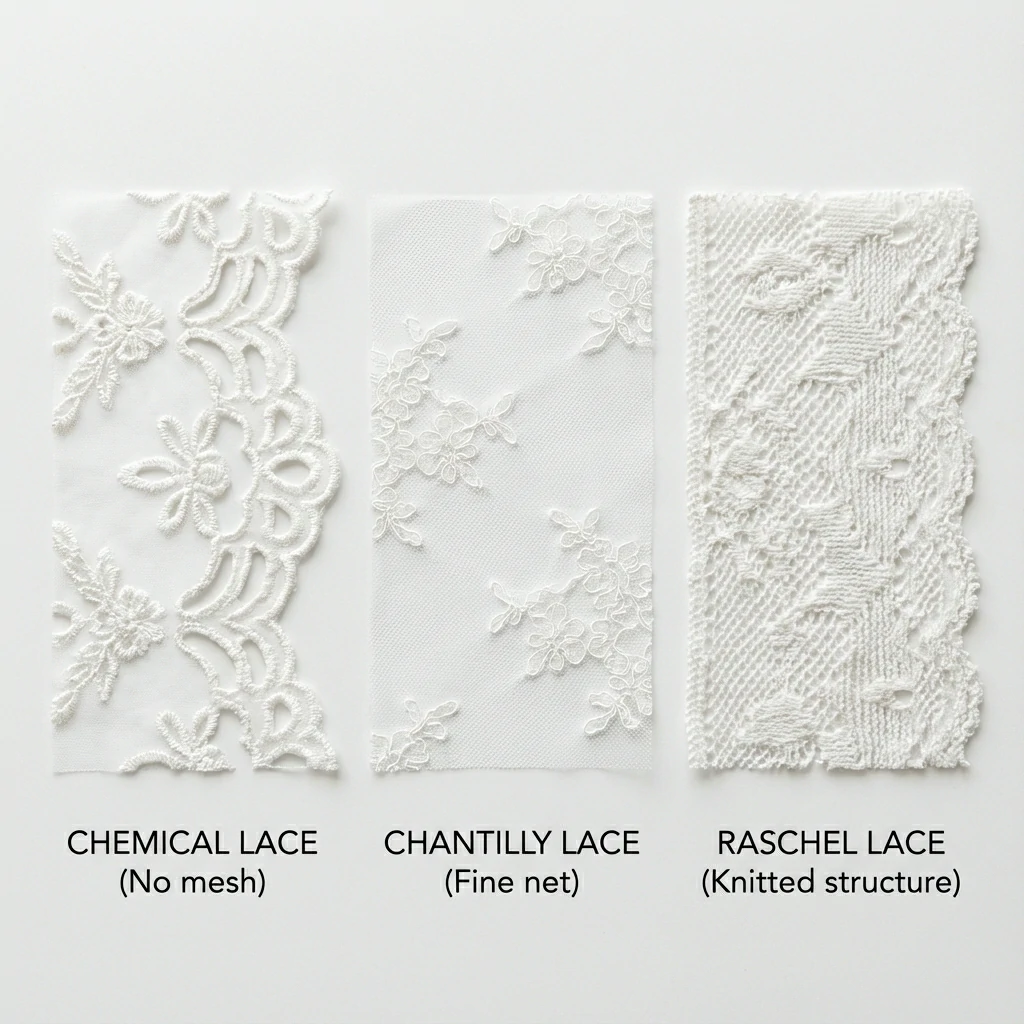
Chantilly lace has a fine mesh background with patterns outlined in heavier thread. You can see through it, but there’s always that delicate net behind the design.
Raschel lace is made on warp knitting machines. It’s stretchy, produced quickly, and much cheaper—but lacks the refined detail of chemical lace.
Embroidered lace features designs stitched onto a permanent base fabric like tulle or organza. The base stays; it doesn’t dissolve away.
| Feature | Chemical Lace | Chantilly | Raschel | Embroidered |
|---|---|---|---|---|
| Background | None | Fine mesh | Knitted net | Permanent fabric |
| Production | Schiffli + dissolve | Leavers machine | Warp knitting | Embroidery on base |
| Stretch | None | Minimal | Yes | Depends on base |
| Price range | $$-$$$ | $$$-$$$$ | $ | $$-$$$ |
| Detail level | High | Very high | Medium | High |
| Best for | Appliqués, statement pieces | Bridal, couture | Everyday lingerie | Overlays, panels |
Key Characteristics of Chemical Lace
When you’re examining chemical lace, look for these defining features.
No background fabric. This is the most obvious identifier. Hold it up to light—you should see clear openings between design elements, not sheer fabric.
Connected motifs. The pattern elements link together through thread bars or bridges. These connections are structural; without them, the design would fall apart.
Defined edges. Because there’s no background to cut, chemical lace often has clean, finished edges that don’t require additional hemming.
Dimensional texture. Quality chemical lace has raised areas where thread density creates depth. Run your finger across it and you’ll feel the pattern.
Cuttable motifs. Many chemical lace designs allow you to cut out individual motifs for use as appliqués. The lack of background fabric makes this possible without unraveling.
How Chemical Lace Is Made
The manufacturing process explains both the name and the cost. Here’s what happens in our factory from design to finished product.
Step 1: Design & Pattern Creation
Every chemical lace starts as a digital design. Our designers create the pattern in specialized software, mapping out exactly where each stitch will go.
The design phase is critical. Unlike regular embroidery where mistakes hide against a background, chemical lace exposes everything. Spacing between motifs, density of stitching, placement of connecting bars—all of this must be calculated precisely.
We typically produce samples before full production. A design that looks perfect on screen might have weak connection points or awkward spacing when actually produced.
Step 2: Embroidery on Water-Soluble Fabric
The base fabric is PVA—polyvinyl alcohol—a material that completely dissolves in hot water. It looks like thin, slightly stiff fabric with a plasticky feel.
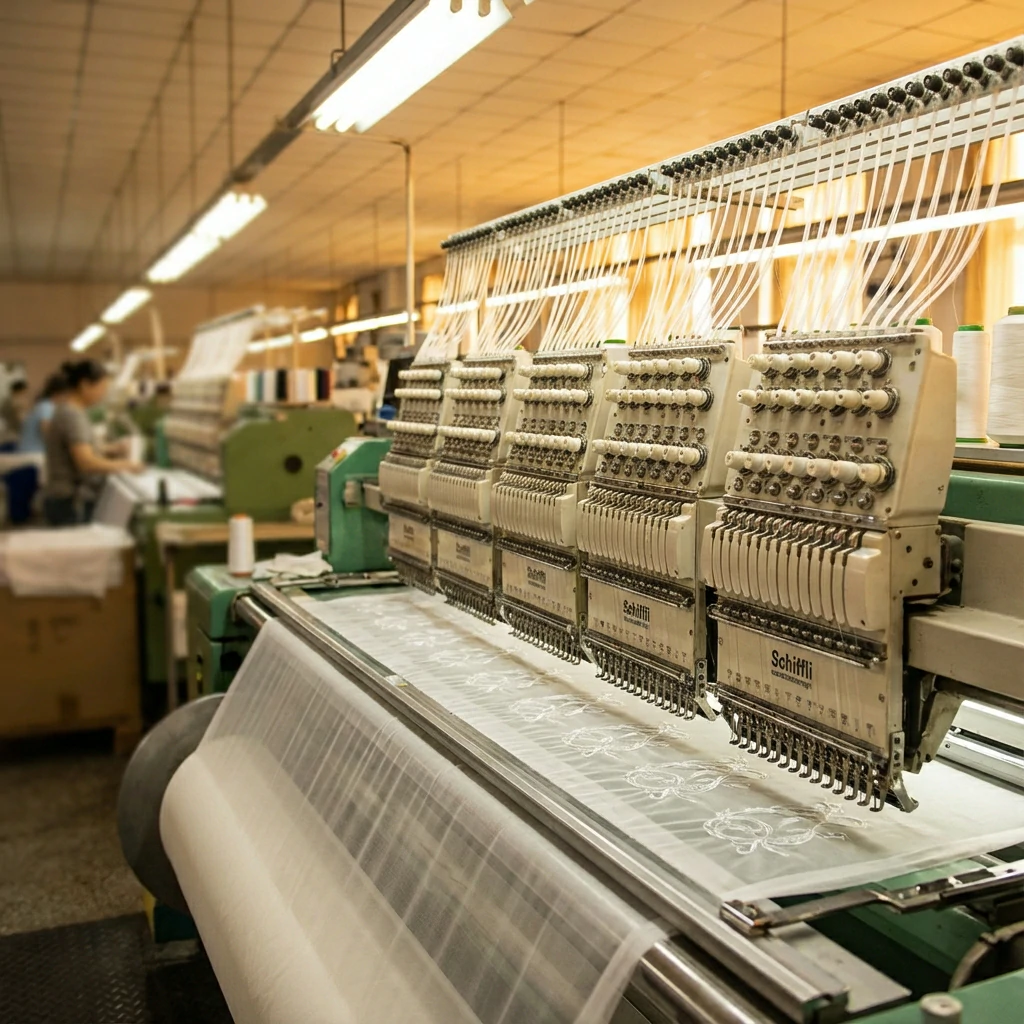
We stretch the PVA fabric onto large Schiffli machine frames. These machines can handle panels several meters wide, with hundreds of needles working simultaneously.
The embroidery process takes hours, sometimes days for complex designs. Each needle follows the programmed pattern, building up the design stitch by stitch on the temporary base.
Thread quality matters enormously here. Weak thread breaks during embroidery, causing defects. Poor-quality thread also doesn’t hold up during the dissolving process.
Step 3: Dissolving the Base Fabric
This is where “chemical lace” gets its name—though modern production usually just uses hot water.
We submerge the embroidered panels in heated water baths. The temperature must be precise: hot enough to dissolve the PVA completely, but not so hot that it damages the embroidery thread.
The PVA breaks down and washes away, leaving only the embroidered pattern behind. What was solid fabric becomes open lace.
Some manufacturers still use chemical solvents for certain specialty applications, but water-based dissolving dominates modern production. It’s cheaper, safer, and leaves less residue.
Step 4: Washing & Finishing
The lace emerges from the dissolving bath with residue that needs cleaning. We wash it multiple times to remove any remaining PVA traces.
After washing comes finishing. Depending on the end use, we might apply softeners for better drape, stiffeners for structure, or treatments for specific performance characteristics.
The lace is then dried carefully. Improper drying causes shrinkage, warping, or texture changes that ruin the final product.
Step 5: Quality Control
Every roll gets inspected before shipping. We check for broken threads, incomplete dissolving, pattern alignment issues, and consistent width.
Quality problems at this stage are expensive—the production time is already invested. This is why design validation and thread quality matter so much in earlier steps.
Defective sections get cut out. Minor flaws might be acceptable depending on the buyer’s standards, but obvious problems like holes or undissolved base fabric mean rejection.
Types of Chemical Lace
Chemical lace comes in several variations depending on design style and intended use.
Cord Lace
Cord lace features raised, rope-like outlines around the design motifs. The “cords” are created by dense satin stitching that builds up above the surface.
This type is extremely popular in African fashion, particularly Nigerian traditional wear. The dimensional texture catches light beautifully and photographs well.
Guipure Motifs
These are individual, separate design elements—flowers, leaves, geometric shapes—that can be cut apart and applied individually.
Bridal designers love guipure motifs for customization. They can place individual flowers exactly where they want them on a bodice or train.
Allover Chemical Lace
Continuous patterns that cover the entire fabric width without distinct separable motifs. The design flows as one piece.
This works well for panels, overlays, and applications where you need consistent coverage rather than individual appliqués.
| Type | Structure | Best Applications |
|---|---|---|
| Cord lace | Raised outlines | African fashion, statement pieces |
| Guipure motifs | Separable elements | Bridal appliqués, custom placement |
| Allover | Continuous pattern | Overlays, panels, full garments |
Common Uses of Chemical Lace
Chemical lace appears across multiple industries, though bridal and fashion dominate.
Bridal wear relies heavily on chemical lace for appliqués, bodice overlays, and train accents. The dimensional quality photographs beautifully, which matters enormously for wedding imagery.
Evening wear and couture use chemical lace to create statement pieces. The lack of background allows skin to show through, creating that peek-a-boo effect designers love.
African traditional clothing represents a massive market for cord lace specifically. Nigerian fashion alone drives significant global demand.
Home textiles use chemical lace for decorative accents—tablecloth edges, curtain trims, pillow embellishments.
How to Identify Quality Chemical Lace
Not all chemical lace is created equal. Here’s what separates premium from poor quality.
Check Thread Density
Quality chemical lace has consistent, dense stitching throughout. Thin areas where you can see through the stitching indicate corners cut during production.
Examine the Connections
The bars connecting motifs should be secure and evenly spaced. Weak connections break during handling or sewing, leaving you with pieces that fall apart.
Feel the Finish
Residue from incomplete dissolving leaves lace feeling stiff or sticky. Quality lace should feel clean and flexible, with no PVA traces.
Test Edge Stability
Pull gently at the edges. Quality lace holds together. Cheap lace unravels or shows loose threads immediately.
FAQs
What is chemical lace?
Chemical lace is embroidered lace with no background mesh or fabric. The pattern is stitched onto a water-soluble base that dissolves away during production, leaving only the embroidered design. Names like guipure, water soluble lace, and schiffli lace all refer to this same product.
How is chemical lace made?
The process involves embroidering a design onto PVA (water-soluble) fabric, then dissolving the base in hot water. What remains is the embroidered pattern with open spaces where the base fabric used to be. The lace is then washed, finished, and inspected before shipping.
Is chemical lace the same as guipure lace?
Yes. Guipure is simply the French name for chemical lace. The terms are interchangeable, though “guipure” tends to appear more in bridal and European markets, while “chemical lace” is more common in manufacturing and B2B contexts.
Why is chemical lace more expensive than regular lace?