
Dyeing lace trims at a factory level involves far more than dropping lace trim into a colored bath.While we partner with professional dyeing facilities, our role as lace manufacturers is to manage the entire process. This guide will walk you through exactly how we handle your custom-color lace order, from initial reference to final shipment.
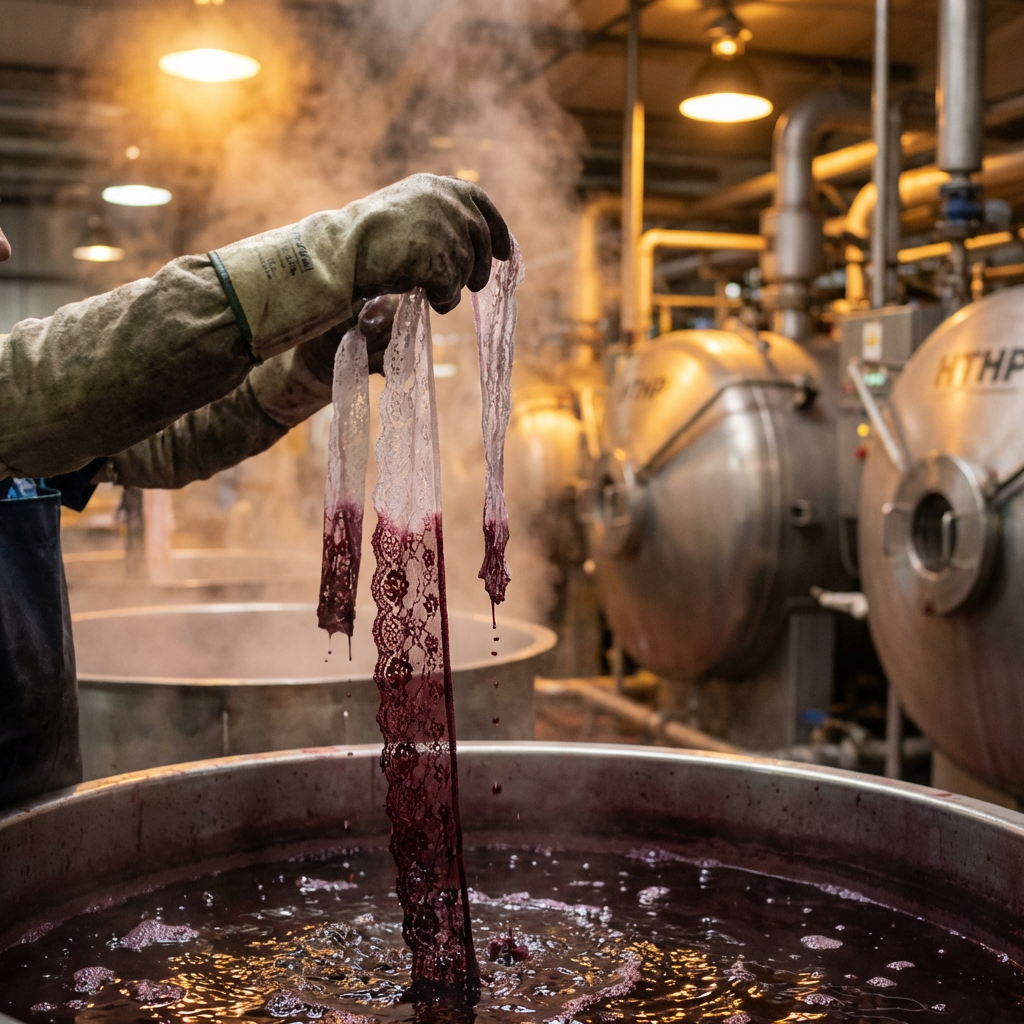
What Happens When You Place a Custom-Color Trim Order
Many customers assume dyeing lace trims is a simple final step. In reality, our role as a manufacturer is that of a technical coordinator.
We translate your mood board, Pantone reference, or fabric swatch into a technical brief. We then manage the sampling rounds, hold the dyehouse to international fastness standards, and ensure the bulk production matches the approved sample. This structured process ensures that the lace edging on a sleeve matches the body fabric of the garment under every lighting condition.
What We Need From You Before Dyeing Lace Trims
The information provided at the inquiry stage determines the dyeing method, timeline, and price. For garment accessories, where color consistency across different materials is vital, these details are non-negotiable.
Color Reference
An unambiguous color target is essential. A Pantone TPG or TCX number is the gold standard because it provides a universal digital reflectance value. If you provide a physical swatch, we require two pieces: one for the dyehouse to use as a master reference and one for our internal quality control. We strictly avoid digital images, as screen variance makes them impossible to use for chemical recipe formulation.
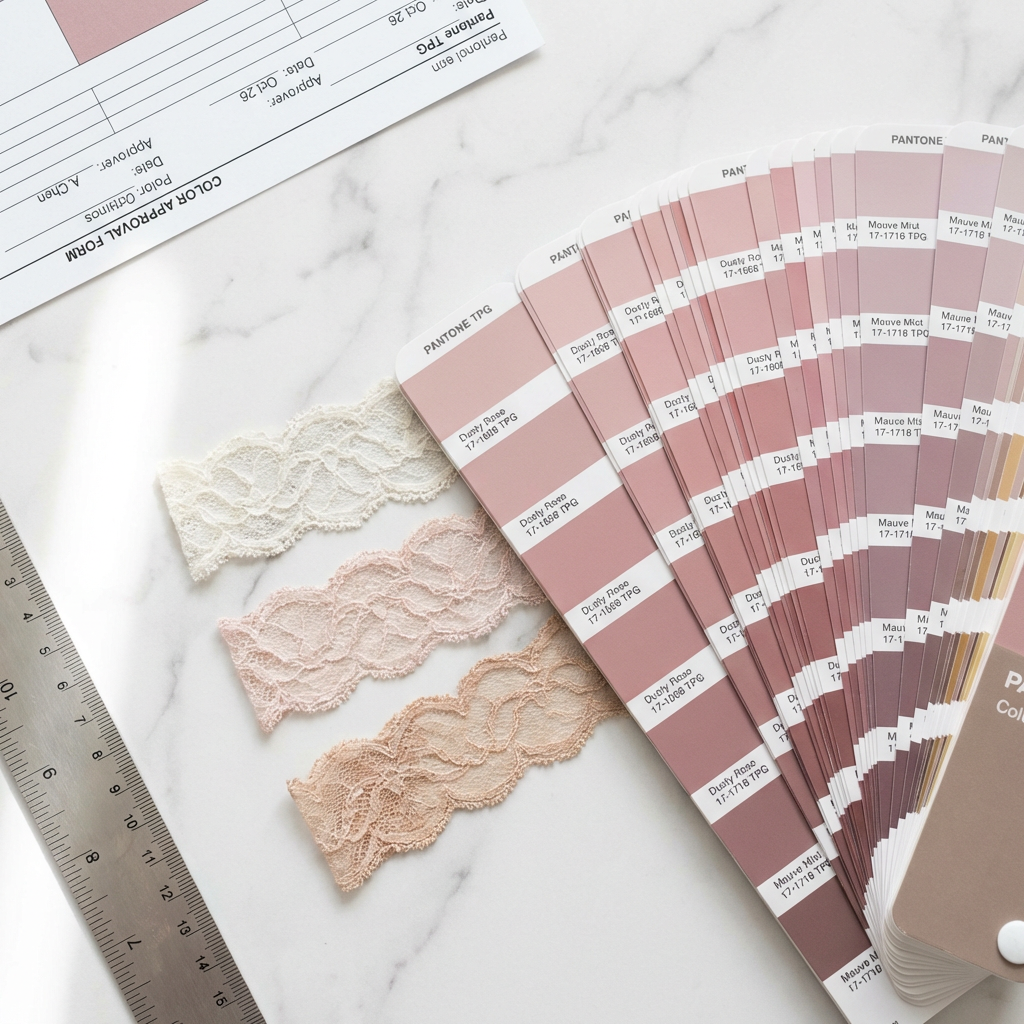
Fiber Composition
We must know the exact fiber content of the trim. Lace trims are often complex, containing a mix of nylon, cotton, polyester, and elastane (spandex). Each fiber reacts differently to heat and chemicals. A misidentified fiber leads to “patchy” dyeing or, worse, the total degradation of the trim’s elasticity.
Application and Washing Requirements
Will this trim be used on high-end lingerie that requires delicate hand-washing, or on industrial workwear that undergoes high-temperature laundering? Knowing the end-use allows us to select the correct fixing agents and additives to ensure the color stays locked in the fiber.
Methods for Dyeing Lace Trims
In the accessory world, the timing of the dyeing process defines the versatility and quality of the final trim.
Yarn Dyeing (Color Before Weaving)
In yarn dyeing, individual threads are colored before they are loaded onto the lace machines. This is the only method for creating multi-color patterns or “yarn-dyed” jacquard effects.
- Pros: Exceptional color depth and superior color fastness. Allows for intricate, multi-colored floral or geometric designs.
- Cons: Higher Minimum Order Quantities (MOQs) and longer lead times.
Piece Dyeing (Color After Weaving)
This is the most common method for dyeing lace trims used in fashion. We weave the lace in a “greige” (undyed) state and then dye the finished rolls of trim to the specific Pantone shade.
- Pros: Highly flexible. We can hold greige stock and dye small batches (low MOQs) with fast turnaround times.
- Cons: Limited to solid colors. The entire trim—ground and motif—will be the same shade.
Yarn Dyeing vs. Piece Dyeing — Which Method Fits Your Order?
Choosing between the two methods is one of the first decisions we make when reviewing a new order. The table below summarizes the key differences:
| Yarn Dyeing | Piece Dyeing | |
|---|---|---|
| Color capability | Multi-color patterns possible | Solid color only |
| Minimum order quantity | Higher | Lower |
| Lead time | Longer | Shorter |
| Color fastness | Superior | Good |
| Unit cost | Higher | Lower |
| Design flexibility | Fixed once yarn is dyed | Color can be selected close to delivery |
| Best for | Premium patterned lace, multicolor designs | Standard solid-color orders, small batches, fast turnaround |
Most custom-color orders are piece-dyed, suited for solid-color lace in specific Pantone shades used in trim, lingerie, or garments, especially for smaller batches and time-sensitive projects. Yarn-dyed options are preferred for multi-color patterns in premium or branded lines, where color contrast is key.
There is no single best method — the right approach depends on your design needs and order requirements.

Achieving Color Precision: The Light Box Standard
In the factory, we test the trim against the master swatch under multiple specific light sources:
- D65 (Artificial Daylight): The international standard for average North Sky Daylight. This is our primary reference point.
- TL84 / U30 (Store Light): Simulates the fluorescent lighting found in major retail stores (European and US standards).
- CWF (Cool White Fluorescent): Standard office lighting used primarily in the US.
- Inca (Incandescent / Tungsten): Simulates warm home lighting.
If the lace trim matches the swatch in D65 but shifts significantly in TL84, we call this metamerism. In such cases, the dyehouse must adjust the chemical recipe to ensure a “stable” match across all light sources.

How Material Choice Affects the Dyeing Chemistry
Different fibers require different chemical “keys” to open the fiber structure and accept the dye.
Cotton Trim
Cotton uses reactive dyes in an alkaline bath (usually involving soda ash). The dye forms a covalent bond with the cellulose, making it part of the fiber itself.
- Key Additives: Softeners are often added to the final rinse to maintain the “hand-feel” of the cotton after the alkaline process.
Polyester Trim
Polyester is non-porous and requires disperse dyes. The dye bath must be heated to 130°C in a High-Temperature High-Pressure (HTHP) vessel. Without this pressure, the dye cannot penetrate the synthetic fiber.
Nylon Trim
Nylon is highly receptive to acid dyes. It provides the most vibrant color saturation of all fibers, which is why it is the standard for neon and high-saturation fashion trims.
The Challenge: Poly-Cotton and Mixed Fiber Trims
Many modern trims are “CVC” or “TC” (Poly-Cotton blends). These require a Two-Bath Process. We first dye the polyester at 130°C, perform a chemical “reduction clear” to strip excess dye, and then dye the cotton in a separate cycle at 60°C. This process is more expensive and takes longer, but it is the only way to achieve a uniform color on a blended trim.
Durability and Fastness: Protecting the Color
A common concern for garment manufacturers is color fading or bleeding (staining other parts of the garment). To prevent this, we follow international Color Fastness Grades (typically Level 3.5 to 4.5).
Preventing Fading and Staining
To ensure the color remains stable through multiple washes, we use specialized Fixing Agents (often referred to as “fixing powders” or liquids in the factory). These chemicals act as a molecular sealant, locking the dye molecules inside the fiber.
We test for three main types of fastness:
- Wash Fastness: Ensuring the dye doesn’t leach into the water during a 40°C or 60°C cycle.
- Crocking (Rubbing Fastness): Ensuring the color doesn’t transfer to other fabrics when rubbed — critical for trims used on white garments.
- Light Fastness: Ensuring the color doesn’t fade when exposed to UV light (crucial for outdoor wear or window-side retail displays).
Anti-Phenolic Yellowing
For white or very pale trims, we often add Anti-Yellowing agents. This prevents the trim from turning yellow when stored in polybags, a common chemical reaction between the lace and the BHT (Butylated Hydroxytoluene) found in plastic packaging.
Our Quality Control & Delivery Process
We follow these rigorous steps to ensure the lace trim you receive has consistent quality and meets your requirements.
| Phase | Key Actions |
|---|---|
| 1. Pre-Production Color Confirmation | • We create lab dips for your approval. • Colors are checked under multiple standard light sources to prevent metamerism (color shifting). • A pre-production sample is provided for final confirmation before bulk production. |
| 2. In-Production Monitoring | • We manage dye lots closely to monitor color consistency. |
| 3. Finishing & Setting | • The lace is heat-set to achieve its final, precise width and hand-feel. • This ensures dimensional stability and prevents shrinkage or warping during sewing. |
| 4. Final Inspection & Packaging | • A final quality check is performed on the finished product, covering color, width, and appearance. • Finally, they are properly packaged and prepared for shipment. |
FAQs
Why does the same color look different on cotton vs. polyester?
Different fibers reflect light differently. Cotton’s matte surface absorbs light, while polyester’s sheen makes the same color appear brighter or deeper.
How to prevent color bleeding?
To prevent color bleeding, a high Color Fastness Grade must be specified. This ensures the dyeing process includes special treatments to lock in color and wash out any loose dye.
What is a “Lab Dip”?
It’s a small dyed sample of your trim, created for you to approve the color before we start full production.
Can you add special functional finishes?
Yes. Functional treatments for flame retardancy, anti-bacterial properties, or extra softness can be added during the final stages of the dyeing process.
Why does poly-cotton lace cost more to dye?
It requires a two-step process, as polyester and cotton need different dyes. This doubles the time, energy, and resources, which increases the cost.
Can you dye to a specific Pantone color?
Yes. A Pantone number provides a precise reference for color matching, and a lab dip is always created for approval before starting bulk production.
Summary for Designers
When ordering dyed lace trims, remember: Composition + Color Standard + Light Source = Success. By providing clear fiber details and using a light box for approval, you ensure that your garment accessories meet the highest professional standards.