
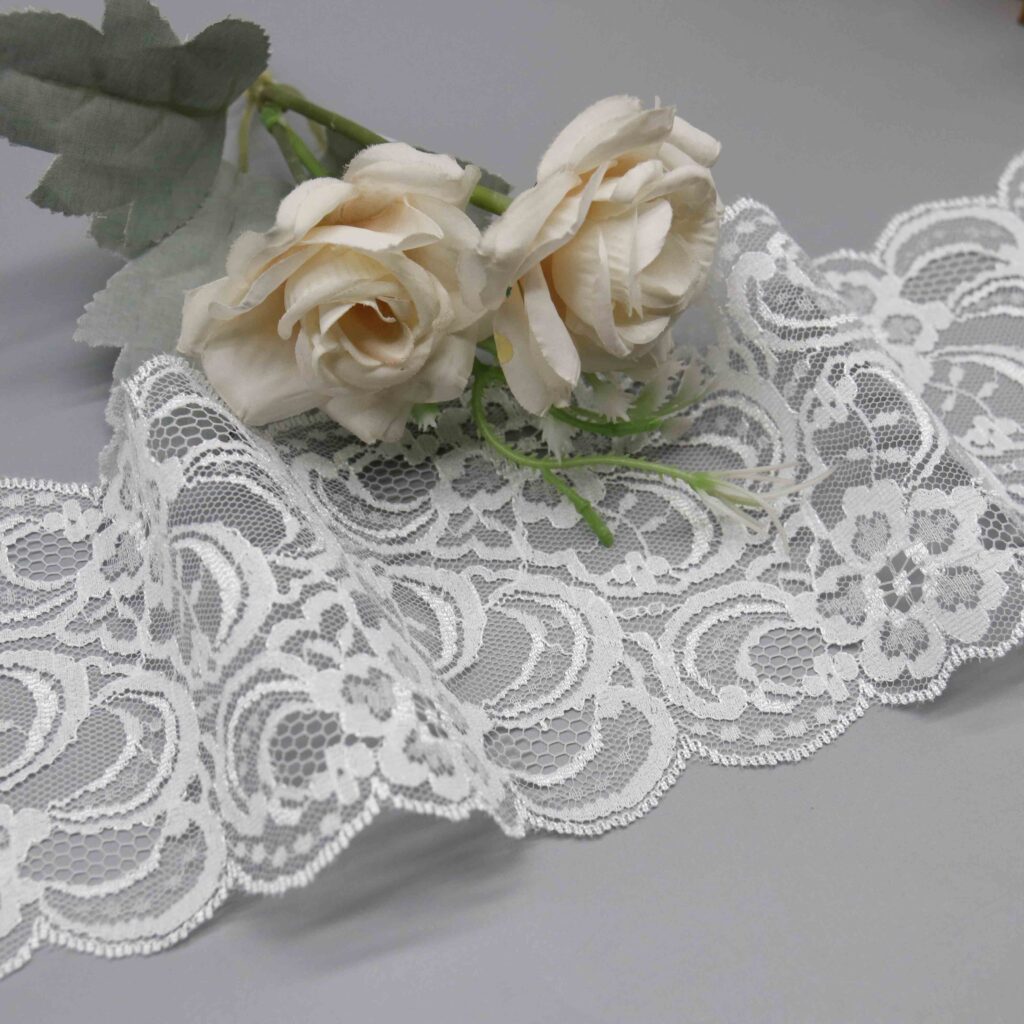
The lingerie trim market offers three main material categories: pure cotton, pure synthetic, and blended constructions. Each serves different applications. Matching material properties to specific use cases separates successful product lines from those plagued by quality complaints.
Understanding Lace Trim Materials
Material selection begins with understanding what each composition offers—and where it falls short.
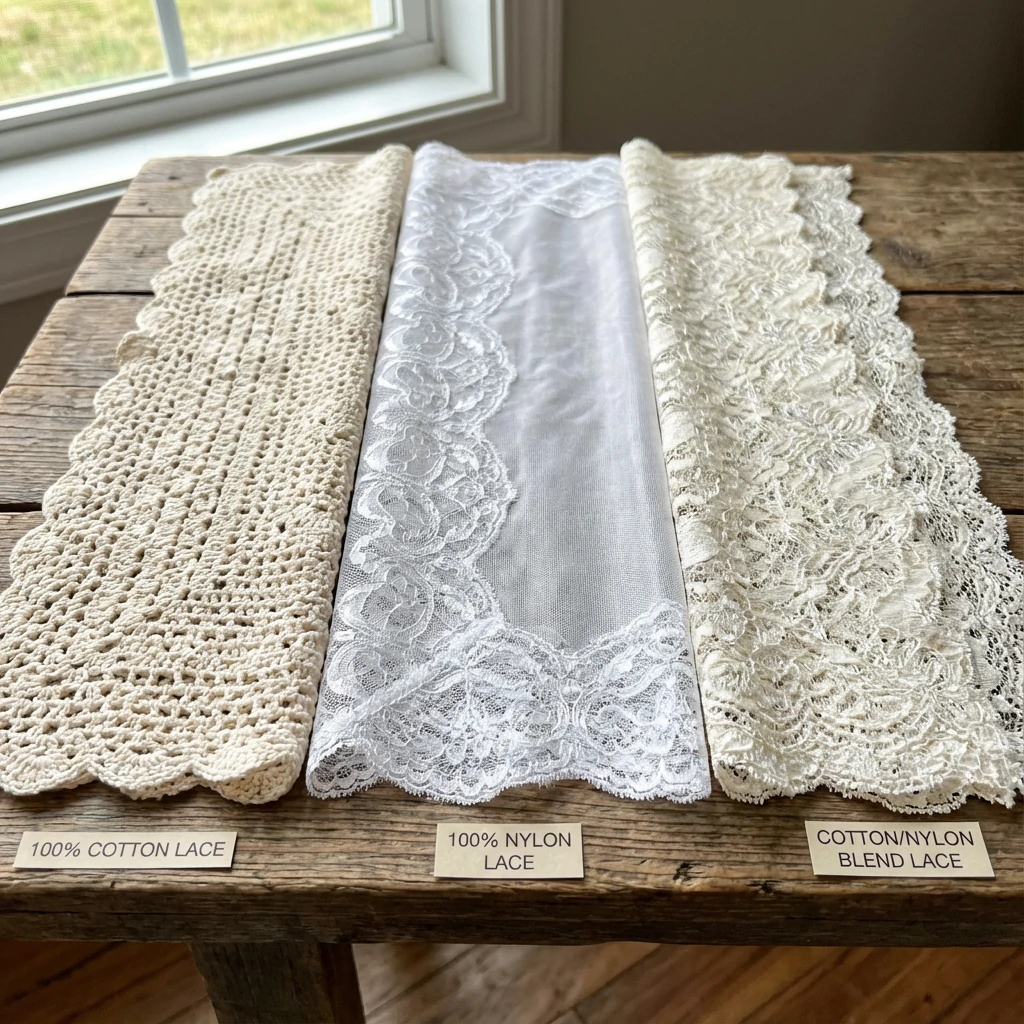
Pure Cotton Lace
Cotton lace delivers natural softness and breathability. The material has a long history in intimate apparel for good reason: it feels comfortable against skin and absorbs moisture effectively.
Suitable applications:
Decorative overlays with minimal stretch requirements
Heritage or vintage-inspired collections
Low-stress trim positions away from high-friction areas
Limitations: Cotton lacks elasticity. The fibers stretch under tension and fail to recover original dimensions. Repeated washing accelerates this degradation. For any application requiring consistent fit—waistbands, leg openings, bra bands—pure cotton creates durability issues.
Pure Nylon or Polyester Lace
Synthetic laces dominate volume production. The economics are favorable: lower material costs, consistent supply, predictable performance metrics.
Suitable applications:
Budget-tier product lines prioritizing cost efficiency
Outerwear trim where direct skin contact is limited
High-volume manufacturing requiring material consistency
Limitations: Synthetic fibers lack breathability. Extended skin contact can cause discomfort, particularly in warm conditions. Consumer perception also plays a role—synthetics often register as “cheap” even when technically well-constructed.
Blended Construction: Nylon Mesh with Cotton Embroidery
Blended materials address the limitations of single-fiber compositions. The most effective configuration pairs a nylon mesh base with cotton thread embroidery.
How it works: The nylon mesh provides structural integrity—stretch, recovery, dimensional stability. The cotton embroidery forms the skin-contact surface, delivering the comfort properties associated with natural fibers.
Suitable applications:
Direct skin contact positions (bra edges, waistbands, leg openings)
Mid-market to premium product positioning
Applications requiring both stretch performance and comfort
Trade-off: Higher material cost compared to pure synthetic. The value proposition depends on target market positioning and acceptable return rates.
Brand effect:Yituo is an expert in this field. It has passed GRS, BCI, OTEX and other certifications. Its daily production capacity reaches 300,000 meters. It can quickly prototype in 1-3 days and has a very high price advantage.
Material Selection by Application
Different garment areas impose different performance requirements. Systematic material matching reduces quality issues.

Bra Components
Bras present three distinct trim applications:
Cup edges: Visible design element with moderate functional requirements. Scalloped edges create finished appearance without additional hemming. Both cotton and blended materials perform adequately; selection depends on price point strategy.
Center gore: Small area with high visual impact. Decorative patterns add perceived value. Material choice is secondary to design execution.
Band edges: High-priority comfort zone. The band contacts the ribcage throughout wear. Synthetic-only trim in this position generates discomfort complaints. Blended materials with cotton embroidery surface significantly outperform pure synthetic options.
Underwear Components
Waistbands: Elastic lace has largely replaced traditional elastic in mid-range and premium segments. The stretch requirement eliminates pure cotton as an option. Blended elastic lace with cotton surface represents the industry standard for this application.
Leg openings: Performance requirements mirror waistbands—stretch, recovery, and comfortable skin contact. Narrow widths (1-2 cm) reduce bulk while maintaining design impact.
Back panels: Primarily decorative function. Pattern and width selection matters more than material composition, though skin comfort remains relevant.
Sleepwear and Loungewear
Extended wear duration increases comfort sensitivity.
Necklines: High-visibility position with frequent skin contact. Wide lace trim (4-6 cm) creates product differentiation. Cotton embroidery surfaces excel in this application.
Hem finishing: Adds visual weight and drape. Scalloped edges photograph well and communicate quality.
Strap details: Narrow lace overlays or edge treatments provide low-cost product differentiation.
Selection Factors Beyond Material
Material composition forms the foundation. Additional variables affect final product performance.
Elasticity Classification
Stretch lace: Required for waistbands, leg openings, and bra bands. Quality differentiation occurs in recovery performance—inferior products stretch but fail to return to original dimensions. Test recovery by extending samples and observing snap-back speed.
Non-stretch lace: Appropriate for decorative applications, overlays, and positions where dimensional stability matters more than flexibility.
Edge Configuration
Scalloped edges: Industry standard for visible trim applications. Creates finished appearance, photographs effectively, eliminates secondary hemming operations.
Straight edges: Limited to applications where trim will be concealed or folded under other layers.
Width Specifications
| Application | Recommended Width | Rationale |
|---|---|---|
| Bra cup edges | 1-2 cm | Minimizes bulk, maintains proportion |
| Underwear waistbands | 2-4 cm | Balances visibility and function |
| Camisole necklines | 4-6 cm | Creates statement design element |
| Decorative panels | 6+ cm | Positions lace as primary design feature |
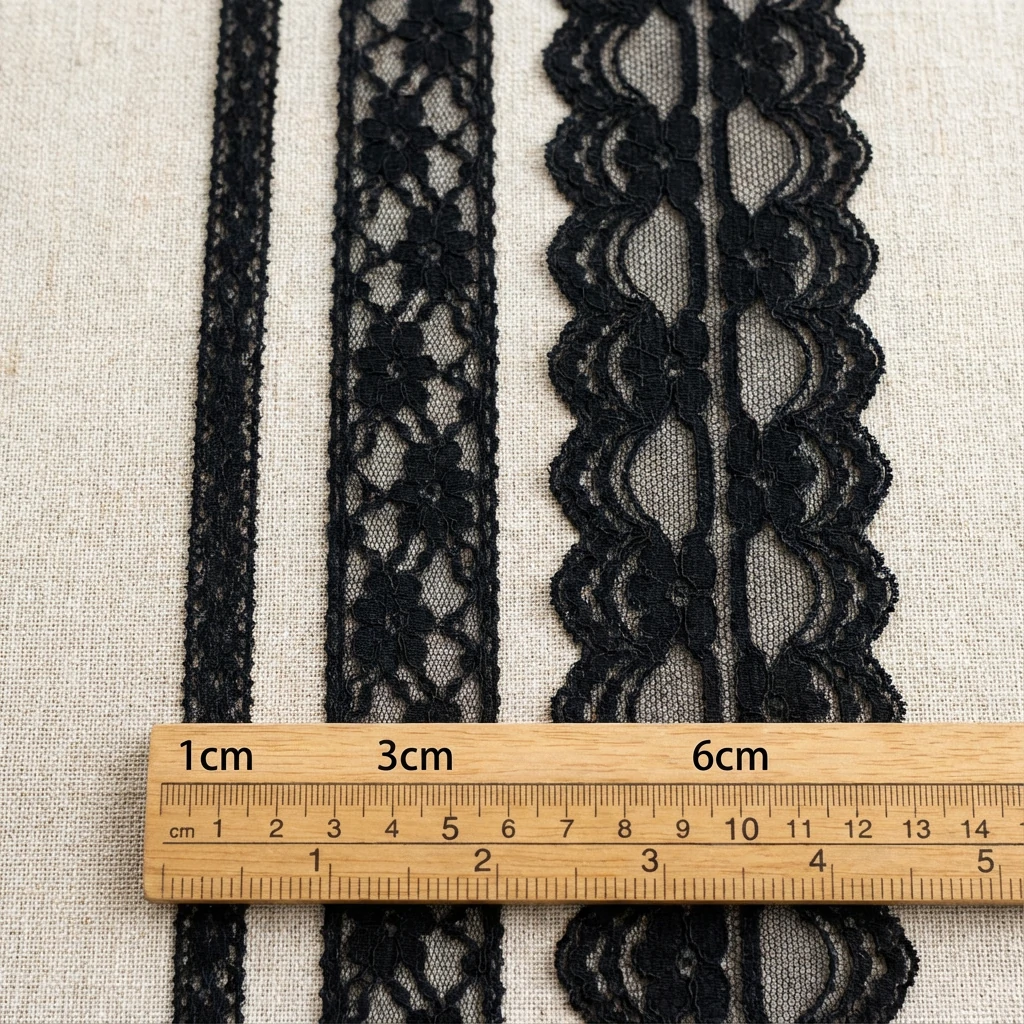
Width directly affects cost per meter. Sample multiple widths before production commitment.
Sourcing Framework
Effective sourcing extends beyond material selection to quality verification and supply chain management.
Pre-Order Evaluation
Physical sample assessment: Digital images fail to communicate texture, hand-feel, and construction quality. Request physical samples before specification finalization.
Stretch and recovery testing: Extend elastic samples to working stretch range and release. Quality materials return to original dimensions immediately. Slow recovery indicates premature stretch-out in use.
Reverse-side inspection: Some lace constructions present acceptable face appearance with rough or irregular backing. For skin-contact applications, both sides require evaluation.
Durability Verification
Wash cycle testing: Supplier durability claims require independent verification. Subject samples to target market wash conditions (machine wash, tumble dry where applicable). Document shrinkage, color change, and edge integrity.
Multiple cycle exposure: Single wash tests provide insufficient data. Five to ten cycles minimum reveal degradation patterns invisible in initial testing.
Color Performance
Light color stability: Test nude and white samples against light fabrics. Dye transfer becomes immediately apparent and generates customer complaints.
Dark color retention: Evaluate black and dark samples for fade resistance. Inferior dyes wash out progressively, creating premature aging appearance.
Supply Chain Considerations
Standard versus custom colors: Standard colorways (black, white, nude range) typically carry lower minimum order quantities. Custom colors require dye lot minimums and extended lead times.
Production sample verification: Confirm production specifications match approved samples. Request pre-production samples from actual production runs when possible.
FAQs
What lace material works best for bra band edges?
Blended construction with nylon mesh base and cotton embroidery surface. The nylon provides stretch and recovery; the cotton delivers skin comfort. Pure synthetic trim in this position generates discomfort complaints.
Can cotton lace be used for underwear waistbands?
Not recommended. Cotton lacks the elasticity waistbands require. The material stretches under tension but fails to recover, resulting in loose fit after minimal wear.
How should lace quality be evaluated before bulk ordering?
Request physical samples, test stretch recovery, wash through multiple cycles, and inspect both face and reverse surfaces. Most quality issues manifest after five to ten wash cycles.
What width specifications apply to different lingerie applications?
Bra edges: 1-2 cm. Waistbands: 2-4 cm. Necklines: 4-6 cm. Decorative panels: 6+ cm. Sample multiple widths—visual appearance in photographs differs from physical assessment.
Does elastic lace cost more than non-stretch alternatives?
Generally yes. Elastic construction adds material and processing costs. However, non-stretch lace cannot substitute in applications requiring stretch performance regardless of price differential.
Summary
Lace trim material selection determines product performance outcomes. Pure cotton serves decorative, low-stress applications. Pure synthetic addresses cost-driven requirements. Blended constructions—particularly nylon mesh with cotton embroidery—deliver the performance profile most intimate apparel applications demand.
Systematic sourcing—physical samples, durability testing, production verification—prevents quality issues that damage brand reputation and generate returns. The investment in pre-production evaluation consistently returns value through reduced quality incidents.