Every maker knows the frustration of rigid lace puckering at curves and digging into the skin instead of moving with the body. Stretch lace completely resolves this by engineering elastane directly into the openwork structure, perfectly balancing beauty with recovery. In sourcing, French floral lace and the scalloped lace edge dominate the conversation—one is built to cover, the other to frame, and understanding this difference is key to putting the right material on the right garment.
This guide breaks down what stretch lace actually is, how French floral lace and scalloped lace edge differ in construction and intent, and how the same elastic base transforms each garment type — from stretch lace lingerie to a stretch lace wedding gown to everyday wear.
What Is Stretch Lace?
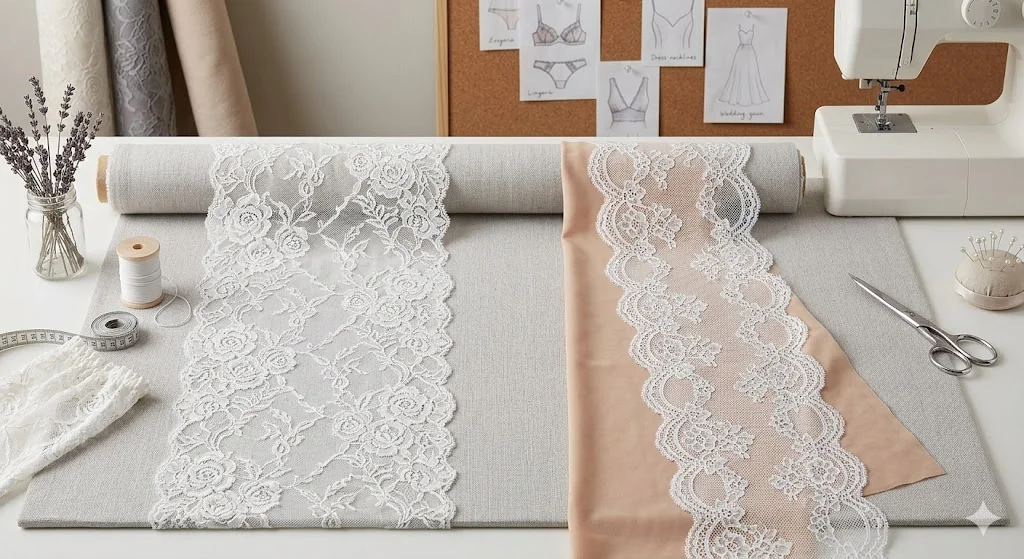
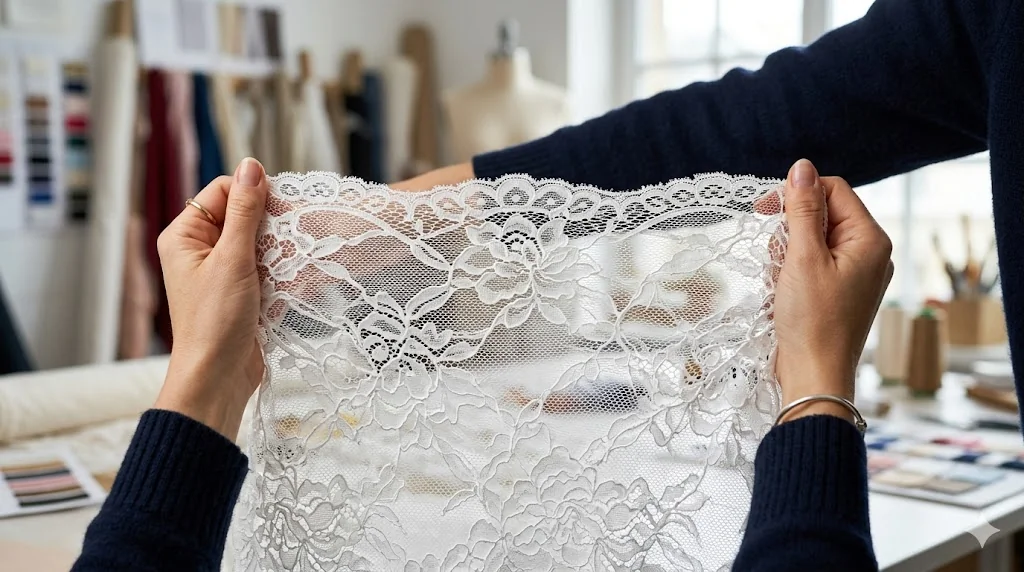
Stretch lace is an openwork lace in which elastane (commonly known as spandex) is knitted directly into the lace structure, rather than relying on a stretch backing or a bias cut for its give. The decorative motif and the recovery live in the same fabric. When you pull it, the lace lengthens; when you release it, the pattern returns to shape without warping or distorting the motif.
That distinction matters more than it first sounds. Traditional lace borrows its stretch from how it is cut or what it is fused to, which means the lace itself fights the body. A true elastic lace works with the body, recovering to its original dimensions after repeated wear and laundering. It is this behavior — soft hand, high recovery, openwork breathability — that lets a single fabric serve close-to-body categories that rigid lace could never handle comfortably.
French Floral Lace vs. Scalloped Lace Edge
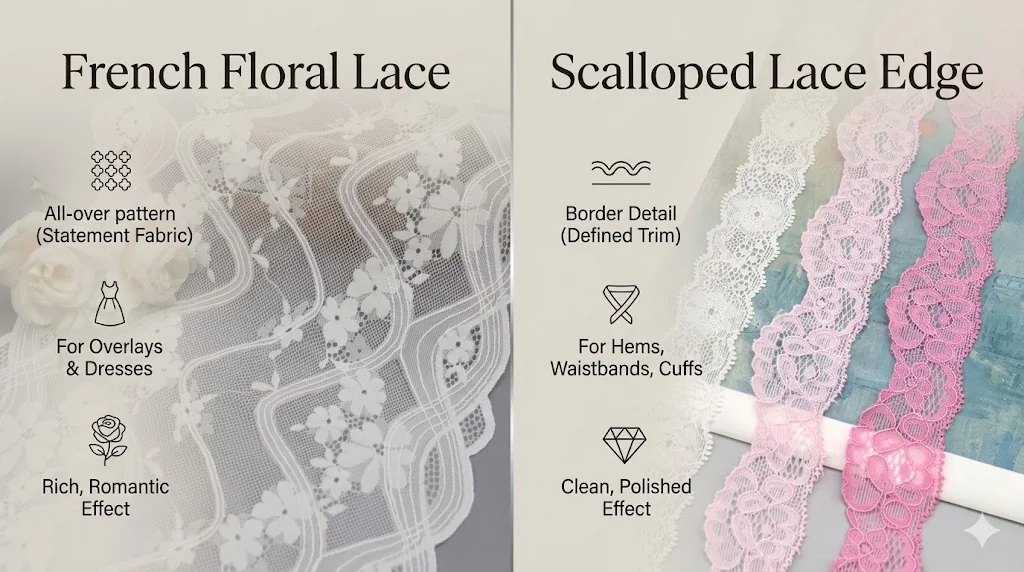
Both styles can be built on the same elastic base, but they are designed to do opposite jobs. French floral lace spreads its beauty across the whole surface; the scalloped lace edge concentrates it along a single finished border. The comparison below is the fastest way to see where each belongs.
| Property | French Floral Lace | Scalloped Lace Edge |
|---|---|---|
| Where the detail lives | All-over, edge to edge | Along one finished, wave-like border |
| Primary role | The statement fabric itself | A defined trim or hem |
| Best on | Overlays, full-coverage cups, dresses | Leg openings, waistbands, cuffs, necklines |
| Finishing need | Often needs edge binding | Self-hemming — no extra binding |
| Visual effect | Rich, layered, romantic | Clean, framed, polished |
French Floral Lace
French floral lace is defined by intricate, all-over botanical motifs — roses, vines, scrolling petals — rendered across the full width of the fabric. When this design is engineered as a floral stretch lace fabric, the florals stop being a flat decoration and become a second skin: the pattern wraps around curves smoothly without the motifs warping or the openwork gaping at stress points.
Because the decorative interest covers the entire surface, this floral fabric is at its best when the lace is the garment, not an accent on it. It carries full-coverage stretch lace bras and bralettes where you want detail everywhere, a flowing lace stretch dress or camisole that needs an elegant all-over texture, and overlay panels on a stretch lace bodysuit or gown where the lace sits directly over skin or a base layer. The stretch is what makes this possible — an all-over rigid floral would bind and pucker the moment the wearer moved.
Scalloped Lace Edge
A scalloped lace edge tells the opposite story. Instead of covering the surface, all the decorative interest is concentrated along a finished, wave-like border. That scalloped border is self-hemming — it gives you a clean, decorative edge without any additional binding or folding, which removes a sewing step and produces a crisp, professional trim line.
As a stretch trim lace, the scalloped edge earns its place wherever a garment needs both a defined border and the ability to flex. A length of stretch elastic lace trim finishes a stretch lace boyshort or waistband so it stretches over the body and still lies flat. It frames the cuffs, hemline, or neckline of a stretch lace top with a single refined detail. And it adds contrast as a layering accent on otherwise plain fabrics. The eye is drawn to one deliberate border rather than an all-over pattern — definition instead of immersion.
How Stretch Lace Transforms Each Garment Type
The real decision is never "floral or scalloped" in the abstract — it is matching the lace style to what the garment has to do. The recovery and comfort of the elastic base is what unlocks every one of these use cases.
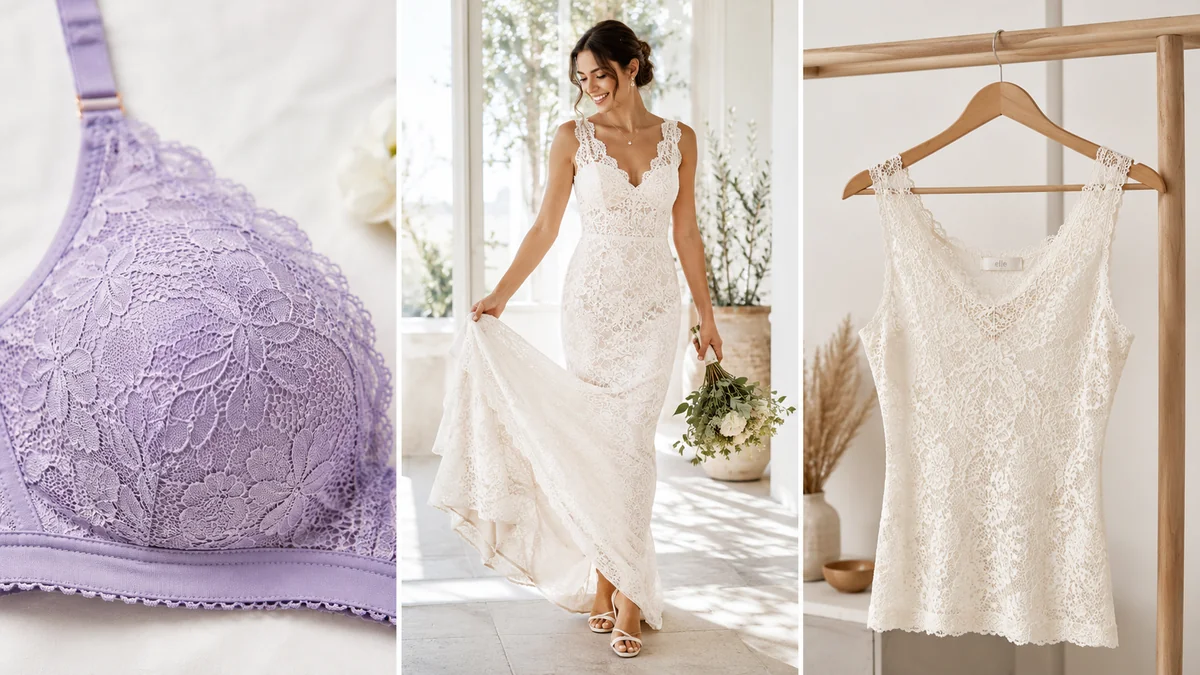
Lingerie and shapewear. This is where the material matters most, because the trim sits directly against skin and must move through every position. French floral works as a full-coverage cup or all-over bralette, the foundation of most stretch lace lingerie; the scalloped edge finishes the leg openings of a stretch lace boyshort and waistbands so they flex without digging in. Rigid lace fails here within a few wash cycles.
Bridal and eveningwear. The 2026 direction is lighter, more movable bridal. A single-layer floral overlay turns a heavy dress into a graceful stretch lace wedding gown that lets a bride sit, dance, and move comfortably. A scalloped edge finishes a hem or neckline with a couture border that still gives.
Loungewear and everyday upgrades. Inserted at a neckline, sleeve cuff, or hemline, a strip of scalloped trim turns a basic chiffon or jersey piece — or a simple stretch lace top — into an elevated staple. Because the trim itself stretches, sewing tolerances loosen, which makes it forgiving for small-batch makers and home sewers alike.
The throughline is simple: French floral builds all-over romance, the scalloped edge defines a crisp border, but both only reach their potential when they are built on a proper elastic base. Flexibility is what carries the beauty through real wear.
summarize
French floral lace and the scalloped lace edge serve genuinely different design goals — one immerses, the other frames. But the material that transforms either of them from a pretty flat trim into a garment that performs is the same. Whether it becomes stretch lace lingerie, a stretch lace wedding gown, or an everyday stretch lace top, choose the style for the look you want and the elastic base for the way it has to move — and the garment does both.
FAQs
French floral lace or scalloped lace edge — which should I choose? Decide by role. If you want the lace to be the garment — a floral stretch lace fabric for a dress or overlay — choose all-over French floral. If you want a clean, finished border on an otherwise plain piece, choose a scalloped lace edge. On any fitted, close-to-body garment, make sure whichever you pick is a stretch lace.
Does a scalloped lace edge really skip the need for binding? Yes. The scalloped border is a finished, self-hemming edge, so stretch elastic lace trim can be sewn straight onto a leg opening, cuff, or hem without folding or binding — which is why it speeds up production.
Is stretch lace always better than rigid lace? Not always. For structural outerwear or framed decorative panels, rigid lace can be fine. But for any garment that has to move with the body — stretch lace bras, swimwear, a fitted lace stretch dress — the elastic version is the smarter choice because it recovers its shape and won't pucker or chafe.
Can French floral lace be used as an overlay on a bodysuit? That is one of its strongest uses. A floral overlay over a stretch lace bodysuit adds depth and texture without adding bulk, and because it stretches with the base, the floral motif stays undistorted across the curves.
Will stretch lace lose its shape after washing?


 WhatsApp Us