
Introduction
Most kids' trim compliance files I get sent open with ASTM F963 and EN 71-3. Both are toy standards by their own scope text — F963 covers toys intended for children's use, EN 71 covers toys as defined by Directive 2009/48/EC. Neither reaches a lace tape sewn onto a dress. A file built on them looks thorough and still misses the requirements that actually attach to the order.
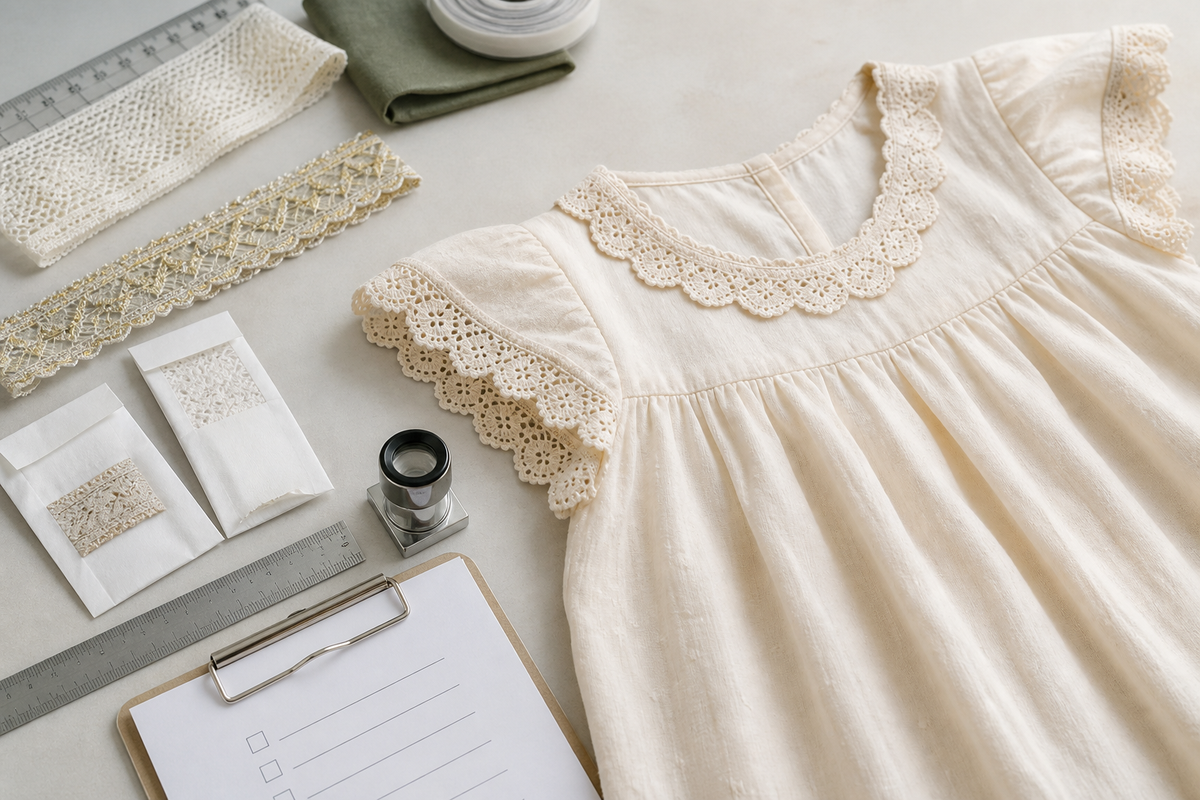
Separate three things before judging any trim: the material, the construction, and where it sits on the body. A plain cotton lace and a lurex version of the identical pattern carry different obligations. The same tape is judged differently at a neckline seam than as a bonnet tie. Get those three sorted and the requirement list writes itself.
Which standards follow the trim and which follow the finished garment
Requirements attach at three levels, and confusing them is what produces both over-testing and gaps. Garment category rules follow the finished product — flammability under 16 CFR 1610, and the separate sleepwear regime in 1615 and 1616. Material rules follow the fibre and any coating, wherever it ends up. Placement rules depend on how the trim functions in the assembled garment.
Garment category is where most files go wrong first. CPSC treats infant garments, tight-fitting sleepwear and loose-fitting sleepwear as distinct classifications. 16 CFR 1615.1(c) defines infant garments; the 6 mm (1/4 inch) trim protrusion condition sits in 1615.1(o)(2), with the parallel sizes 7-14 provision at 1616.2(m)(2). That 6 mm figure gets quoted as a general childrenswear rule constantly. It is a condition for qualifying a garment as tight-fitting sleepwear, nothing more.
Phthalate requirements need an end-use assessment. The CPSIA restriction applies to covered children's toys and child care articles; CPSC identifies children's sleepwear and bibs among its child care examples. Ordinary wearing apparel is not automatically in the same category. Specify the intended use, age group and relevant components before deciding which phthalate requirements and testing provisions belong in the lace RFQ.
Requirement family | What triggers it | Named clause or method | Line on the trim spec |
|---|---|---|---|
Lead content | Metallic, coated or plasticized components | 16 CFR 1500.91 determination; total lead testing for components outside it | State fibre content and declare whether any metallic or coated yarn is present |
Azo dyes | Direct and prolonged skin or oral contact | REACH Annex XVII entry 43, 30 mg/kg release limit for listed aromatic amines | Require an aromatic amine release report per dye lot |
Skin-contact chemistry | Contact with children up to age 3 | OEKO-TEX Standard 100 Product Class I, including colorfastness to saliva | Name the product class, not the scheme |
Cords and ties | Lace functioning as a tie, casing or drawstring | EN 14682:2014; 16 CFR 1120 for US upper outerwear | Declare functional or decorative use, with finished cord length |
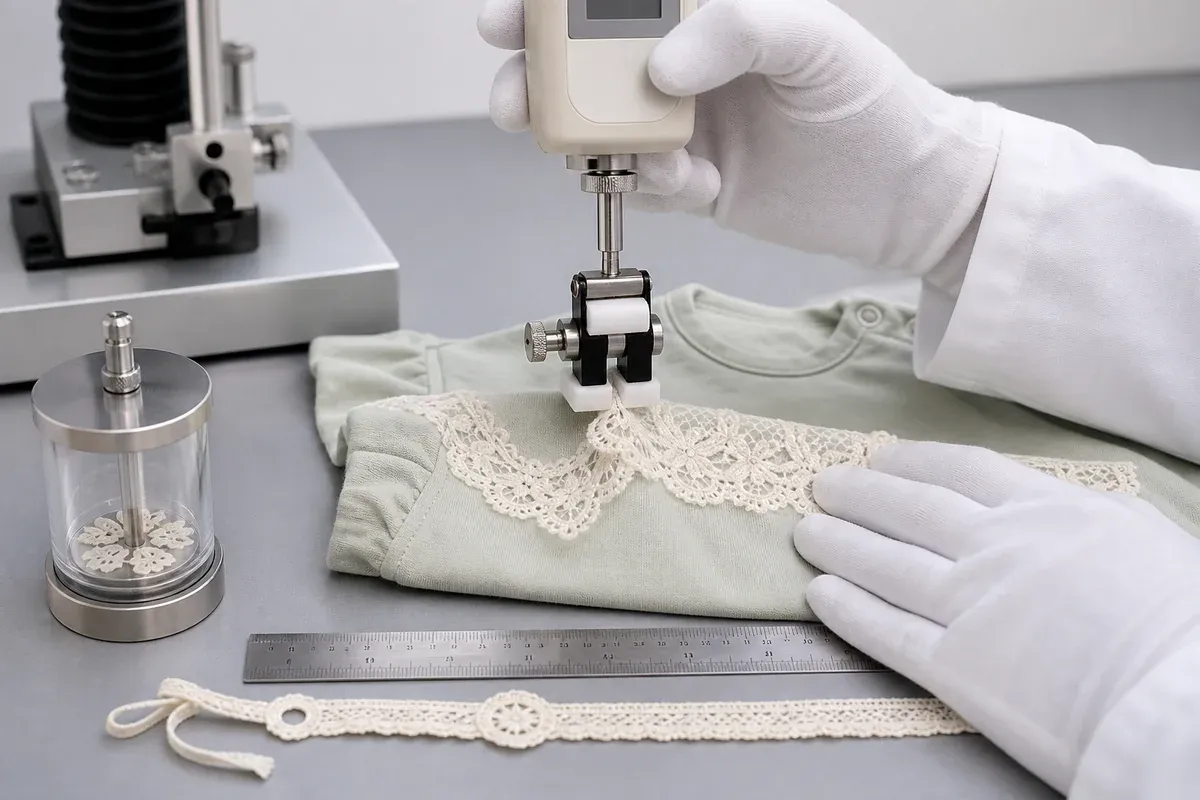
Attachment integrity | Any applied element on a garment for under-3s | 16 CFR 1500.51-1500.53 use and abuse, then 1501.4 small parts cylinder | Prohibit detachable elements by construction |
Dimensional stability | Trim sewn to a body fabric that will be home laundered | Wash testing on the body fabric's own care cycle | Shrinkage matched to the body fabric, with the tolerance stated |
The chemical file is the shorter one
Plain cotton lace does not need a lead test. CPSC has already determined that plain dyed or undyed textiles and non-metallic threads do not exceed the 100 ppm limit, under 16 CFR 1500.91. The determination is material-specific, not garment-specific — cotton stays under it, gold thread does not. So the lead exposure on a lace trim sits in the lurex yarn, the metallic shimmer finish, or a plasticized coating, not in the ground fabric.
Azo-dye compliance depends on the dyes and processing used. REACH Annex XVII entry 43 restricts azo colourants that can release listed aromatic amines above 30 mg/kg in relevant textile articles with direct and prolonged skin or oral contact. Agree suitable evidence and dye-lot traceability for the order; the restriction itself does not prescribe a universal report for every dye lot. A change in the lace dyeing process — recipe, auxiliary, dyestuff supplier — resets the question.
Two more items belong on the skin-contact list. Colorfastness to saliva is distinct from colorfastness to perspiration under OEKO-TEX Product Class I, and a trim that passes the second can still fail the first. Formaldehyde is evaluated against product-class-specific limits, so any figure quoted without a product class attached tells you nothing.
Mechanical failures are the ones that reach recall
Four CPSC recalls between October 2025 and July 2026 illustrate what actually goes wrong on children's garments: Grundens youth jackets, Allura Imports sweatshirts and Lola Plus The Boys clothing for drawstrings exceeding allowable length, Peony Design baby bibs and stroller bags for a snap that detached and became a choking hazard. Four selected cases prove a pattern worth designing against, not a statistic about every recall. All four were mechanical or dimensional. No chemical certificate addresses any of them.
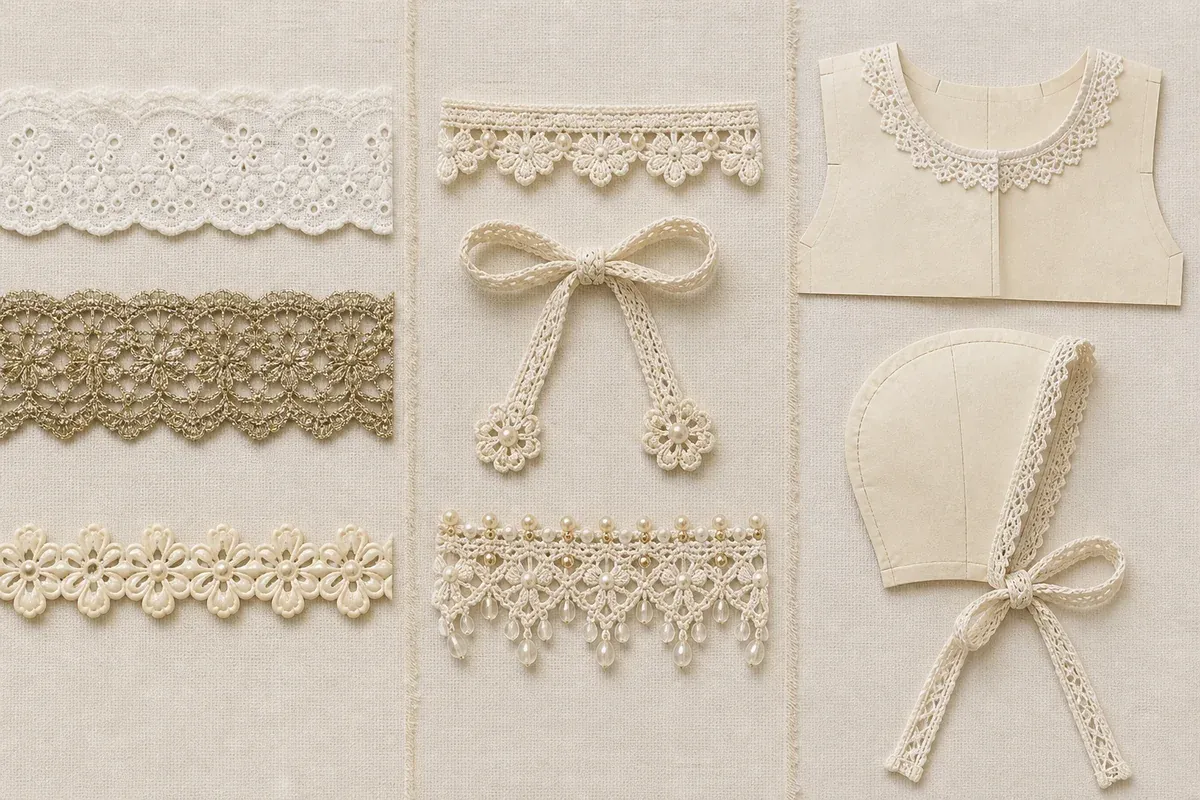
Cord treatment turns on function, not appearance. EN 14682:2014 governs cords and drawstrings on children's clothing, and a lace tie on a baby bonnet is functional — a lace edge on a neckline seam is decorative. The UK Office for Product Safety and Standards published a PRISM worked example on exactly this line: a 342 mm decorative neck cord on a garment for under-3s, assessed as an entanglement risk through a foreseeable daytime-nap scenario. It is a risk-assessment methodology example rather than an incident report, and it demonstrates that “decorative” is not a defence once a cord reaches the neck area.
For babywear, some constructions fail before testing starts. Beaded and sequined lace introduces small parts held on by thread. Pompom lace concentrates pull-off load on a single anchor point. Both may survive use-and-abuse conditioning under 16 CFR 1500.51-1500.53 and still be the wrong decision on a garment for a child who will chew the neckline. Disqualify them at spec stage for under-3s instead of testing your way to a maybe.
Shrinkage differential is what the customer sees after three washes
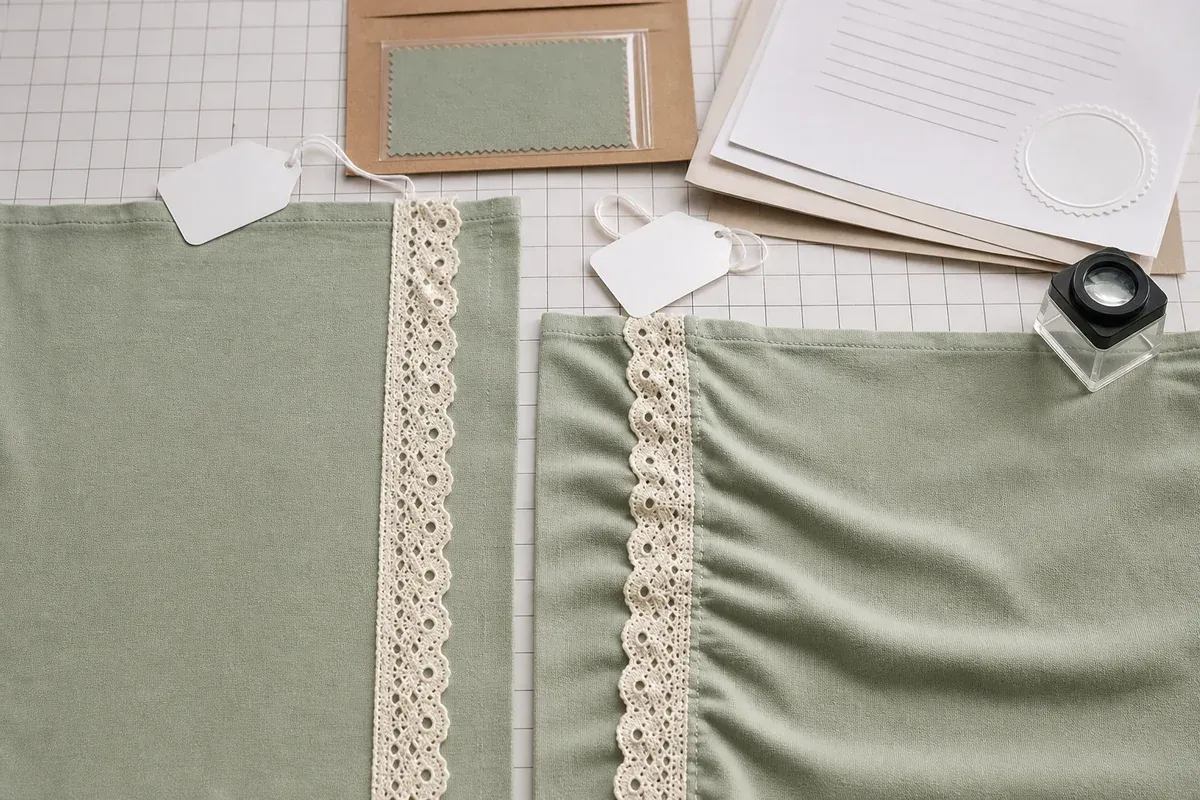
The complaint I hear most on kids' garments is not a failed lab report. It is a puckered lace edge against a body fabric that stayed flat after three home washes, with the supplier calling it normal. It is not normal, and it is not a lace defect — it is an unspecified differential between two materials that were tested separately and never together.
No published shrinkage figure will settle this for your order, because the number depends on the ground structure, the finishing route and the wash cycle used. Specify matched shrinkage against the body fabric's own care instructions, state the tolerance, and require the batch test record with the shipment. A photo tells you the pattern, not the post-wash result. Our cotton lace shrinkage reference covers the test routes in more depth.
For a 0-12 month layette, cotton lace trim is the defensible starting point — matte, moisture-absorbing, and soft enough for direct contact — provided its shrinkage is measured against the specific body fabric rather than assumed from the fibre name. If edge stability after laundering is the risk you are managing, a fine cotton embroidery edge and a heavier crochet structure behave differently and should be sampled against each other, not chosen from a swatch card. Hand feel matters too, and skin-friendly lace trim selection deserves its own bend-and-rub check before approval.
Verify the certificate before it enters the file
Whether a certification applies depends on the holder, the product scope and the validity window. I have rejected an OEKO-TEX certificate because it named a different factory than the one running the order, and the supplier argued it still counted. It did not. A certificate covering a plain cotton lace held by one entity says nothing about a metallic variant of the same pattern made elsewhere.
Product class is the second check people skip. Product Class I is the babies class, covering textiles in direct contact with babies and small children up to age 3 — “OEKO-TEX certified” without a class named is an incomplete statement. Scope also moves over time: since 1 April 2025, STANDARD 100 certificates no longer carry “organic” or “GMO-free” cotton claims at all, so an organic claim now has to come from a GOTS or OCS certificate instead.
Then tie it to your actual shipment. A trim specified to the right standard can still fail pre-shipment testing for colorfastness to saliva because the certificate predates the dye lot you ordered. Ask for dye lot traceability alongside the certificate, and treat colorfastness on lace trim as a per-batch result rather than a property of the article.
Work the testing calendar backwards from the retail date
Labor Day 2026 falls on September 7, the latest date the holiday can land. The date is verified; what follows from it is planning judgment. Back-to-school and Labor Day sell-through is one continuous US childrenswear push, and retailers set distribution-centre receipt windows against the start of it, not against the holiday itself.
Work backwards in this order. Bulk shipment has to clear pre-shipment inspection, which cannot start until the ordered construction has passed its physical and chemical tests, which cannot start until the trim is locked, which cannot happen until sampling confirms the shrinkage match against the actual body fabric. Every retest inserts a full lab turnaround into that chain.
A late holiday date does not buy you room. Distribution-centre receipt sets your deadline, and a failed azo dye report on a dye lot you approved late is the failure that eats the margin.
The mistake that causes most of these failures
Treating a supplier certificate as a substitute for product-level testing on the ordered construction is the single error behind most kids' trim rejections. The certificate describes a material made at a place during a period. Your order is a construction, in a colour, sewn to a specific body fabric, sitting at a specific place on a specific age band's garment.
The deeper problem is how these files get assembled. Buyers build them by collecting scheme names, then discover at pre-shipment that no scheme was ever scoped to the thing they bought. Build the file the other way round — start from end-use, derive the requirement, name the method, then ask which certificate covers it. Files built that way are shorter, and they hold.
Discuss a real requirement
Turn the reading into a practical next step.
Send a short note, product reference, photograph, swatch or tech pack. Technical feasibility, sampling, documentation and production terms are confirmed after review.
Start an inquiry