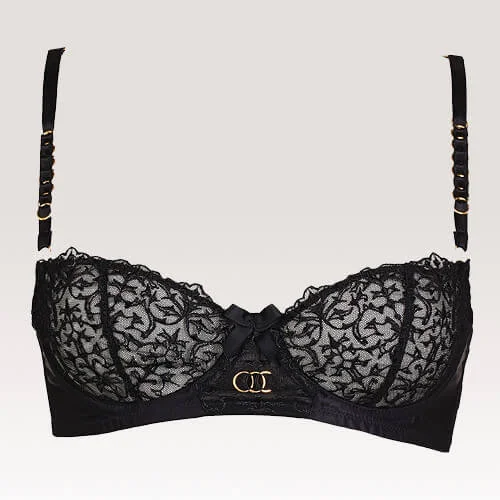
Introduction: In the realm of intimate apparel, no textile carries the same romantic weight, seductive transparency, and historical gravity as lace. It is a fabric that balances on a razor-thin wire between absolute vulnerability and structural mastery. Yet, while "lace lingerie" is universally marketed as a premium commodity, the word "lace" itself functions as a vast umbrella covering entirely different manufacturing tiers, engineering constraints, and economic values. From mass-market knitwear to antique French looms and hand-clipped motifs, this definitive guide deconstructs the mechanics, economics, and preservation of lingerie’s most defining textile.
1. The Aristocratic Genesis: From Wealth Disparity to Undergarment Revolution
To truly appreciate why a few square centimeters of lace on a luxury bra can command hundreds of dollars, one must look backward to the late 15th century. Originating in the independent city-states of Northern Italy and Flanders, lace was not born as a utilitarian fabric but as a pure, distilled manifestation of wealth, power, and political leverage. Before industrialization, every millimetric twist of thread was executed entirely by hand by master craftsmen and cloistered artisans working in conditions that strained human eyesight to its absolute limits.
Historically, handmade lace was divided into two fundamental methodologies: Needle Lace and Bobbin Lace. Needle lace was an incredibly arduous process where a pattern was drawn on parchment, and a single needle and thread built up thousands of interlocking buttonhole stitches over a temporary scaffolding of structural threads. Bobbin lace, by contrast, involved winding individual threads onto weighted wooden or bone spools, which were then twisted, plaited, and pinned over a specialized pillow tracking a complex geometric grid. A single flounce could take months, sometimes years, to execute.
💡 Historical Context & Sumptuary Laws
During the Baroque and Renaissance eras, the monetary value of high-tier lace frequently surpassed that of gold bullion or prime real estate in metropolitan capitals. Because of this astronomical value, lace was strictly protected by sumptuary laws—state decrees that dictated who could wear what based on rigid caste lines. It was a fabric reserved exclusively for the high clergy and royal aristocracy, displayed loudly on outer garments, ruffs, and heavy cuffs to assert social dominance. Using such a costly material on a concealed undergarment would have been viewed as an act of absolute, unthinkable madness.
The tectonic shift occurred in the crucible of the British Industrial Revolution. In 1813, an inventor named John Leavers perfected a terrifyingly complex machinery setup in Nottingham, England. The Leavers Lace Machine successfully mechanized the intricate, multidirectional twistings of traditional handmade bobbin lace. This invention laid the cornerstone for the modern lingerie industry. For the first time in human history, lace could be produced with structural continuity at a scale that allowed it to transition from an external signifier of royal wealth to an intimate, sensual experience against a woman’s bare skin.
2. The Modern Taxonomy: Five Essential Lingerie Laces and Embroideries
When browsing the lingerie market today, consumers are bombarded with the word "lace" indiscriminately across all price points. However, a $30 bralette from a fast-fashion mall chain and a $400 bespoke half-cup bra from an independent atelier do not share the same textile DNA. Understanding the core machinery, structural limits, and chemical composition of these textiles is vital for any discerning collector.
A. Raschel Lace: The Workhorse of Contemporary Commercial Intimates
If you look inside the average underwear drawer, chances are over 85% of the lace items are products of the Raschel knitting machine. Developed as a modern offshoot of warp-knitting technology, Raschel machines utilize a Jacquard apparatus to electronically program and knit entire rows of loops simultaneously. This machine can churn out thousands of meters of wide-width patterned lace at breakneck industrial speeds.
The primary advantage of Raschel lace is its extraordinary cost efficiency and compatibility with modern synthetic polymers like nylon, polyester, and elastane (Spandex). Because it is a knitted structure rather than a twisted one, it accommodates stretch effortlessly. This makes it highly functional for functional everyday lingerie components like stretch wings, side bands, and raw-cut boy-shorts that require high elastic recovery.
However, from a purely aesthetic viewpoint, Raschel lace is inherently two-dimensional. The patterns are flat, lacking structural topography or relief lines. When held up to the light, it betrays its highly chemical, industrial origins, occasionally feeling scratchy or stiff if processed with low-grade nylon polymers. It is the democratic standard of the modern market—built for utility, stretch, and volume, but devoid of artistic rarity.
B. Leavers Lace: The Haute Couture Benchmark of Intimate Luxury
At the opposite end of the industrial spectrum sits Leavers Lace. The machines required to weave this textile are massive, monolithic iron beasts engineered over a century ago. They operate on a purely mechanical logic, driven by complex punch-card systems reminiscent of early computing. No factory in the world builds new Leavers machines today; the global industry survives entirely on the meticulous maintenance, restoration, and operation of surviving antique looms.
What sets Leavers lace apart is its method of construction: it does not knit threads into loops; it literally wraps, twists, and knots thousands of fine bobbins of yarn around independent warp threads. This multi-directional tension allows for unparalleled design complexity, ultra-fine transparency, and organic, fluid linework that mimics nature perfectly. While Nottingham was its historical cradle, the undisputed capital of modern Leavers lace is Northern France, specifically the historic regions of Calais and Caudry. True luxury houses proudly preserve the protected geographical denomination "Dentelle de Calais-Caudry" on their garment tags.
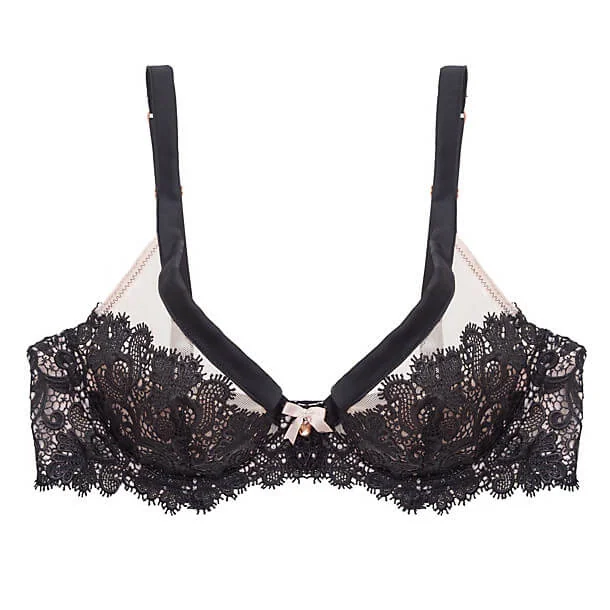
Within this category, Chantilly Lace reigns supreme. Characterized by its extraordinarily delicate, diaphanous net background (tulle) and dense floral motifs outlined by a fine cord thread, it represents the pinnacle of dark romance. A crucial detail of true Leavers Chantilly lace is the "hand-clipped" edge. As the machine weaves the pattern, structural float threads span the empty spaces between motifs. Once the textile is removed from the loom, specialized artisans must manually cut away these excess threads with ultra-sharp shears. This meticulous human intervention leaves behind microscopic raw thread whiskers—a definitive hallmark of authentic luxury lace.
C. Schiffli Embroidery: The Art of Multi-Threaded Topography
A common point of confusion among consumers and casual lingerie enthusiasts is the inability to differentiate between lace and embroidery. Technically, they are entirely separate disciplines. While lace is a structural textile created from nothing but raw yarn, embroidery requires a pre-existing base fabric upon which decorative patterns are stitched.
In modern lingerie manufacturing, fine embroideries are produced on massive, high-precision Schiffli machines. These machines utilize a two-thread lockstitch system—similar to a standard home sewing machine but scaled up to track hundreds of needles simultaneously across a moving vertical plane of fine net or tulle. Because the embroidery needles are free from the geometric grid constraints of traditional weaving looms, Schiffli embroidery can achieve astonishing, painterly details.
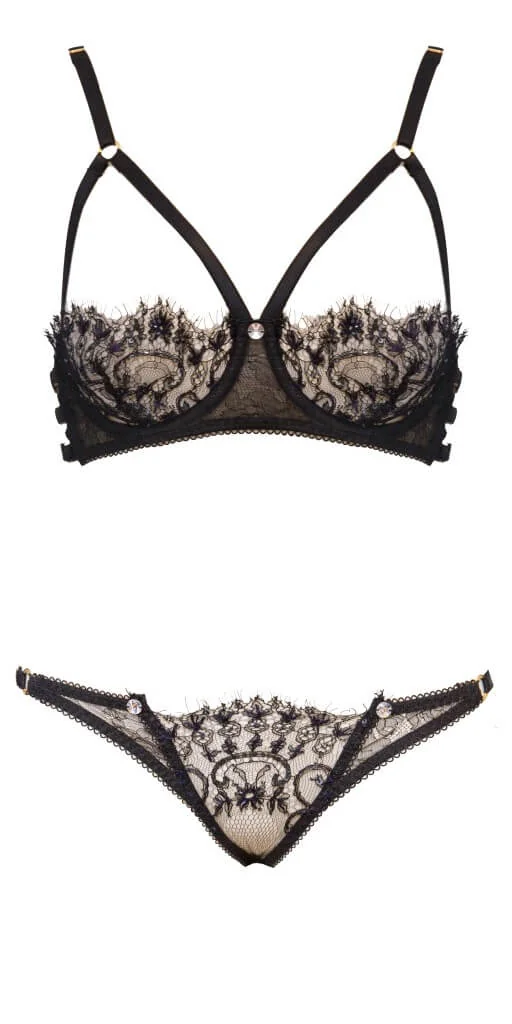
Brands like Freya and Agent Provocateur utilize Schiffli embroidery extensively across mid-to-high tiers. It allows for multi-colored floral realism, high tactile relief (where the stitches sit proud of the base fabric), and dramatic thematic motifs. Furthermore, ultra-luxury houses often collaborate with historic Swiss or Italian embroidery mills to develop entirely proprietary, copyrighted motifs—such as Bordelle’s famous, high-concept "thorn" and architectural geometric collections.
D. Guipure Lace: The Disappearing Chemical Illusion
Guipure Lace, known also as chemical lace, presents a fascinating technological illusion. It begins its life not as a lace, but as a heavy, dense embroidery stitched onto a highly unstable sacrificial base fabric. Historically, this base fabric was made of chemically treated wool or paper; today, it is typically a water-soluble polyvinyl alcohol (PVA) non-woven substrate.
The Schiffli embroidery machine stitches dense, heavy interlocking patterns over this sacrificial backing, ensuring that every element of the floral or geometric design is securely connected to its neighboring motif via structural cords called "bars" or "brides." Once the stitching run is complete, the entire roll of fabric is submerged in a chemical or boiling water bath. The backing substrate completely dissolves into the solution, leaving behind a self-supporting, freestanding lace architecture characterized by its thick, corded, and sculptured texture.
Because Guipure lace completely lacks a background mesh or net, it offers intense graphic contrast against the skin. It possesses zero inherent elasticity and is comparatively heavy, meaning designers rarely use it for the structural wings or full cups of full-support bras. Instead, it is highly prized by brands like Myla and Fleur of England for spot placement along the bridge, the upper cradle, or as placement motifs on luxury G-strings and suspenders.
E. Embellished Laces: Artisanal Layering and Fine Material Addition
For the uppermost echelon of high-end lingerie, a standard machine-woven lace serves merely as a blank canvas. Embellished laces undergo a secondary, often highly artisanal processing phase to introduce tactile and visual depth. This is achieved through three primary techniques:
- Cording (Soutache Application): A fine, raised cord or ribbon is meticulously stitched over the perimeter lines of the machine lace motifs, creating a stark, high-contrast boundary line that makes the pattern pop visually.
- Over-Embroidery: A process where mechanized or hand-guided needles restitch over woven lace patterns using distinct yarn variations, such as high-luster mercerized cotton, metallic lamé threads, or contrast-colored silk.
- Hand-Beading and Sequining: The literal pinnacle of luxury time-investment. Microscopic glass bugle beads, Swarovski crystals, and miniature sequins are stitched one-by-one by hand onto the intersections of fine French Chantilly lace. This craft requires an incredibly specialized eye-to-hand coordination, adding immense weight, liquid drape, and reflective properties to couture lingerie sets.
📊 Textile Matrix: Comparison of Lingerie Lace & Embroidery Tyology
| Textile Class | Primary Machinery | Structural Behavior | Market Positioning | Optimal Placement |
|---|---|---|---|---|
| Raschel Lace | Modern Warp-Knitter | High stretch elasticity, flat profile | Mass Market / Commercial | Wings, side bands, everyday briefs |
| Leavers Lace | Antique Twist-Loom | Diaphanous, ultra-fine, hand-clipped | Premium / Luxury / Couture | Cup overlays, luxury slips, eyelash edges |
| Schiffli Embroidery | Lockstitch Shuttle Rail | Stable mesh base, dense multi-color | Mid-Tier to High-End Bridge | Upper bra cups, unlined sheer panels |
| Guipure Lace | Dissolvable Substrate Mill | Zero-net base, structural, heavy weight | Mid-Premium to Couture | Cradles, center-front bridge, motifs |
3. Form, Width, and Edging: How Lace Dimensions Dictate Pattern Drafting
For a lingerie pattern cutter or creative director, lace is not simply a bolt of uniform textile that can be chopped up carelessly. The physical format and edge profile in which the lace leaves the machine completely govern how a garment can be engineered across the human anatomy.
Format A: All-Over Lace
All-over lace mimics the behavior of traditional dressmaking fabrics. It features a wide, consistent width—typically 140cm to 160cm—with basic industrial selvedges rather than decorative scallops. This configuration allows pattern pieces to be nested efficiently in any direction, subject only to the grainline and stretch direction of the knit. Designers choose all-over lace for expansive, multi-paneled garments such as silk-lined babydolls, full bodysuit panels, or the foundational lining of longline basques.
Format B: Lace Trims
Trims are linear bands measuring anywhere from a few millimeters to a couple of centimeters wide. They almost always feature one raw or clean-finished mounting edge and one highly stylized decorative or scalloped edge. Trims are essentially functional embellishments utilized to finish raw edges along a knicker waistband, soften the under-arm cut of a bra wing, or provide a delicate frame around a plunging neckline.
Format C: Flounce Lace
A flounce lace occupies a middle-width ground, characterized by a completely asymmetric edge configuration. One long edge is woven completely flat for insertion into structural seams, while the opposing edge bursts into a dramatic, sweeping scalloped wave. Flounces are manufactured in perfectly mirrored, symmetrical pairs. They are a staple for executing garments where a scalloped lace border needs to cascade fluidly around a curve without buckling—such as the leg opening of a French knicker or the structural overlay of a balcony bra cup.
Format D: Galloon Lace
The Galloon is the absolute holy grail format for classical brassiere architecture. It is a ribbon-like lace band featuring identical, mirrored scalloped designs on both the top and bottom borders. Because the scallops are mathematically identical on both margins, a pattern master can fold a single length of galloon lace in half along its longitudinal axis and simultaneously cut a perfectly symmetrical left and right bra cup. This ensures that the delicate scalloped edge frames both breasts with flawless, geometric symmetry.
4. The Economics of Imperfection: Pattern Matching, Scale, and Hidden Costs
The consumer paradox of luxury lingerie is often centered on scale: why does an item consisting of less than a quarter-yard of total material cost exponentially more than a heavy wool coat or a structured denim jacket? The answer lies not within the cost of the raw yarn, but within the hidden nightmare of pattern matching and industrial fabric wastage.
When cutting a basic cotton t-shirt, pattern pieces are packed tightly together on a massive marker layout like puzzle pieces, optimizing fabric usage down to a 90-95% efficiency rating. When engineering a high-tier scalloped lace bra, this industrial efficiency completely collapses. If a designer mandates that the scalloped border must sit seamlessly along the top edge of the cup, continue uninterrupted across the central bridge (cradle), and extend neatly into the side wing, the pattern pieces can no longer be nested freely.
⚠️ The Reality of Material Wastage
To achieve a mirrored, continuous floral flow across a bra cradle, the pattern cutter must manually place each individual pattern piece over a specific floral repeat or net cluster. This leaves vast gulfs of empty, unusable space between the cut pattern pieces. In the production of symmetrical Leavers lace bras, the material wastage rate frequently ranges from 35% to over 50%. Half of the expensive luxury fabric bought by the brand winds up on the cutting room floor as useless shred.
Let us scale this mathematical reality up to industrial production metrics. Imagine a high-end designer utilizing a beaded French Leavers trim that wholesales at $45 per meter. If a standard layout forces a mere 5 centimeters of necessary wastage per bra cup to maintain proper floral alignment, that translates to a hidden material loss of roughly $2.25 per single garment. When scaled across a production run of 5,000 units, the factory is forced to throw away thousands of dollars worth of premium material just to satisfy the visual requirement of a continuous pattern.
To circumvent these brutal economics without sacrificing the premium aesthetic, smart mid-tier commercial contemporary labels utilize a clever engineering trick: they drape the core structural foundation of the bra using a highly optimized, economical all-over lace or sheer power-net fabric, and then strategically top-stitch a narrow, matching scalloped lace trim directly over the raw edges. This gives the optical illusion of a fully integrated luxury scalloped construction while reducing the fabric wastage cost to near zero.
The Labor Monopoly: Lace Appliqué in Haute Couture Intimates
While mechanical pattern matching is costly, it pales in comparison to the intense labor demands of true Lace Appliqué. This technique represents the absolute absolute apex of luxury lingerie construction—championed by houses like Carine Gilson and La Perla.
Lace appliqué cannot be performed by automated assembly lines. The process begins with a master artisan taking an expanse of ultra-fine French Chantilly lace and manually dissecting individual flower heads, leaf sprays, or intricate scrollwork from the mesh backing using fine, curved embroidery scissors. These isolated lace fragments are then carefully pinned by hand onto the surface of a contrast fabric—typically premium 19-momme pure mulberry silk satin.
A highly skilled machinist then guides the silk under the needle of a specialized sewing machine, executing a microscopic zig-zag stitch along the chaotic, organic perimeter of the lace motif. Once the lace is permanently anchored to the silk, the garment is turned completely inside out. The artisan manually slides a pair of specialized shears between the layers and cuts away the solid silk backing fabric from behind the lace motif, leaving a breathtaking "window" of pure transparency where the lace sits floating natively inside the silk framework. A single couture slip utilizing extensive hand-appliqué can require up to 12 to 18 hours of continuous, undistracted manual labor, explaining why these garments command retail prices soaring past $600 to $1,500.
5. The Preservation Protocols: Conservation-Level Care for Luxury Lace
Given the architectural fragility and intense financial investment required to acquire premium lace lingerie, subjecting these garments to standard domestic laundry cycles is an act of fiscal self-destruction. The aggressive mechanical tumbling of a washing machine drum, combined with friction from heavy outer garments, zippers, and denim rivets, will instantly tear fine tulle, warp elastic filaments, and pill delicate silk threads. To safeguard your collection, adhere to these three uncompromising conservation protocols:
Protocol 1: The Ambient Submersion Wash
Lace garments must always be washed by hand in a dedicated, sanitized basin. Fill the basin with cool to tepid water (never exceeding 30°C / 85°F). Introduce a premium, rinse-free specialty lingerie wash—such as Soak or Eucalan—which uses gentle formulas that lift oils and soil without degrading synthetic elastanes or stripping natural sericin proteins from silk laces. Submerge the lingerie and gently agitate the water with your hand. Let it soak undisturbed for 15 minutes.
When removing the garment, never wring, twist, or compress the lace cups into a fist to expel water. Doing so causes microscopic fractures in the delicate elastane fibers, leading to premature sagging and shape loss. Instead, lay the wet lingerie flat onto a clean, plush, light-colored bath towel. Roll the towel up loosely like a jelly roll, and press down smoothly along its length. The towel will draw the moisture out of the lace naturally without subjecting the garment to structural tension.
Protocol 2: Thermal and Ultraviolet Isolation
The residential tumble dryer is the absolute executioner of fine lingerie. The extreme heat generated inside a dryer drum cross-links and bakes the polyurethane strings inside spandex, causing them to snap, fray, and lose their elastic memory entirely.
Lace intimates should be reshaped while damp and laid completely flat on a horizontal drying grid, or hung carefully by the center gore over a rounded hanger away from direct heat sources. Furthermore, never expose wet or dry white and pastel lace to direct, unshielded sunlight. Strong ultraviolet rays trigger rapid chemical degradation in nylon polymers, turning pristine white or blush laces an irreversible, oxidized dingy yellow color within hours.
Protocol 3: Microscopic Separation and Storage
The method by which you house your lingerie collection inside your wardrobe is just as vital as how you clean it. Bras should be stored nested neatly behind one another in a dedicated drawer lined with smooth fabric or acid-free tissue paper.
The single greatest internal threat to a lace collection is the bra’s own fastening hardware. An unclasped metal hook-and-eye closure shifting freely inside a dark drawer acts as an aggressive claw. The tiny metal teeth will easily catch onto the fragile hexagonal tulle net of an adjacent Chantilly bra, creating an unfixable pull, snag, or structural tear. Always secure the back clasps of every single bra before storing them, and isolate heavily beaded or corded pieces inside individual silk or breathable cotton pouch bags.
Conclusion: Cultivating an Educated Eye for Intimate Craft
Ultimately, lace is far more than a superficial layer of decoration applied to a functional undergarment; it is a profound historical dialogue between industrial engineering and fine art. By training your eye to decode the flat, efficient weave of a modern Raschel knit, the dramatic relief of a Schiffli embroidery, the airy transparency of an antique French Leavers loom, and the intense labor cost of a hand-cut appliqué window, you transcend the status of a passive consumer.
In an era dominated by disposable, fast-fashion alternatives, developing a deep, intimate literacy regarding the structural realities and hidden costs of lace allows you to make informed, intentional investments. It empowers you to select pieces that do not merely look beautiful on a hanger, but carry a lasting value that respects the master artisans, historic mills, and incredible design geometry behind every stitch.



 WhatsApp Us