3 working days. Day 1 is technical reading and card making, Day 2 is machine setup and trial runs, Day 3 is finishing, inspection, and dispatch — with the courier booked the same day.
This article shows you what happens inside each of those days, what we need from you to start the clock, and where the honest limits are. Dyeing sits outside the 3 days, and we explain why below.
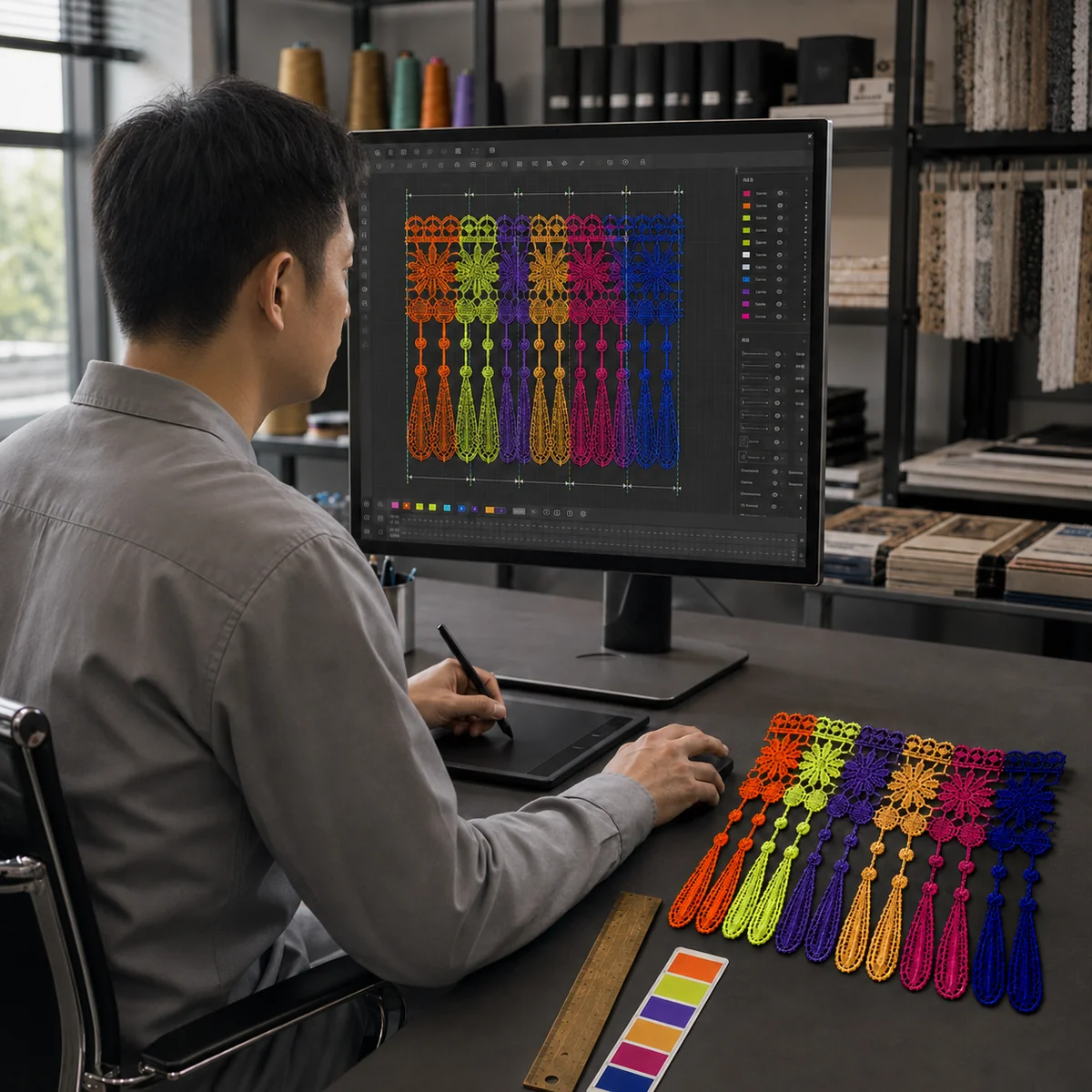
What Is Lace Customization?
Lace customization gets used as if it means one thing. In practice it covers three levels of work with very different cost structures.
Level 1 — Colour and yarn substitution. The pattern already exists on our cards. You are changing the shade, or swapping cotton for polyester, or adding spandex. No new pattern development is needed.
Level 2 — Pattern modification. An existing design adjusted to your spec: width changed, one edge re-scalloped, motif spacing opened up, density reduced to soften the hand. We edit the card rather than build it.
Level 3 — Full bespoke development. Your own artwork, digitized and carded from nothing. This is where the real craft sits, and where cost sits with it — a new card is hours of skilled pattern work before a single metre of lace exists.
The 3-day window applies to all three levels at the sampling stage, because samples run in stock yarn. What changes across levels is the development cost, not the clock. Worth knowing when you compare quotes: a supplier promising free samples in 3 days across the board is either only doing Level 1 work, or absorbing Level 3 cost somewhere you cannot see.
How Our Custom Lace Digitizing & Proofing Works
One term needs unpacking first, because it is where most of the value and most of the risk lives.
Digitizing — what we call card making — is the translation of a flat image into machine instructions. Every needle movement, every guide bar shift, every stitch in the repeat has to be defined. A lace machine does not read a JPEG. It reads a card, and building that card is a craft skill.
We make our own cards in house. That is why 3 days is achievable rather than aspirational: nothing in the chain sits in a third party's queue.
Day 1 — Design Intake and Technical Reading
The clock starts when we have enough to make a card. That means one of two inputs.
A physical sample. Fastest and most accurate. Give us the actual lace — a swatch from last season, a competitor's trim, a vintage piece — and we analyse it directly: structure, ground, yarn count, motif construction, finished width, repeat length. Nothing gets inferred. If you have a physical reference, send it.
An image plus parameters. Photographs, artwork, and sketches all work, but an image cannot tell us dimensions or fibre. So it needs to arrive with:
-
Finished width — in mm or inches, and confirm whether that includes any picot edge
-
Material — cotton, polyester, nylon, spandex content, and whether recycled or organic content is required
-
Repeat length, if your placement depends on it
-
Colour — a physical swatch or a Pantone reference, plus the dyeing standard you test against
-
Certification requirement — flag this now, not later
-
End use — babywear, lingerie, and outerwear pull different construction decisions out of the same drawing
Our technical team reads the input before anything gets programmed. This is where problems get caught cheaply: a motif that cannot hold at the requested width, a density that will not survive the stated wash test, a repeat that fights the machine's needle pitch. Raising these on Day 1 costs an email. Finding them after bulk cutting costs a season.
If you need a Transaction Certificate, say so here. A TC is issued per shipment under GRS, RCS, GOTS, or OCS, and the material has to be sourced and documented as certified from the beginning. We support TC issuance — but it cannot be attached retroactively to a batch that was not run as certified. Tell us on Day 1 and it is routine. Tell us at shipment and it is not possible.
Day 1 — Card Making
With the spec confirmed, the same day moves into development.
Our pattern technicians build the machine card: mapping the motif onto the needle bed, setting the ground structure, defining stitch sequence and thread paths, then calculating how the repeat lands across the working width so the pattern runs true with no visible seam at the join.
Two things drive how long this takes — motif complexity, and whether we are editing an existing card or building from zero. A geometric eyelet edge is not a floral guipure panel.
This labour is what sits behind our sampling fee. Simple samples we do free. Full bespoke development carries a fee sized to the actual card-making hours, refunded against your bulk order once it reaches MOQ. And for customers we work with regularly, we waive sampling repeatedly as a matter of course — once there is a relationship, development stops being a line item.
There is no minimum order quantity for sampling. One metre for evaluation is a legitimate request and we treat it as one.
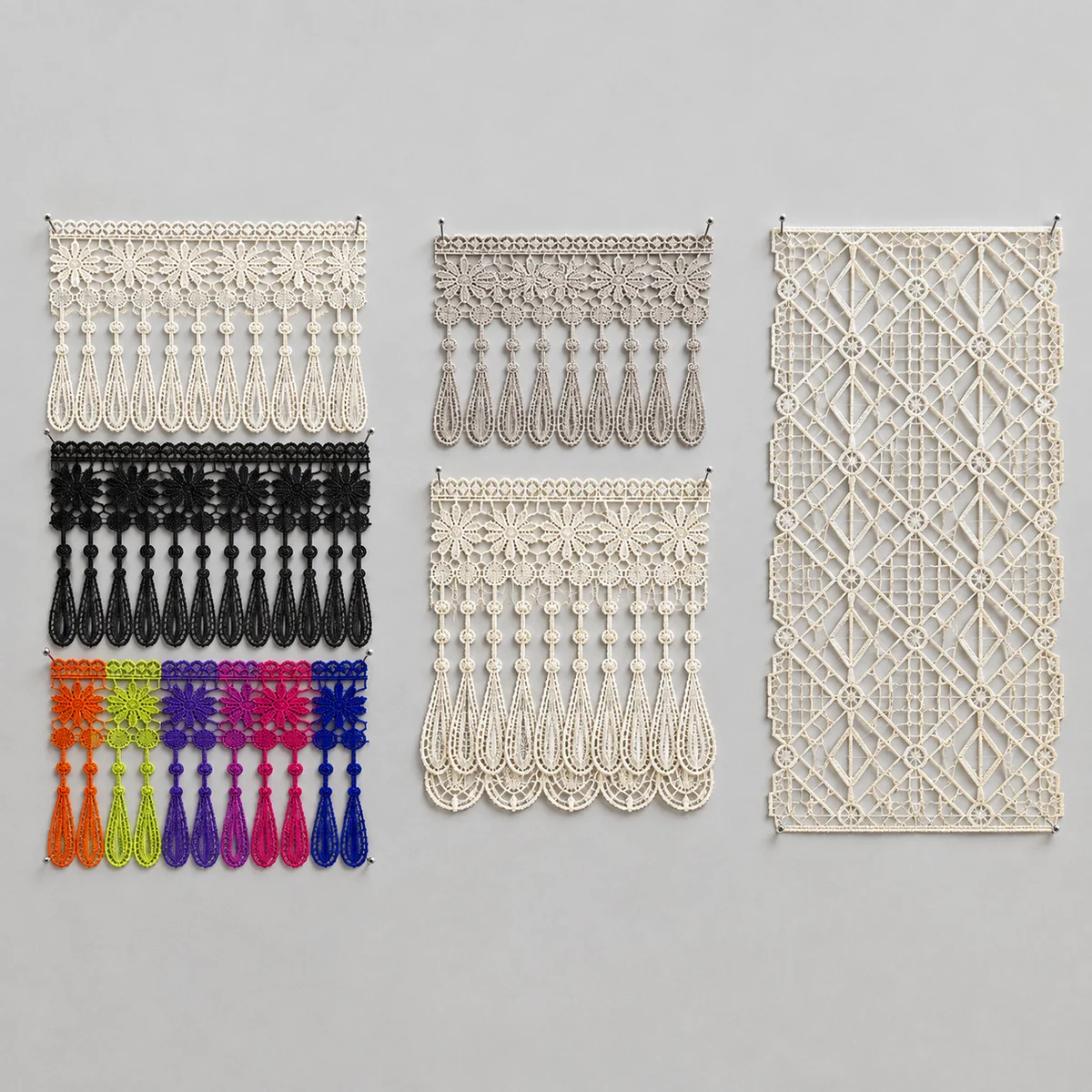
Day 2 — Machine Selection, Setup and the First Trial Run
Machine choice follows the construction your design requires, not whatever happens to be free. We run 146 knitting machines and 60 shuttle embroidery machines on our own floor, plus our own crochet and edging equipment — so routing a design to the right machine is a scheduling decision, not a sourcing one. Your sample never queues behind a subcontractor's order book.
Day 2 is physical. The card gets loaded, the machine threaded to the specified yarn, tension set, and we run the first trial length.
The first run is almost never the final one, and any mill telling you otherwise is not running trials. Yarn tension behaves differently on the machine than in the calculation. A motif that looked balanced on screen can read heavy in thread. Stretch recovery has to be measured on real fabric, not predicted. Our technicians adjust tension, stitch density, and thread path, then run again. That iteration is Day 2.
Because samples run in stock yarn, this is also where the dyeing boundary becomes visible. The trial gives you structure, width, motif, and hand-feel in an available colour. It is a construction sample, and it answers construction questions.
Day 3 — Finishing, Quality Control and Same-Day Dispatch
Raw off-machine lace is not finished lace, and the route depends on construction.
Chemical lace goes through dissolving, where the water-soluble ground is washed away and the motif is left standing on its own. Embroidered and knitted lace gets heat-set for dimensional stability. Then hand work: trimming connecting threads, cleaning the scallop edge, removing jump stitches. On fine guipure this is genuinely manual, and it is the difference between a sample that reads as a finished trim and one that reads as machine output.
Inspection before anything ships covers width against spec, repeat length and pattern accuracy against the approved reference, edge quality and scallop consistency, structural integrity, hand-feel against the stated end use, and stretch recovery on elastic constructions.
Then the sample goes out. The 3 days are ex-factory, and the courier is booked the same day — so your time to hand is 3 working days plus transit from Shaoxing. We send tracking when it leaves. We say ex-factory rather than delivered because we control our floor and we do not control international air freight, and a promise that depends on customs is not worth making.
Where the 3 days stop. Dyeing is a separate stage with its own clock: bulk dyeing runs 3–5 days, expedited when a deadline requires it, and lab dips take 2–3 days. If colour matters, the honest sequence is construction sample first, so width and structure get locked, then lab dips against your standard, then a dyed sample if you need one. Compressing all of that into one shipment means approving colour and construction at once — and if either is wrong, you restart both.
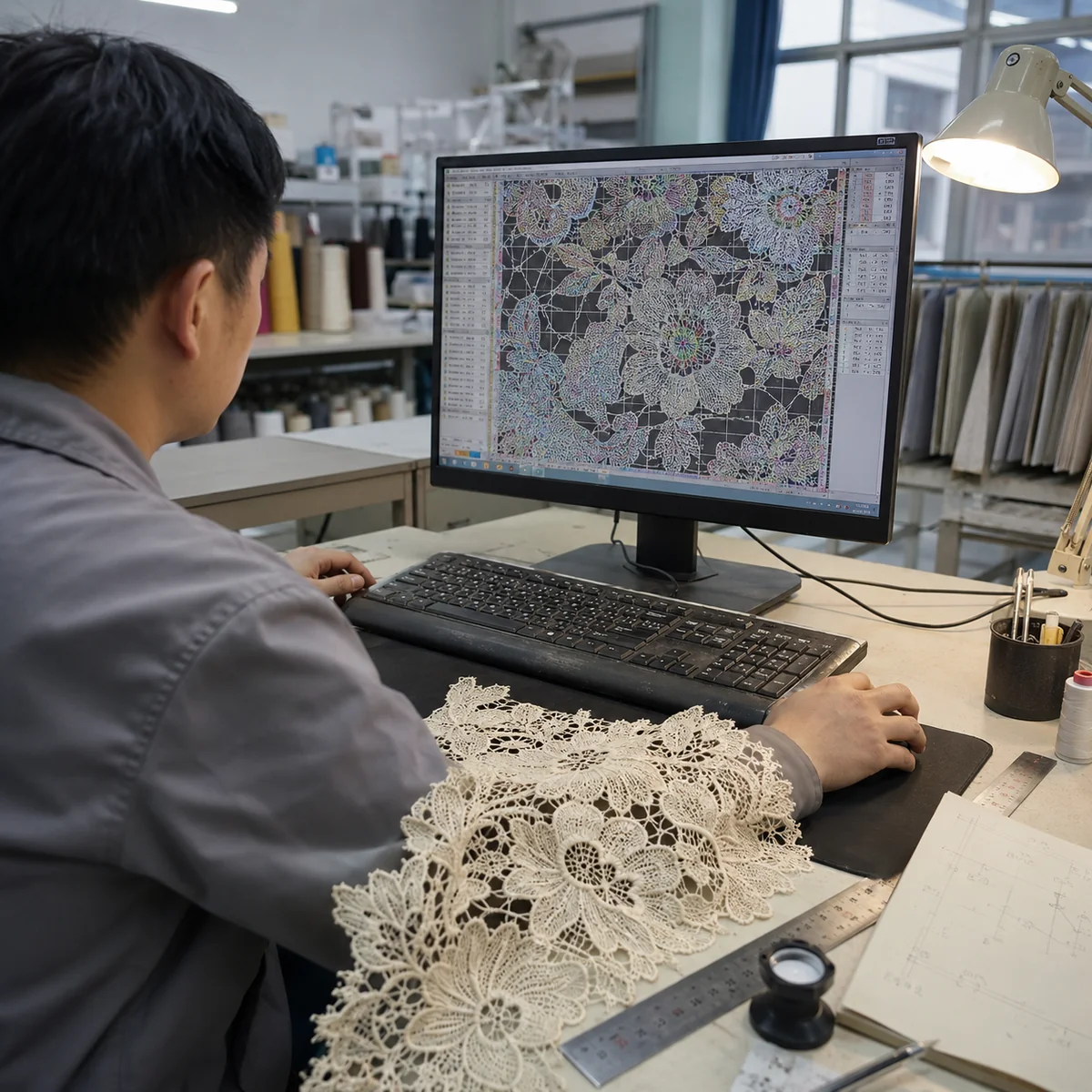
Types of Custom Lace We Develop
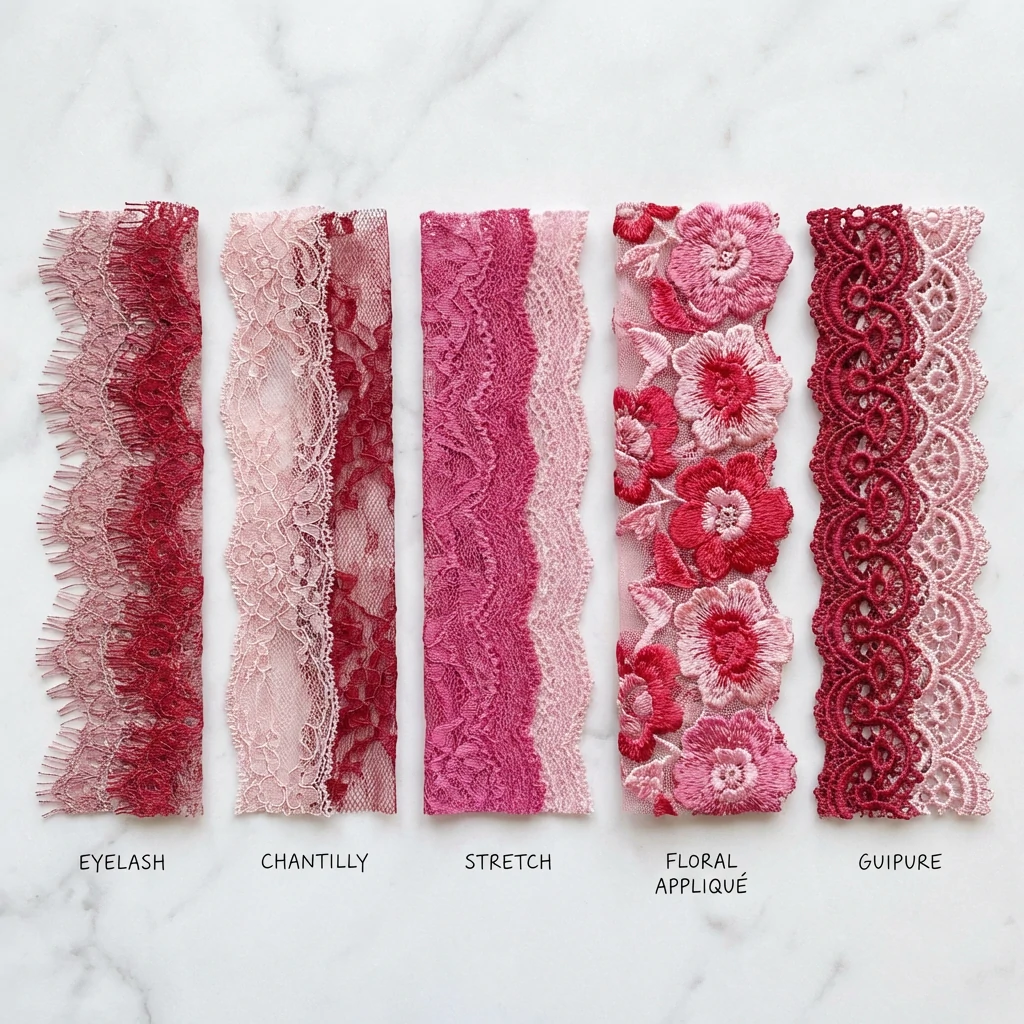
These four constructions are not interchangeable styles. Each comes off different equipment, behaves differently in assembly, and carries a different cost floor.
| Construction | How it is made | Best for |
|---|---|---|
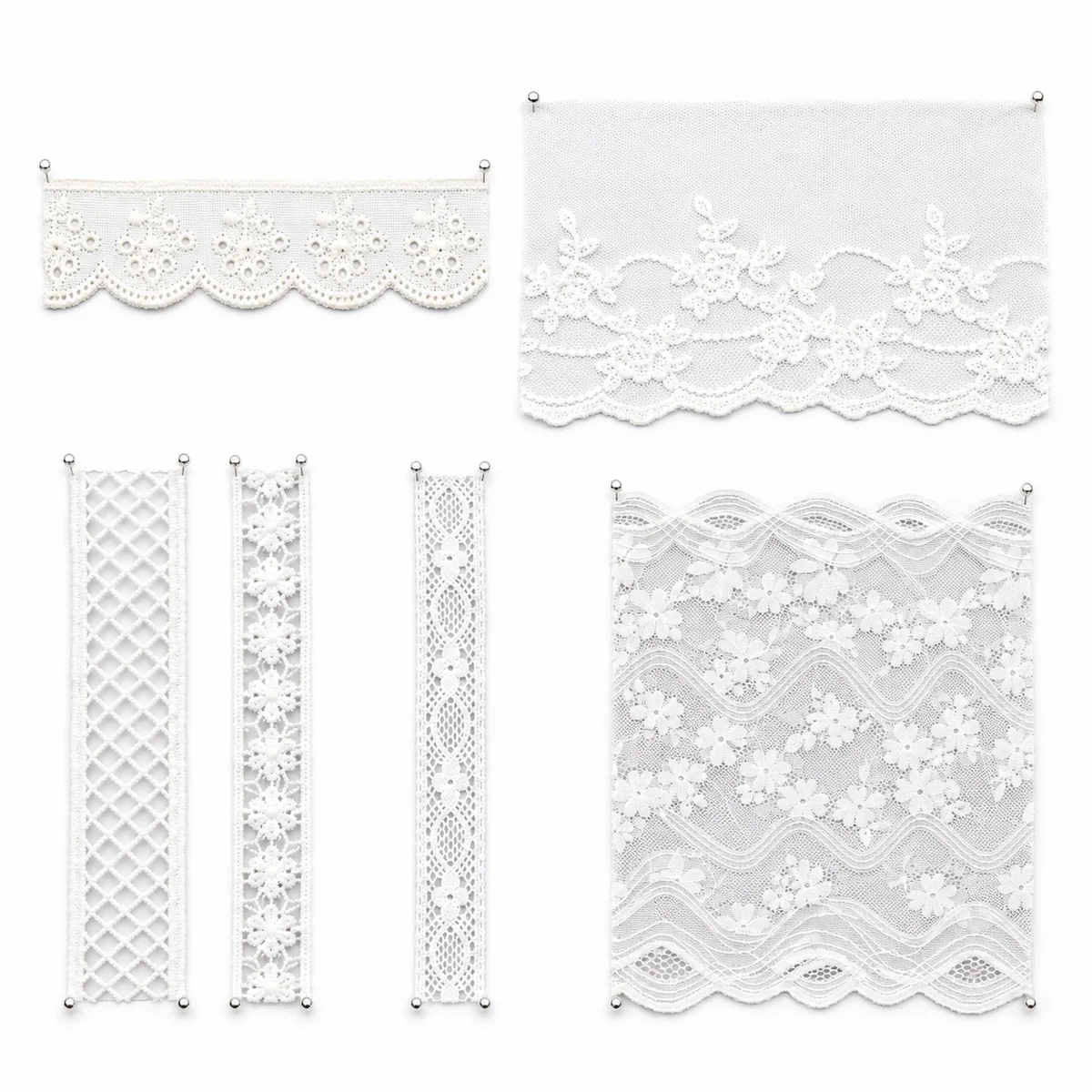
| Embroidered (Schiffli) | Motif stitched onto a stable ground with needle-and-shuttle | Cotton babywear, blouses, eyelet, dress panels |
| Knitted / warp-knitted | Lace structure and ground formed together; elastic with spandex | Lingerie, stretch trims, bra wings, activewear |
| Chemical (water-soluble) | Embroidered on a dissolving ground, leaving the motif alone | Bridal, occasionwear, appliqué, statement panels |
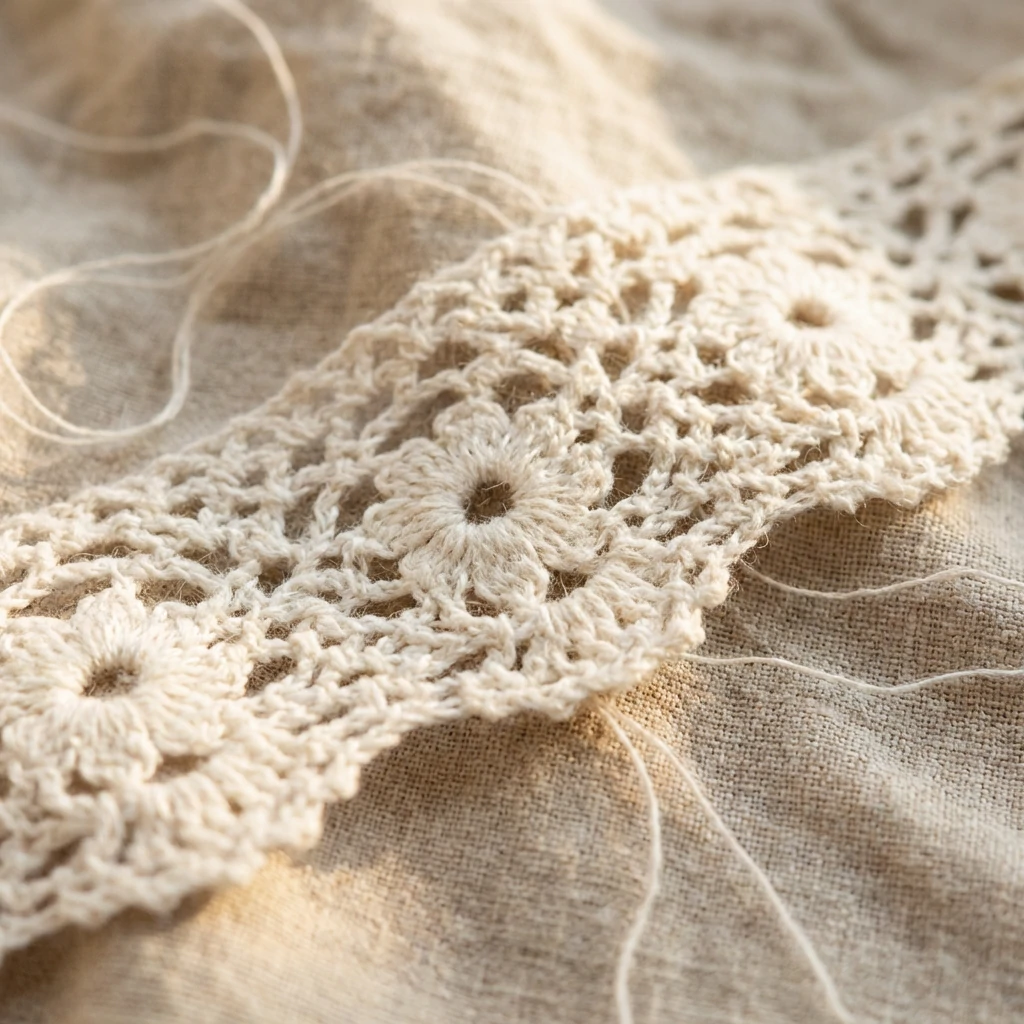
| Crochet / narrow trim | Narrow banding with a defined picot or scalloped edge | Hem edging, necklines, babywear, home textiles |
Embroidered lace is what our 60 shuttle machines produce, and it is the construction where a mill either owns the equipment or does not — there is no faking Schiffli output on a knitting machine. Knitted lace is our largest capability at 146 machines, and it is the construction our recycled and organic certificates cover at process level.
Chemical lace is the most labour-intensive of the four and prices accordingly, because the value is in the dissolving and the hand-finishing rather than the machine time. Crochet trim looks the simplest and is the least forgiving: an uneven scallop pitch is invisible on a swatch and glaringly obvious along a finished hem. We run this on our own crochet and edging machines, which matters precisely because narrow trim is where inconsistency shows fastest.
On fibre. Any of the four can run in conventional or organic cotton, polyester, recycled polyester, nylon, or spandex blends. Fibre choice is largely independent of construction — but entirely dependent on certification. Recycled polyester without GRS or RCS documentation is just polyester as far as a compliance auditor is concerned.
A Short History: Why Card Making Is the Whole Game
Lace was hand-made for most of its existence. Bobbin and needle lace were counted in weeks per metre, and the craft concentrated in a handful of European towns whose names still work as style descriptors — Chantilly, Valenciennes, Alençon.
Mechanisation arrived in stages through the nineteenth century. Heathcoat's bobbinet machine and later Leavers' machine in Nottingham made patterned lace producible at scale. In Switzerland, Isaak Gröbli's shuttle embroidery machine of the 1860s married the sewing machine's shuttle principle to hand-embroidery frames, and St. Gallen became the centre of embroidered lace — the direct ancestor of the Schiffli machines running on our floor today.
Here is the part worth noticing. Mechanisation never removed the skilled step; it moved it. On hand-made lace the skill was in the making. On machine-made lace it migrated into the pattern instruction — the punched card, and now its digital equivalent. The machine is fast, precise, and completely literal. It executes exactly what the card says, mistakes included.
Which is why "who makes your cards" tells you more than "how many machines do you have." A large machine park with outsourced digitizing has a bottleneck it does not control. Every design change, every trial adjustment, every correction enters somebody else's queue — and that is where most three-week sample timelines actually come from.
Shaoxing Yituo Garment Accessories Co., Ltd. develops cards in house and runs the machines in house, in Yuecheng District, Shaoxing. That combination is the reason we quote 3 days ex-factory instead of two to three weeks. It is not a scheduling trick. It is the absence of a handoff.
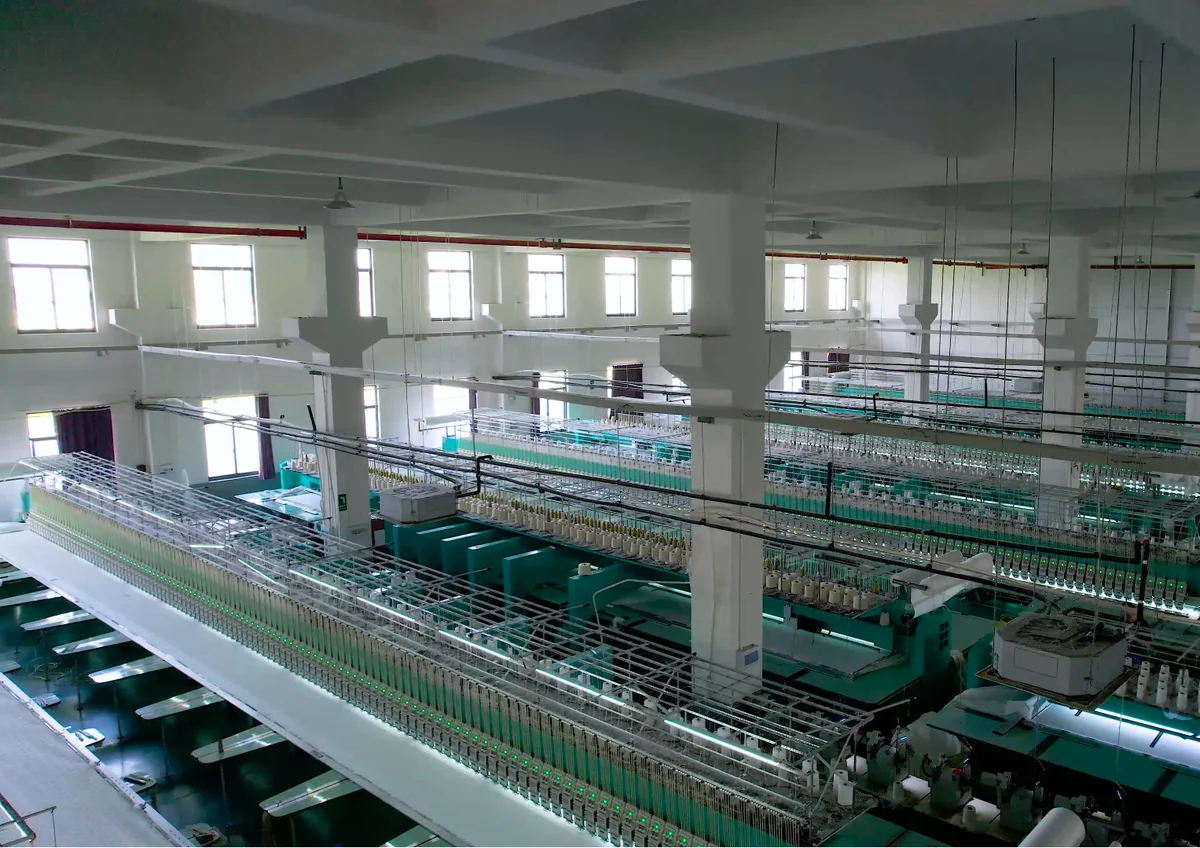
From Approved Sample to Bulk Production
An approved sample is not a purchase order, and the terms shift between the two stages. Here they are plainly.
Minimum Order Quantities
Sampling has no MOQ. For bulk, our general floors are 5,000 yards on lace and narrow trim and 2,000 yards on fabric.
Those are starting points, not walls. MOQ is genuinely open to discussion depending on the product, so raise it early rather than walking away from a quote. What drives the number is fixed cost that does not divide — a machine setup and a dye lot cost the same whether you take 2,000 yards or 20,000. Sometimes there is a route around it, like a stock shade that avoids a dedicated dye lot. Tell us your real volume and we will tell you honestly whether it works.
Certification
We hold seven certifications, and each answers a different question.
| Certificate | What it covers |
|---|---|
| GRS | Recycled content plus social, environmental, and chemical criteria |
| RCS | Recycled content tracking only |
| GOTS | Organic fibre, processing, and social criteria |
| OCS | Organic content tracking only |
| BCI | Better Cotton chain of custody |
| OEKO-TEX STANDARD 100 | Tested for harmful substances — Product Class I, baby articles |
| Intertek TQP | Independent facility assessment: management, risk, process control, testing, monitoring |
The OEKO-TEX class designation is the detail most buyers skip. Class I covers baby articles and is the strictest of the four classes, which is the one that matters if you make babywear, childrenswear, or intimates. Worth asking any supplier which class theirs is, rather than accepting the logo.
TQP is the one to ask for when your compliance team requires third-party assessment of the factory itself, not just testing of the product coming out of it.
Confidentiality and Pattern Exclusivity
A card you pay to develop is yours. We do not run it for anyone else.
This is the question buyers hesitate to ask and the most reasonable question in sourcing. Bespoke development only makes commercial sense if the output stays exclusive — otherwise you have funded your competitor's trim. We also sign NDAs: send us yours, or ask and we will provide one. Get it signed before you send artwork if that is your preference. We would rather handle paperwork first than receive a diluted version of your design.
FAQs
Do you charge for samples?
Depends on complexity, and we tell you which category you are in before any work starts. Simple samples are free — colour or yarn substitution, minor pattern edits, anything not requiring new card development. Full bespoke development carries a fee sized to the card-making hours, refundable against your bulk order. Established customers get sampling waived repeatedly.
Is the 3-day turnaround real, or a best case?
It is ex-factory and it excludes dyeing. Those two qualifiers are the whole answer. Day 1 is card making, Day 2 is machine work, Day 3 is finishing and dispatch with the courier booked same-day. What we do not control is international transit, so your time to hand is 3 working days plus freight. If a supplier quotes you "3 days delivered" to another continent, ask which day the plane leaves.
How long does dyeing add?
Bulk dyeing runs 3–5 days and we can expedite when a deadline requires it. Lab dips take 2–3 days.
Can you match a colour from a physical swatch, not just a Pantone code?
Yes, and we would rather have the swatch. A Pantone reference is a starting point, but that code was never dyed on your yarn — the same number reads differently on cotton than on polyester, and differently again on a spandex blend.
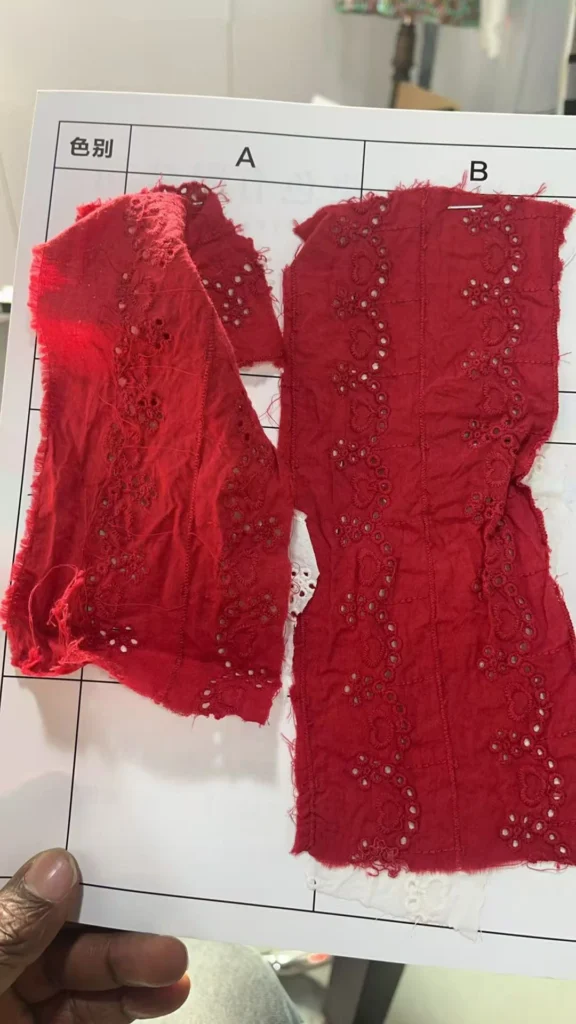
Working from a physical sample, we run dye trials against your actual reference until the match holds. We normally submit lab dips as an A/B pair, two shades bracketing your target, so you are choosing between real dyed yarn rather than approving a single attempt or rejecting it and waiting. Send the swatch, the Pantone reference if you have one, and the dyeing standard you test against.
What is your MOQ, and can it be negotiated?
Sampling has no MOQ. For bulk the general floors are 5,000 yards on lace and narrow trim and 2,000 yards on fabric, and both are open to discussion depending on the product. Raise it in your first email rather than assuming the number is fixed — there is often a route worth exploring, particularly if a stock shade can avoid a dedicated dye lot.
Which certification do I actually need?
If your customer audits a recycled claim, GRS. If you need recycled content verified without the social scope, RCS. Organic claim, GOTS; organic content tracking only, OCS. Better Cotton member brand, BCI.
For anything with skin contact, check OEKO-TEX STANDARD 100 and specifically the product class. Ours is Class I, baby articles — the strictest of the four. Beyond product certificates, Intertek TQP covers the facility itself, which is what compliance teams ask for when product testing alone is not enough.
Can you issue a Transaction Certificate?
Yes, with two conditions that come from the standards rather than from us. Declare the requirement at enquiry, before sampling, because certified material has to be sourced and documented as certified at every step. And confirm the process scope covers your specific product in writing before you commit. The most expensive certification mistake we see is a buyer assuming a logo-covered website means their order is covered.
If I pay for pattern development, can you sell my design to someone else?
No. The card is yours and we do not run it for another customer.
Will you sign an NDA?
Yes. Send yours or ask us for one, and sign it before artwork changes hands if that suits you better.
Can one order include embroidered, knitted, and crochet trims?
Yes, and it is a practical argument for consolidating. All three run on our own floor, so a multi-construction order means one supplier, one set of paperwork, one shipment, one quality standard. MOQ applies per design and per colourway rather than per order, so combining constructions does not lower the per-item minimum — but it does remove the overhead of running three suppliers against one delivery date.
Starting a Project
Send us either a physical sample or an image with the parameters listed under Day 1. If colour is part of the brief, include your swatch or Pantone reference and the dyeing standard. If you need a TC, say so in the first email.


 WhatsApp Us