
Custom Lace
Custom Water-Soluble Lace
Explore the work behind openwork lace. Start with your pattern, sample or idea, and discuss the details that matter for your finished product.
Discuss your designSee the pattern take shape.
4sColored embroidery running on the machine.
The video could not load. Open the file to try again.
Different designs and process examples from the workshop—not one continuous order.
Prepare the pattern. Review a trial.
Pattern layout and trial embroidery give the design a practical starting point for review.
Pattern layout
5sA repeating flower-and-drop motif in the pattern layout.
The video could not load. Open the file to try again.
Trial embroidery
4sWhite repeating openwork motifs on the embroidery machine.
The video could not load. Open the file to try again.
A closer look at the stitching.
The footage shows inspection and stitch repair as individual workshop tasks. Agree the relevant checks for your design when reviewing the sample.
Inspecting the embroidery
4sMotif fabric held against a backlight.
The video could not load. Open the file to try again.
Stitch repair
4sA hand guides an embroidery hoop for stitch repair.
The video could not load. Open the file to try again.
From wet processing to finishing.
See further workshop stages. The processing and finish for your order are confirmed against the selected materials and sample.
Wet processing
4sWet fabric moves inside a processing drum.
The video could not load. Open the file to try again.
Finishing work
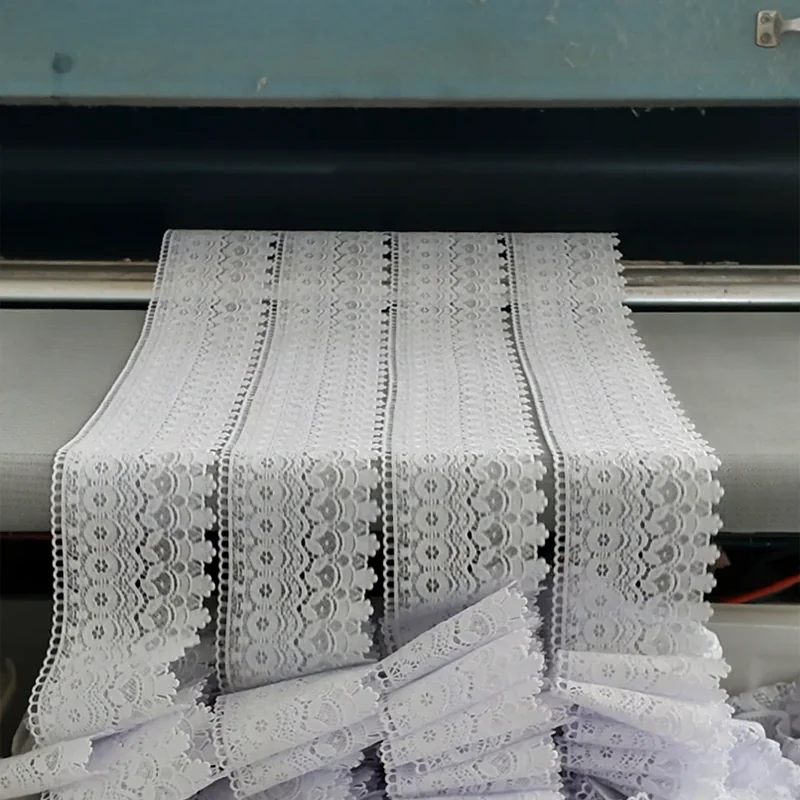
4sWhite lace strips pass through finishing rollers.
The video could not load. Open the file to try again.
Review the whole piece, then the details.
Look at the sample in its intended application and agree any changes before production.
- Motif outlines, connecting areas and openwork appearance.
- Dimensions, edges, color, feel and the reverse.
- Attachment and handling on the actual product; any agreed test requirements.
Show us the openwork you have in mind.
Send a reference and explain where the lace will be used. A short brief helps focus the design discussion.
- Motif, outline, desired openings and overall dimensions.
- Color, feel and how the lace will attach to the finished product.
- Planned quantity, target date and any care or testing requirements.
Explore openwork references.
Use an existing design to explain your preferred direction. The product specification and development route need to be checked separately.
Your questions, answered
How does water-soluble lace differ from embroidery on fabric or mesh?
Water-soluble embroidery uses a temporary ground that is removed during processing, leaving the embroidery to form the openwork structure. In embroidery on retained fabric or mesh, that ground remains part of the finished piece. The selected design and sample determine the final appearance.
Can any drawing be made into water-soluble lace?
The motif, connecting areas, dimensions and intended use need to be reviewed together. Send your reference and desired size so we can discuss which details may need adjustment.
Can I change the width, color or pattern?
Include the changes you want in your brief. Their suitability and the resulting appearance are confirmed during design and sample review; changing dimensions or fine details can also change the look and feel.
What should I check before approving the sample?
Check outlines, connecting areas, openwork, edges, dimensions and feel, then try the sample on the intended product. Raise any washing, finishing or other testing requirements before approval, and agree the relevant sample and test conditions.
Are quantity, sample charges and lead time fixed for this process?
The applicable terms depend on the materials, design, quantity and delivery requirements and are confirmed in the quotation. Existing catalog products retain their published quantity and price information; a new development needs its own review.