Nine documents, in this order: the sealed sample, the signed spec sheet, approved lab dips, an approved shade band, the pre-production trial report, test reports, valid certificates, an agreed inspection standard, and a contract that records packing requirements and tolerances in numbers.
Approve those and bulk becomes a controlled execution process. Without them, questions may need to be resolved after the goods already exist.
A familiar example looks like this: everyone approves the sample, but when five thousand yards arrive, the lace is two millimetres narrower than expected, the shade varies slightly between the first roll and the eighth, or the compliance team requests a certificate that was not included in the original production requirements. This is rarely about bad faith. More often, the written references were not complete enough for both sides to assess the delivery in the same way.

What "Document Approval" Really Means
Approval is more than a friendly email saying the sample looks great. It converts an opinion into a reference both sides can measure bulk against later. "This is lovely, go ahead" is not specific enough. "Approved against sealed sample YT-0842, width 45mm ±1mm, shade B of lab dip 3, ISO 105-C06 minimum grade 4" is a document. Only the second remains clear if a question arises later.
Every approval you sign also closes a decision that might otherwise be re-opened during production. Without clear references, production teams may have to make practical decisions under time pressure.
The nine documents fall into four families, each answering a different question.
| Family | The question it answers | Documents |
|---|---|---|
| Technical | Is this the right lace? | Sealed sample, spec sheet, PP trial report |
| Colour | Is it the right shade, consistently? | Lab dip, shade band, dyeing standard |
| Compliance | Can you sell it and prove your claims? | Test reports, OEKO-TEX, scope and transaction certificates |
| Commercial | What happens when something is off? | Inspection standard, packing spec, tolerances, NDA |
Buyers tend to focus most on the first two families. The last two deserve equal attention because they help prevent avoidable cost and uncertainty.
The Nine Documents, In Approval Order
Order matters. If colour is approved before construction is confirmed, the colour work may need to be repeated. If certification requirements are introduced after production, the finished goods may not be eligible for the required documentation.
1. The Sealed Sample
The sealed sample is the physical reference both parties sign and keep — the sealer, or counter sample, in sourcing shorthand. You hold one, we hold one, and every bulk roll gets compared to it.
Sign and date the tag, and be specific about what you are sealing. A sealed sample can approve construction, colour, width, and hand-feel at once, or only some of those. Ours ship with the reference and the yarn used, because a construction sample runs in stock yarn, and approving it does not approve the shade. Keep your half — a sealer nobody can find is a sealer nobody can invoke.
2. The Signed Spec Sheet
The sealed sample shows what the lace is. The spec sheet makes it measurable, yet it is often overlooked.
At minimum, get these on paper with numbers and tolerances beside them:
-
Finished width, and whether it includes the picot edge
-
Repeat length, if placement or cutting depends on it
-
Fibre content by percentage, and whether recycled or organic content is required
-
Yarn count, and weight in GSM for fabric
-
Stretch and recovery on any elastic construction
-
Colour reference and the dyeing standard you test against
-
End use — babywear, lingerie, bridal, and outerwear pull different construction decisions out of the same drawing
Two of those commonly require extra attention. Width tolerance is the first: if the sheet says 45mm with no tolerance, the acceptance range remains unclear, because no lace runs at exactly 45mm across five thousand yards. End use is the second, and it may sound like commercial context rather than a spec. It is a spec. A density designed for outerwear laundering is not necessarily the density that feels right against a newborn's skin.
3. Lab Dips
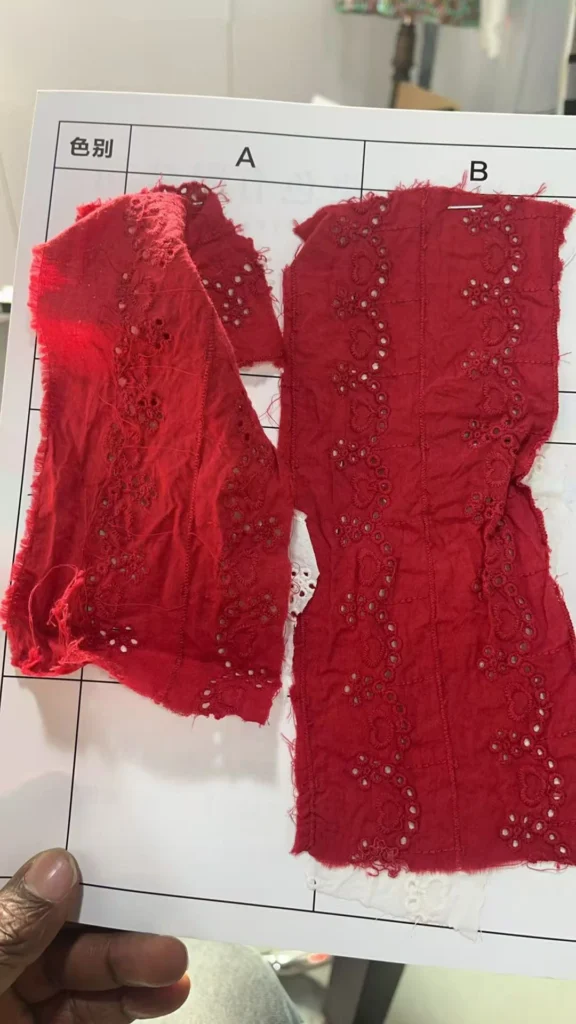
A lab dip is a small dyed swatch submitted for shade approval before bulk dyeing starts. Approve the dip, not the Pantone code — that number was never dyed on your yarn, and the same code reads differently on cotton than on polyester, differently again on a spandex blend. We would rather have your physical swatch.
We normally submit lab dips as an A/B/C set, with options around your target, so you can choose between real dyed yarn instead of evaluating a single attempt. Lab dips take 2 to 3 days, and bulk dyeing runs 3 to 5 days after that, with expedited arrangements available when schedules require them. Confirm construction first, then colour; combining both approvals into one step can mean repeating both if a revision is needed.
4. The Shade Band
This is one of the documents buyers are least likely to request, yet it can prevent costly shade-related complaints.
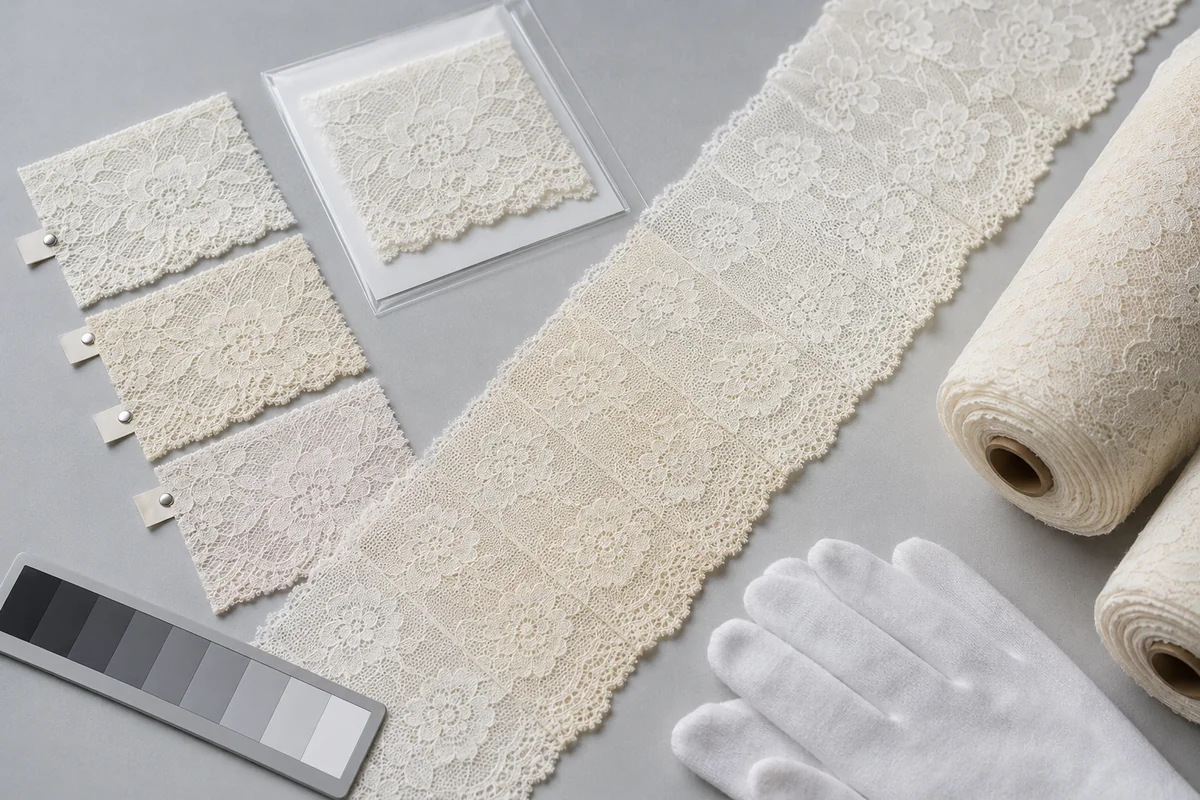
A lab dip approves one shade. It says nothing about whether roll one and roll eight match each other, or whether the left selvedge matches the right. That variation within and between dye lots is normal to some degree in any wet process, and a shade band submits it as a range, so you approve the tolerance rather than a single point.
Where panels sit side by side on the body, this matters more than the shade itself. A bra whose wing reads half a grade lighter than the cup may pass a single-swatch approval but still look inconsistent in the finished garment.
5. The Pre-Production Trial Report
The sample was made on a sampling run. Bulk is made on a production run, at production speed, in your yarn and approved shade. Those are not the same conditions, and a pre-production trial is where any difference can be identified before full production.
Ask for a short bulk trial length before the full quantity is released. You are checking that width holds at production tension, that the repeat runs true across the working width with no visible seam at the join, that the approved shade reproduces at bulk scale, and that hand-feel survives the real finishing route.
A trial may need one or more adjustments before approval. It is better to make those adjustments on a short trial length than during the full order.
6. Test Reports
Test reports answer a different question from certificates. A certificate says a facility or product line was assessed. A test report says this material, tested to this method, returned this result.
For lace and narrow trim, these physical tests help verify performance for the intended use:
-
Colourfastness to washing (ISO 105-C06 / AATCC 61) — a key concern for wash performance
-
Colourfastness to rubbing (ISO 105-X12 / AATCC 8), dry and wet
-
Colourfastness to perspiration (ISO 105-E04) — especially important for intimates and swim
-
Colourfastness to light (ISO 105-B02) where the product sits in a window display
-
Dimensional stability after washing (ISO 6330 / AATCC 135)
-
Stretch and recovery on elastic constructions, recovery figure stated separately
Specify the grade, not just the test. "ISO 105-C06 tested" is not a requirement. "ISO 105-C06, minimum grade 4 for colour change and staining" is.
Chemical testing sits alongside this and depends on destination market: restricted azo dyes and formaldehyde as the usual baseline, REACH and SVHC declarations for the EU, and CPSIA lead and phthalate testing plus a Children's Product Certificate from a CPSC-accepted lab for anything sold as a US children's product. Confirm current requirements with your compliance team — these lists revise.
7. Certificates: Scope Versus Transaction
This distinction is important for production planning and certified product claims.
| Document | What it proves | Issued |
|---|---|---|
| Scope Certificate (SC) | This facility is certified to handle these processes and materials | Per facility, renewed annually |
| Transaction Certificate (TC) | This specific shipment contains the certified material claimed | Per shipment, after the fact |
A scope certificate on a supplier's website tells you they are in the system. It does not tell you your goods are covered. Only a TC does that, and it cannot be issued retroactively for a batch that was not sourced, run, and documented as certified from the start.
So the rule is simple: declare the requirement at enquiry, before sampling. We support TC issuance under GRS, RCS, GOTS, and OCS. When identified on day one, it can be built into the sourcing and production process. When raised only at shipment, it may no longer be possible because the certification standard—not the supplier—sets the conditions.
Make three checks on any certificate you receive. Confirm the validity dates cover your production window, not just the date it reached your inbox. Confirm in writing that the scope covers your specific product and process. Verify the number in the issuing body's public database as well as reviewing the PDF.
On OEKO-TEX STANDARD 100, check the product class. Class I covers baby articles and is the strictest of the four. If your end use is babywear, confirm Class I; for other applications, confirm which product class is required. Ours is Class I. Ask which class rather than accepting the logo alone.
8. The Inspection Standard
Agree what "acceptable quality" means numerically before goods exist. This gives both sides the same basis for inspection and reduces subjective discussion at delivery.
Two frameworks cover this. AQL sampling (ISO 2859-1 or ANSI/ASQ Z1.4) sets how many units get inspected and how many defects allow the lot. The 4-point system (ASTM D5430) scores faults by defect length into points per hundred square yards, which is the more useful framework for lace by the roll.
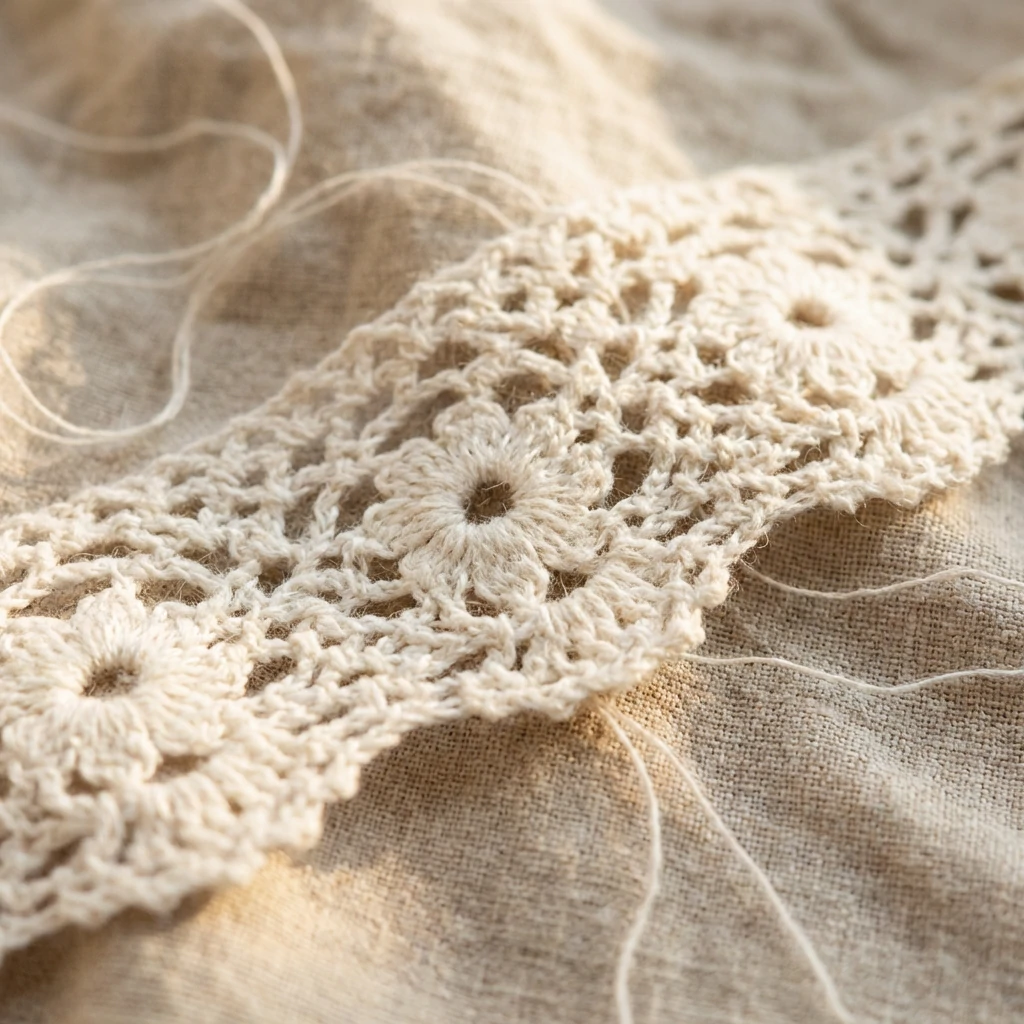
Write down the defect definitions too, because generic standards do not always describe lace-specific issues well — uneven scallop pitch, missed picots, motif distortion, and needle lines. These are easier to define beforehand than interpret after delivery. This is especially important for narrow crochet trim: an inconsistent scallop may be difficult to notice on a small swatch but obvious along a finished hem.
9. Put-Up, Packing, and the Contract Itself
The last document is the least glamorous and one of the most practical. Put-up covers how goods physically arrive: yards per roll, whether splices are permitted and how many, roll and carton labelling, and shipping marks. Splice policy deserves particular attention—a cutting room planning long lays needs continuous length, and a roll delivered in several spliced sections may not meet its production needs even when the total quantity is correct.
Then the commercial terms, in the proforma invoice or contract, as numbers rather than intentions:
-
Quantity tolerance — the accepted over- or under-delivery percentage
-
Width tolerance, repeated here from the spec sheet
-
Shade tolerance, referencing the approved shade band
-
Lead time, with the clock start defined and dyeing counted separately
-
Price validity, payment terms, and Incoterms
-
Pattern exclusivity and confidentiality

Where the Emphasis Shifts, and Why the Paperwork Exists
The nine documents stay constant; their weighting does not. Babywear carries the heaviest compliance load — Class I, CPSIA, tracking labels. Lingerie and swim live on perspiration fastness and stretch recovery, and this is where the shade band earns its keep, because adjacent panels are visible against each other. Bridal leans on the sealed sample and light fastness. Outerwear and home textiles push dimensional stability and rubbing fastness forward.
Lace was sold on relationships and physical samples for most of its history. A buyer went to St. Gallen or Nottingham, felt the goods, and shook hands — the document was the sample. Two changes ended that. Supply chains stretched until buyer and mill no longer met, so trust had to become transferable. Then sustainability and safety claims became legally consequential, and an unverifiable claim turned from marketing into liability.
What did not change is the importance of pattern accuracy. On hand-made lace the skill sat in the making. On machine-made lace, much of it migrated into the pattern instruction—the punched card, and now its digital equivalent. The machine is fast and precise, so the quality of the card directly affects the result.
That is why card-development capability is worth evaluating alongside machine capacity. In-house digitizing can shorten correction cycles and keep sampling, production, and technical communication closely aligned.
Shaoxing Yituo Garment Accessories Co., Ltd. develops cards in house and runs the machines in house in Yuecheng District, Shaoxing — 146 knitting machines, 60 shuttle embroidery machines, plus our own crochet and edging equipment. We hold GRS, RCS, GOTS, OCS, BCI, OEKO-TEX STANDARD 100 Class I, and Intertek TQP. That matters here for one narrow reason: when the technical answer, the trial run, and the certificate come from one floor, approvals resolve in days rather than passing between parties.

FAQs
What is the difference between a sealed sample and a pre-production sample?
The sealed sample is the agreed reference, made at sampling stage and signed by both sides. The pre-production sample comes off a production run in your bulk yarn and approved shade, proving the reference is reproducible. You need both — the first defines the target, the second confirms the factory can hit it at scale.
Do I really need a shade band if the lab dip is approved?
If your product has adjacent panels or repeat purchases across dye lots, yes. A lab dip approves one point; a shade band approves the range around it. Without one, every roll differing slightly from the dip is arguably a defect, which serves neither side, because some variation in a wet process is unavoidable.
What is the difference between a scope certificate and a transaction certificate?
A scope certificate covers the facility and its permitted processes, renewed annually. A transaction certificate covers one shipment and confirms the certified content in the goods you received. Only the TC ties the claim to your order, which is what auditors want.
Can a transaction certificate be issued after production?
Not if the material was not sourced and documented as certified at every required step. Declare the requirement at enquiry, before sampling, so the correct certification process can be planned from the beginning.
Which OEKO-TEX product class do I need?
Class I for baby articles, the strictest of the four. If you make babywear, ask for the product class rather than accepting the logo alone. Ours is Class I.
How long does the approval process add to my lead time?
Colour is the main variable: lab dips 2 to 3 days, bulk dyeing 3 to 5. Document review is usually faster and often runs in parallel. Time lost to approvals is small next to time lost re-running the wrong shade.
Who pays if bulk does not match the approved sample?
Responsibility should follow the agreed contract, the approved references, and the inspection evidence. If bulk falls outside the documented tolerances, the contract should state the remedy and how both parties will handle it. That is the purpose of these nine documents: to replace subjective negotiation with a clear process.
Starting a Project
Send us your physical sample or artwork with the parameters above. If colour is part of the brief, include your swatch or Pantone reference and the dyeing standard you test against. If you need a transaction certificate, say so in the first email so the correct sourcing and documentation process can be arranged from the start.



 WhatsApp Us