The first time I specified "embroidery lace" on a tech pack without qualifying it, I got back a sample that was technically correct and completely wrong. I had pictured a dense, sculptural floral motif with scalloped edges. What arrived was a delicate embroidered net — pretty, but far too sheer to carry the bodice I had designed.
That was my introduction to a distinction most spec sheets bury: chemical lace and mesh tulle embroidery are both sold as embroidery lace, and they are not interchangeable. One is embroidery with the ground fabric chemically dissolved away, leaving pure thread. The other is embroidery stitched onto tulle that stays put.
Here's the short answer before we go deep. Chemical lace gives you dimensional, opaque, self-finishing motifs at a higher price per yard and a heavier hand. Mesh tulle embroidery gives you sheer, lightweight, budget-friendly coverage that drapes beautifully but relies on a net that can snag. The rest of this guide covers how each is manufactured, exactly where the cost gap comes from, how they behave after twenty washes, and which garments each one belongs in.
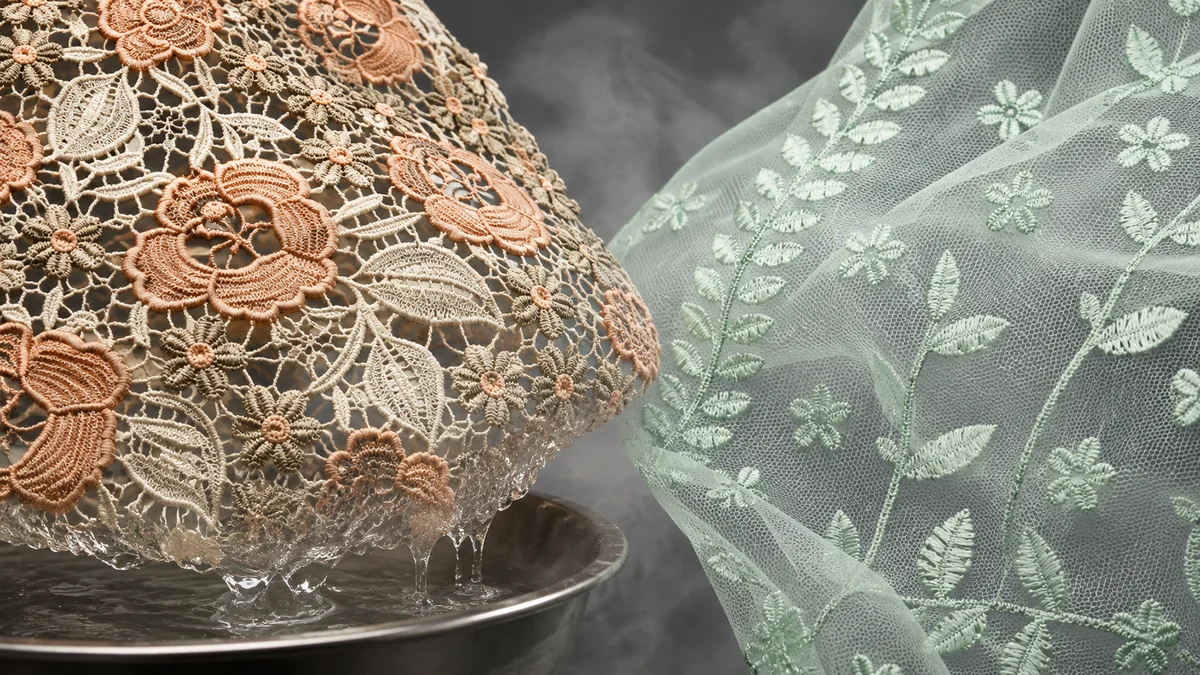
What Chemical Lace and Mesh Tulle Embroidery Actually Are
Both names describe a process, not a pattern — which is why two fabrics with identical motifs can behave nothing alike.
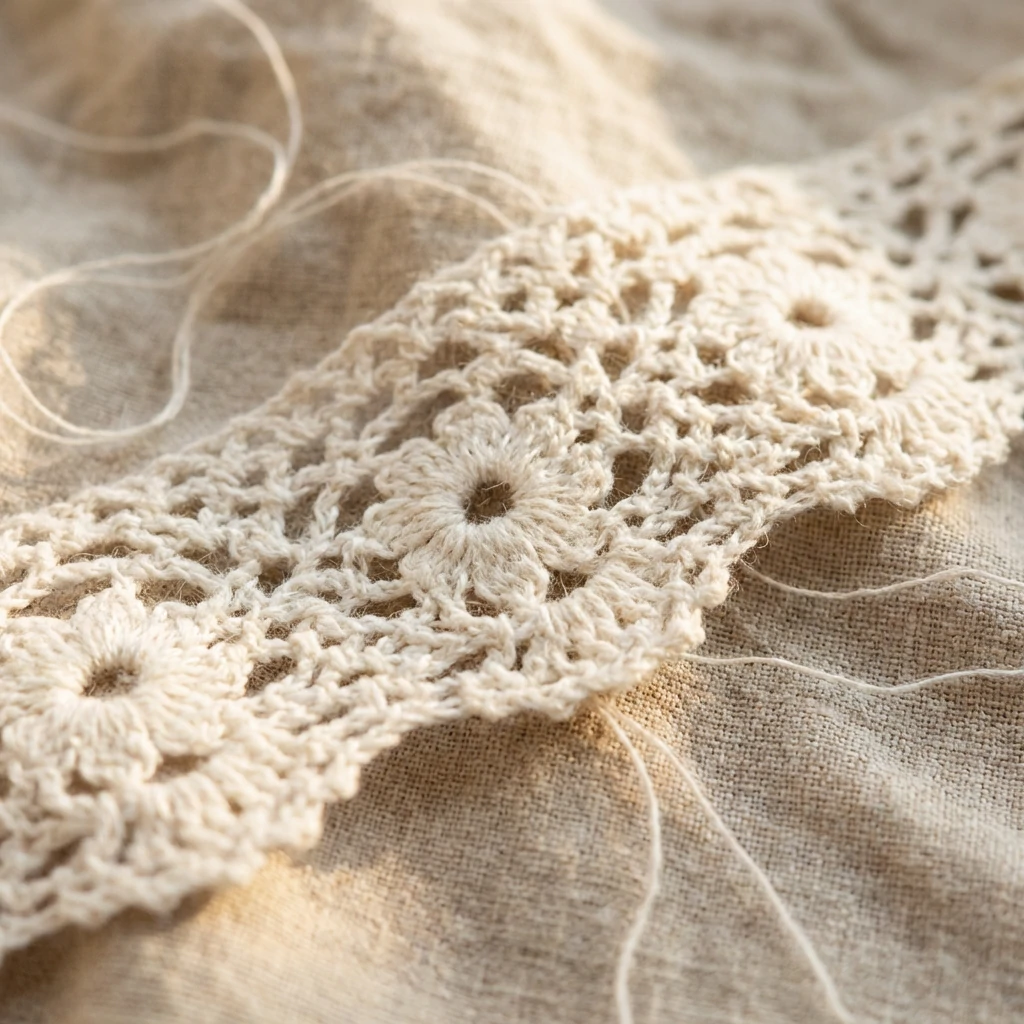
Chemical lace — also called water-soluble lace, and often sold under the broader label guipure lace — starts as embroidery stitched onto a temporary backing. That backing is then dissolved, and what remains is lace built entirely from thread. No ground fabric, no net, just the embroidered structure holding itself together. The name is a holdover from the original method, which used harsh chemicals to eat away the base cloth.
Mesh tulle embroidery is embroidery applied to a fine nylon or polyester net that stays in the finished fabric. The tulle is the canvas and the substrate, so you get a semi-sheer ground with the motif floating on it. This is what most people picture when they hear embroidered tulle fabric.
The distinction in one line: chemical lace subtracts its base, tulle embroidery keeps it. Weight, opacity, edge finishing, price, and failure mode all follow from that single difference.
How Each Fabric Is Made
This is the part worth understanding properly, because the manufacturing route explains every trade-off further down.
The Chemical Lace Process
Production runs in four stages, and each one adds cost.
-
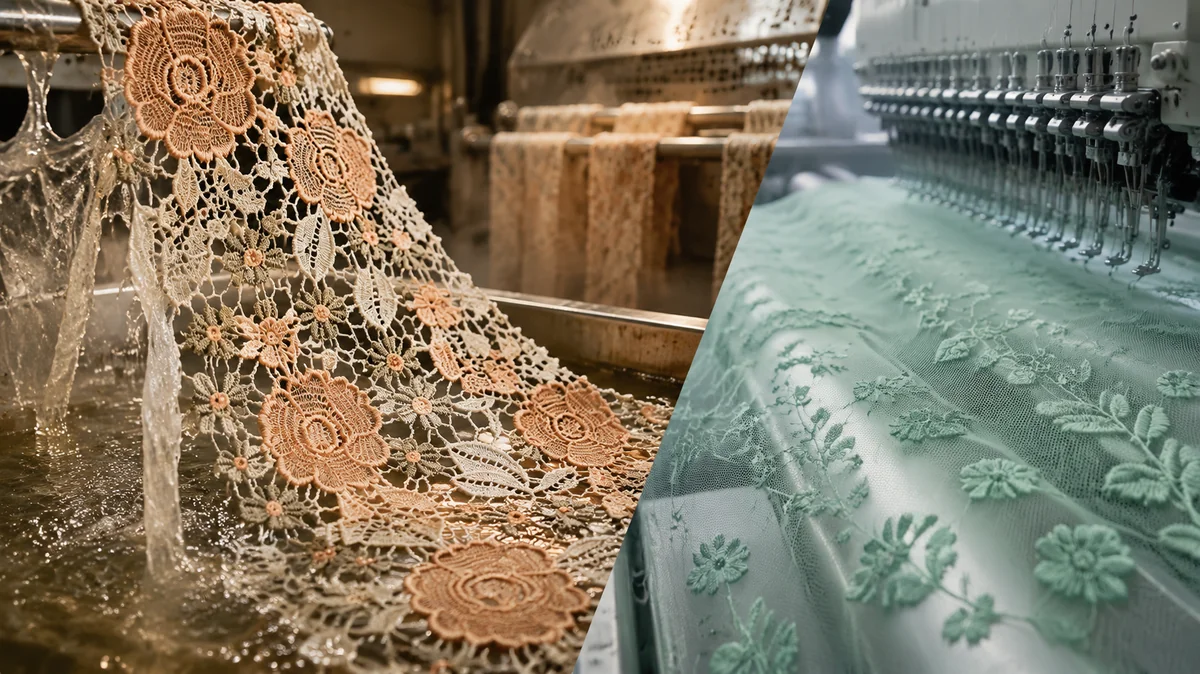
Stitching onto a sacrificial base. Embroidery is worked at high thread density onto a water-soluble substrate — usually a PVA film or a water-soluble non-woven. Historically mills used acetate dissolved in caustic soda, which is where "chemical" came from. Most modern production has moved to hot water for worker safety and easier effluent handling.
-
Building a self-supporting structure. This is the critical engineering step. Because the base will disappear, every motif has to be physically connected to its neighbors by stitched bridges, or bars, sometimes called brides. Miss a connection and the design falls apart in the wash tank. The result? The design work is genuinely harder than it looks, and the stitch count runs far higher than decorative embroidery needs.
-
Dissolving the base. The embroidered panel goes into a hot water bath, typically in the 80–95°C range depending on the substrate, until the backing is fully gone. Time, water, and energy all get consumed here, and the bath has to be controlled so the thread itself is unaffected.
-
Finishing. The lace is dried, sometimes heat-set or stiffened, then inspected. Any broken bridge becomes a hole, so inspection is slow and rejection rates are real.
The Mesh Tulle Embroidery Process
By comparison, this route is short. The tulle is loaded onto a Schiffli or multi-head machine, the motif is embroidered directly onto the net, and the panel is trimmed, cleaned of jump threads, and inspected. That's it — no dissolving stage, no bath, no drying cycle.
The tulle also does structural work that thread would otherwise have to do. Motifs don't need to connect to each other because the net already holds everything in place. Meaning designers get real freedom: scattered, airy, isolated motifs are easy here and difficult or impossible in chemical lace.
The Cost Gap, Broken Down
Designers usually know chemical lace costs more. What's less obvious is why, and that matters — because two of the four cost drivers are things you can influence at the design stage.
| Cost factor | Chemical lace | Mesh tulle embroidery |
|---|---|---|
| Thread consumption | Very high — thread is the entire fabric, plus connecting bars | Moderate — motif only, net does the rest |
| Machine time | Long, driven by dense stitch counts | Shorter, sparse motifs run fast |
| Extra process stages | Dissolving bath, drying, heat-setting | None |
| Ground fabric cost | Sacrificial base is consumed and discarded | Tulle is cheap and stays in the product |
| Reject rate | Higher — a broken bridge is a hole | Lower — net contains most stitch faults |
| Typical relative price | Roughly 2–4× the tulle equivalent | Baseline |
Treat that price multiple as a working range, not a quote. Actual pricing swings hard on stitch density, yarn type, width, and order quantity — a fine viscose chemical lace and a coarse polyester one can differ more from each other than from tulle embroidery. Always cost against a real sample.
The two levers you control are stitch density and motif connectivity. A designer who spaces motifs so they naturally touch reduces the number of connecting bars the mill has to add, and that trims both thread and machine time. I've seen a redraw of the same floral cut sample cost meaningfully just by closing the gaps between repeats.
Durability: How Each One Actually Fails
This is where the comparison gets practical, because the two fabrics don't wear out the same way. They fail differently, and knowing the failure mode tells you where each belongs.
Chemical lace fails at the bridges. Its strength is that it's all thread — dense, cohesive, and surprisingly tough in tension. There's no fine net to ladder, so it shrugs off the snags that destroy tulle. The weakness is that every connecting bar is a single point of failure. Snap one and you get a hole that grows, because that bar was carrying load for the whole motif. Repair is possible but fiddly.
Mesh tulle embroidery fails at the net. The embroidered motif itself is usually robust — it's the ground that gives out. Fine tulle snags on jewelry, zippers, and rough seams, and one pulled filament can run into a visible ladder across an otherwise perfect panel. The motif survives; the fabric around it doesn't.
| Durability factor | Chemical lace | Mesh tulle embroidery |
|---|---|---|
| Snag resistance | Strong — no fine net to catch | Weak — net catches easily |
| Tensile strength | Higher, thread-dense structure | Depends on net gauge |
| Primary failure mode | Broken connecting bar → spreading hole | Snagged filament → ladder |
| Wash tolerance | Good; cool gentle wash, avoid agitation | Good; needs a mesh bag |
| Edge stability | Self-finishing, won't fray | Cut edges need finishing |
| Repairability | Difficult but possible | Motif repairable, ladders rarely are |
That edge stability line deserves emphasis, since it's the single most underrated advantage on this list. Chemical lace can be cut along its scalloped border and used raw — no hem, no binding, no facing. Tulle embroidery cut off-motif leaves you with visible net that almost always needs finishing.
The Main Types You'll Be Offered
Neither category is one product, and specifying the sub-type saves a sampling round.
Chemical lace variants:
-
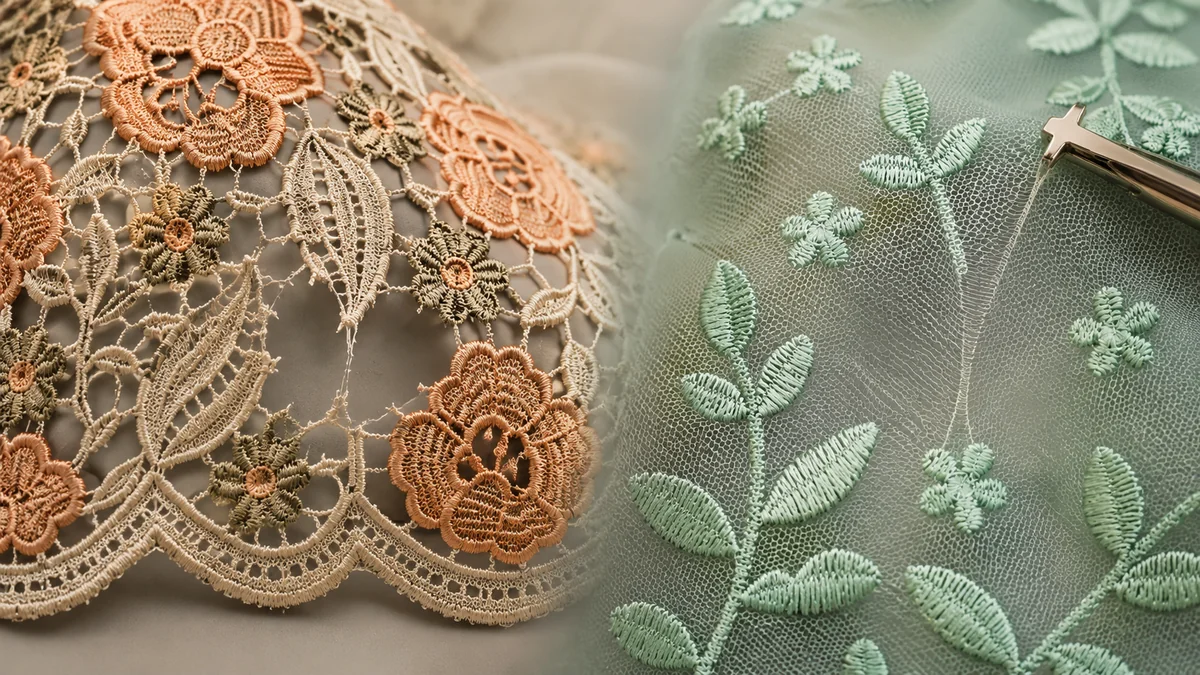
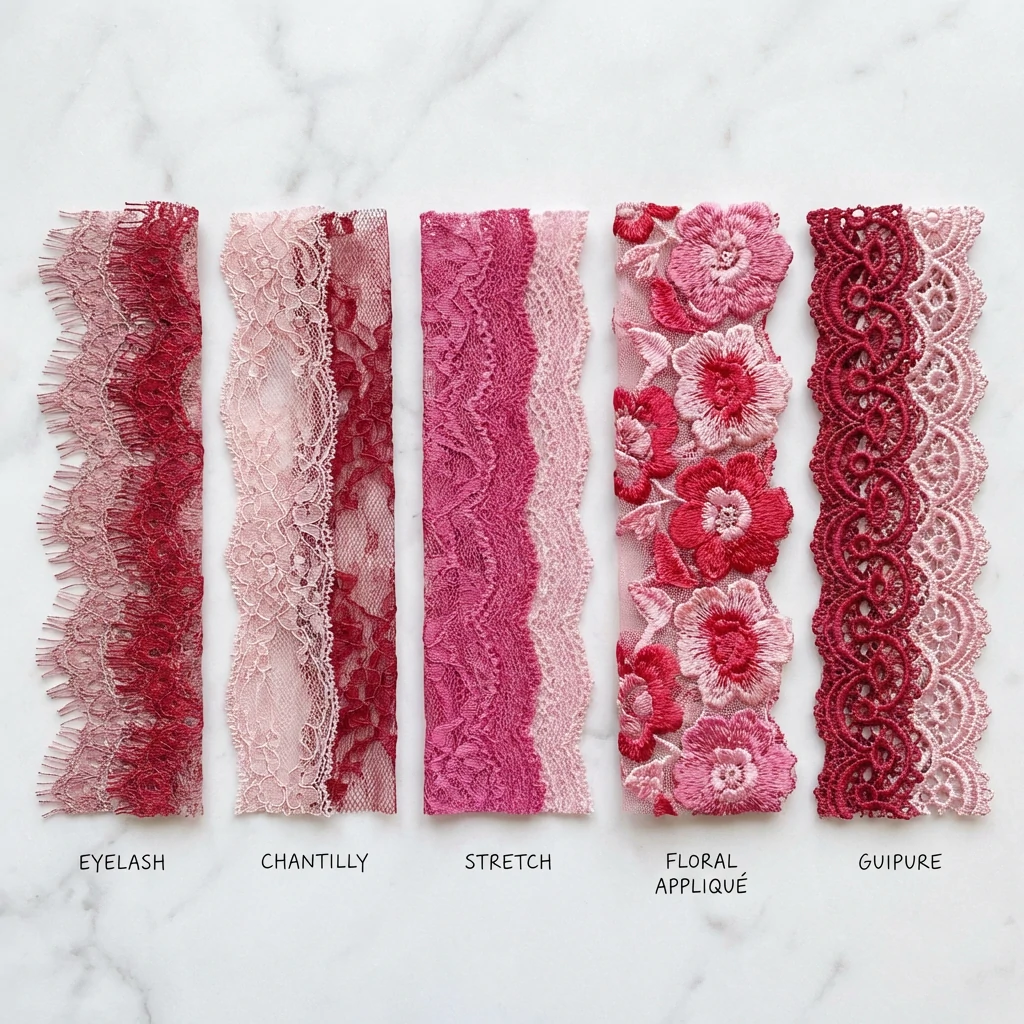
Guipure lace — heavy, boldly dimensional motifs joined by prominent bars. The classic bridal and couture option.
-
Venise lace — raised, almost sculptural needlepoint-style motifs, common as appliqué and trim.
-
Corded chemical lace — a heavier outlining cord follows the motif edge, adding visible relief and definition.
-
Water-soluble trims and appliqués — motifs produced as individual pieces rather than continuous yardage.
Mesh tulle embroidery variants:
-
Embroidered tulle fabric — scattered or all-over motifs on standard net, the everyday overlay workhorse.
-
Beaded or sequined tulle embroidery — embellishment worked in alongside the thread for surface interest.
-
Stretch mesh embroidery — motifs on an elastic net base, essential for close-fitting and lingerie work.
-
Corded tulle lace — cording on net, splitting the difference between the two families in weight and definition.
That last one is worth knowing about. When a design needs more presence than plain tulle embroidery but the chemical lace budget isn't there, corded tulle lace is often the honest compromise.
Where Both Techniques Came From
A little history explains why chemical lace still signals luxury.
Global Origins
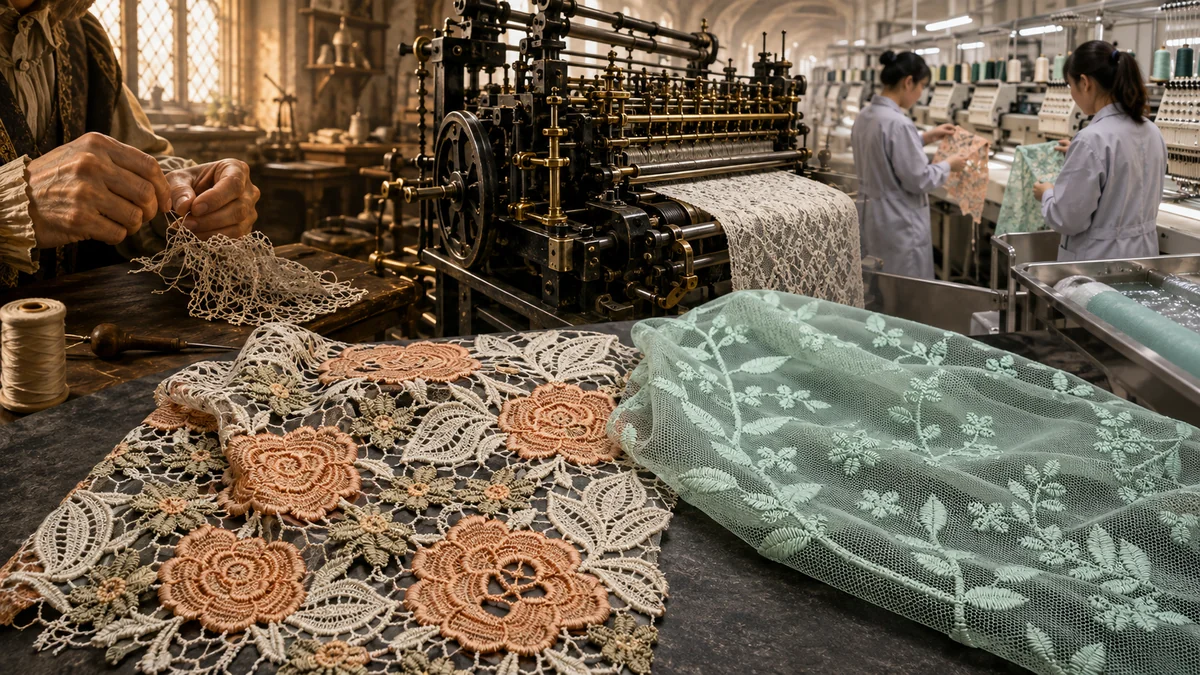
Handmade needle lace came first — Venetian punto in aria in the 16th century built lace entirely from thread, motifs joined by hand-worked bars, no ground fabric at all. It took hundreds of hours per piece and was priced accordingly. The mechanical era arrived with the Schiffli embroidery machine in 19th-century St. Gallen, Switzerland, which used a shuttle to lockstitch across wide fabric widths at scale.
Chemical lace was the marriage of the two ideas. Mills realized that if you embroidered a needle-lace structure onto a base you could then destroy, you could mass-produce something that looked like Venetian handwork. Machine-made tulle, already established from the early 1800s, gave the other branch its canvas.
Regional Craft and Modern Manufacturing
St. Gallen set the quality benchmark that European lace still trades on. Production later concentrated in Asia — particularly China's textile clusters — where Schiffli capacity, water-soluble substrate supply, and dissolving-line infrastructure sit close together. That proximity is why chemical lace became commercially viable at mid-market prices at all.
A capable manufacturer runs both routes on the same floor, and that's more useful to a designer than it sounds. At Yi Tuo we produce chemical lace and mesh tulle embroidery in-house, which means we can sample one motif both ways so you can weigh hand, opacity, and cost side by side before committing to bulk. It also means the substrate choice, dissolving temperature, and yarn spec are controlled in one place rather than split across vendors — the practical difference between a sample you can reorder and one you can't.
Choosing for the Garment
Match the fabric to the job the fabric has to do.
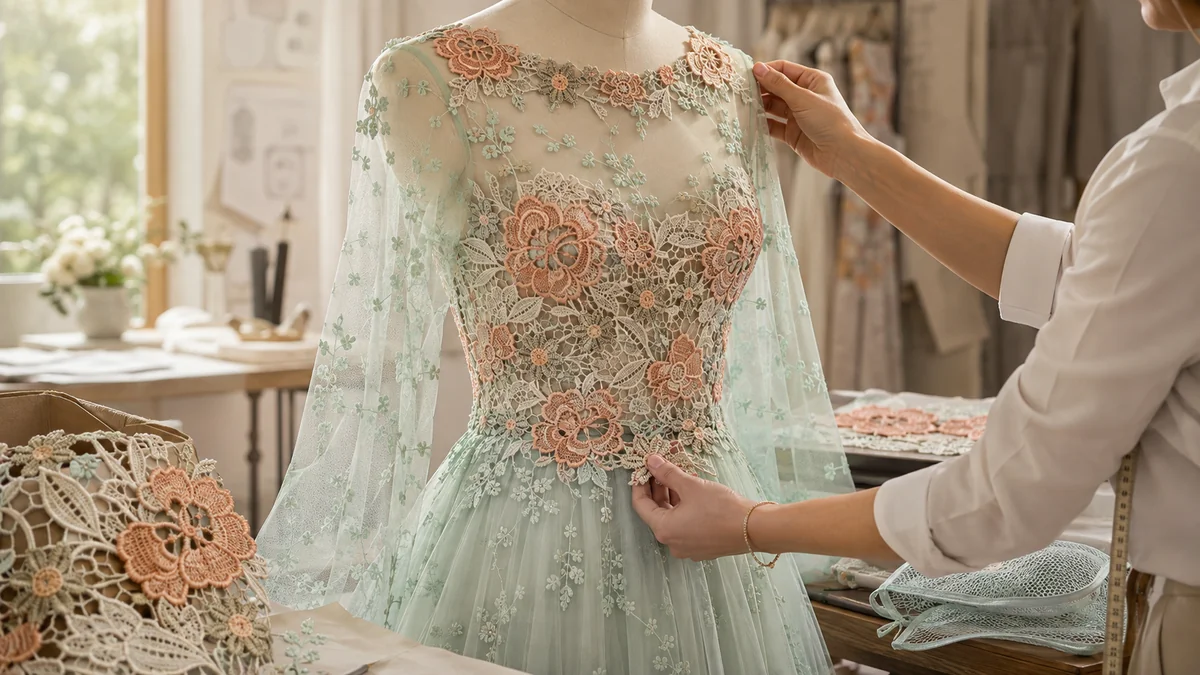
Reach for chemical lace when the design needs a defined edge you don't want to hem, structural presence in a bodice or panel, appliqué that reads dimensional on camera, or opacity without a lining. Bridal, occasionwear, and statement necklines are its home. The weight is a feature there, not a flaw.
Reach for mesh tulle embroidery when the design needs sheerness, fluid drape, illusion panels or sleeves, lightweight all-over coverage, or a large area covered on a real budget. It's the right call for soft romantic silhouettes and anywhere the fabric should disappear into the skin.
A common professional approach uses both: tulle embroidery for the sheer body, chemical lace appliqué at the neckline and hem where definition matters. The two share a motif language well as long as you match yarn color and luster across both.
Care for both is similar and simple. Hand wash cool or dry clean, never wring, and lay flat to dry. Wash tulle embroidery in a mesh bag to keep the net off zippers. Press on the reverse through a cloth on low heat, since both are usually polyester or nylon and will glaze under a hot iron. Store chemical lace flat — hanging lets its own weight pull on the connecting bars over time.
FAQs
What is chemical lace? Chemical lace is embroidery stitched onto a dissolvable backing which is then washed away, leaving lace made purely of thread with no ground fabric. The motifs are held together by stitched connecting bars. The name comes from the original process, which used chemicals to dissolve the base; most mills now use hot water.
Is chemical lace the same as guipure lace? Effectively yes in commercial use — most guipure sold today is chemical lace. Strictly, guipure describes the look: bold motifs joined by visible bars, with no net ground. Chemical lace describes the method used to achieve it.
Why is chemical lace more expensive than embroidered tulle? Four reasons stack up: it consumes far more thread because thread is the whole fabric, it needs much longer machine time at high stitch density, it requires a sacrificial base that's consumed and discarded, and it adds a dissolving and drying stage tulle embroidery skips entirely. Higher reject rates add to that.
Which is more durable, chemical lace or mesh tulle embroidery? Chemical lace is generally tougher in wear because it has no fine net to snag or ladder. But it has a specific vulnerability: break one connecting bar and you get a hole that spreads. Tulle embroidery's motifs hold up well while its net is the weak point.
Can chemical lace be cut without hemming? Yes, and it's one of its best features. Cut along the scalloped border and the edge is self-finishing — no hem, binding, or facing needed, since the thread structure is already closed. Cut across the middle of a motif and you'll need to secure it.
Is water-soluble lace the same as chemical lace? They refer to the same family of fabric. "Water-soluble" describes the modern substrate that dissolves in hot water; "chemical lace" is the older industry term. You'll also see "water soluble embroidery lace" used for the same product.
How do you wash chemical lace without damaging it? Hand wash in cool water with mild detergent, or dry clean. Don't wring, twist, or tumble dry — press water out gently and lay flat. Store it flat rather than hanging so its own weight doesn't stress the connecting bars.
Can I order both chemical lace and embroidery lace by the yard from one supplier?


 WhatsApp Us