
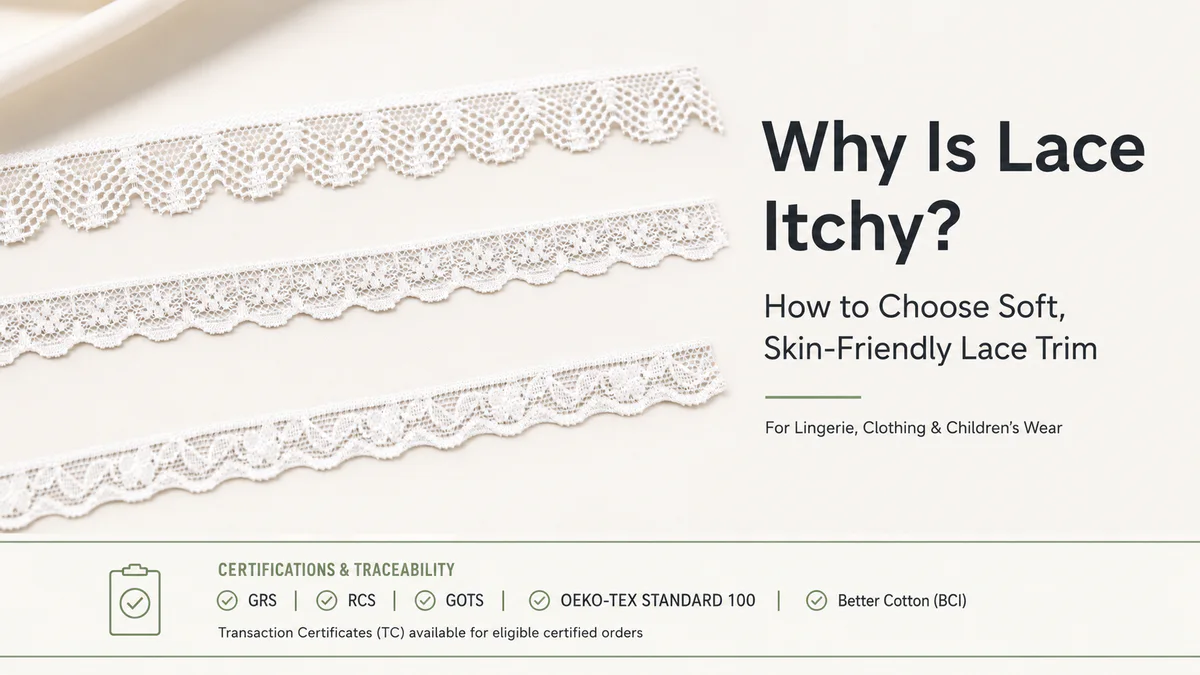
Introduction
Lace should add detail to a garment without making it uncomfortable. When lace feels itchy, the problem is usually not the pattern. It is more often caused by coarse yarn, a stiff finishing treatment, exposed thread ends, or the wrong lace structure for direct skin contact.
This article explains why lace is itchy and how to choose soft lace trim for lingerie, necklines, sleeves, children’s wear, and other clothing. For apparel brands and garment factories, these checks can also reduce comfort complaints before bulk production begins.
Why Is Lace Itchy?
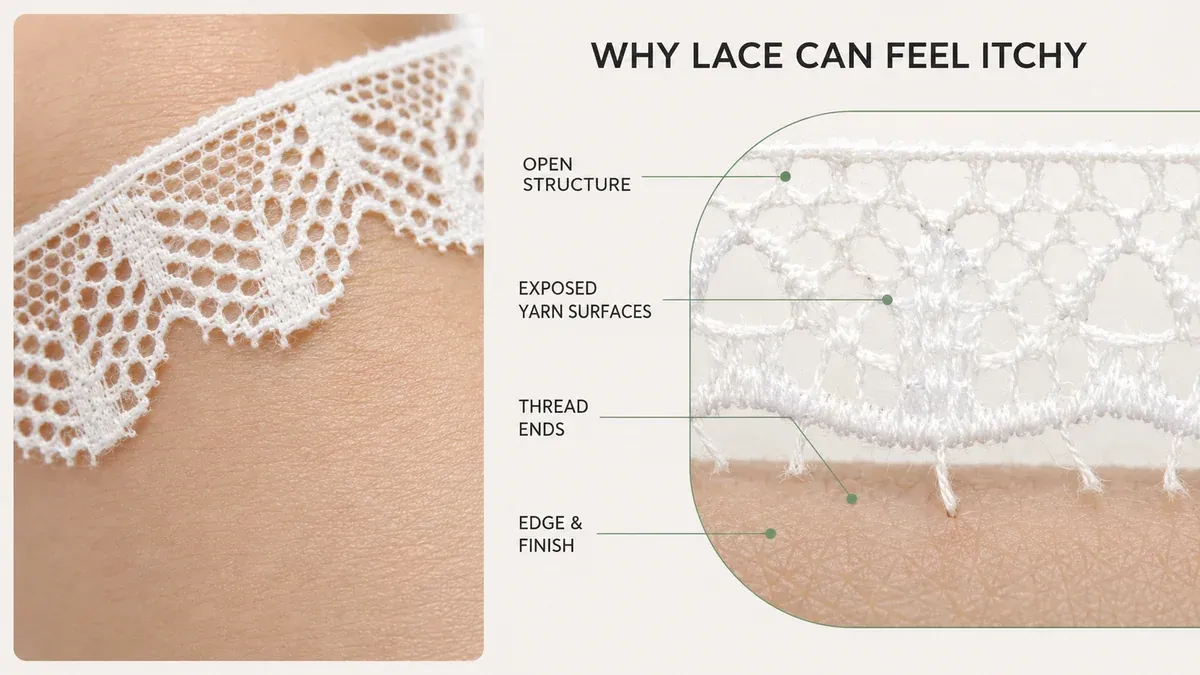
Lace has an open structure. Unlike a solid woven fabric, more yarn surfaces and thread ends remain exposed against the skin. This makes the choice of yarn, finish, edge, and construction especially important.
Most itchy lace can be traced to the following causes.
1. Coarse yarn or filament
Polyester and nylon are not automatically uncomfortable. Fine microfiber nylon and well-finished synthetic yarn can produce very soft lace for lingerie. Problems are more likely when the yarn is thick, rigid, highly twisted, or contains hard filament ends.
Natural fiber is not a guarantee of softness either. Short-staple cotton, dense embroidery, or a rough edge can still irritate the skin. Yarn quality and construction matter as much as fiber content.
2. Stiff finishing treatments
Sizing, resin, starch, and heat-setting treatments help lace keep its shape during production, packing, and transport. If the finish is too heavy, the lace may feel crisp or scratchy.
Some surface stiffness becomes weaker after washing. Stiffness caused by coarse yarn or dense construction usually does not.
3. Rough edges and exposed thread ends
The edge of a lace trim often touches the skin more than the main pattern. Hard scallops, poorly trimmed yarn ends, or a rough sewing edge can make an otherwise attractive lace uncomfortable.
This is especially important for lace used on bra bands, necklines, cuffs, underwear, and children’s clothing.
4. Dense or unsuitable construction
A lace can be well made but still be wrong for a particular garment. Guipure lace and heavily embroidered lace are designed to hold a clear shape. They may work well on an outer layer, collar, or bridal appliqué but feel too firm for a close-fitting bralette.
Soft lace trim for direct skin contact normally needs finer yarn, lower bulk, a smooth back, and enough flexibility to move with the garment.
5. Garment construction
Sometimes the irritation comes from the seam rather than the lace itself. Thick seam allowances, tight elastic, hard labels, and uncovered attachment edges can all create friction.
Before changing the lace, check which part of the finished garment is actually touching the skin.
6. Sensitive skin or chemical irritation
People with eczema, dry skin, or sensitivity to certain dyes and finishes may react more strongly. If irritation includes redness, swelling, or a persistent rash, stop wearing the garment and seek medical advice.
For lace for sensitive skin, request clear fiber information and relevant chemical-safety test reports. OEKO-TEX certification can support harmful-substance screening, but it does not by itself prove that a lace will feel soft or will not irritate every wearer.
How to Tell If Lace Is Good Quality
Appearance alone cannot tell you whether a lace is suitable for skin contact. Evaluate a production sample with the same finishing treatment that will be used for the bulk order.
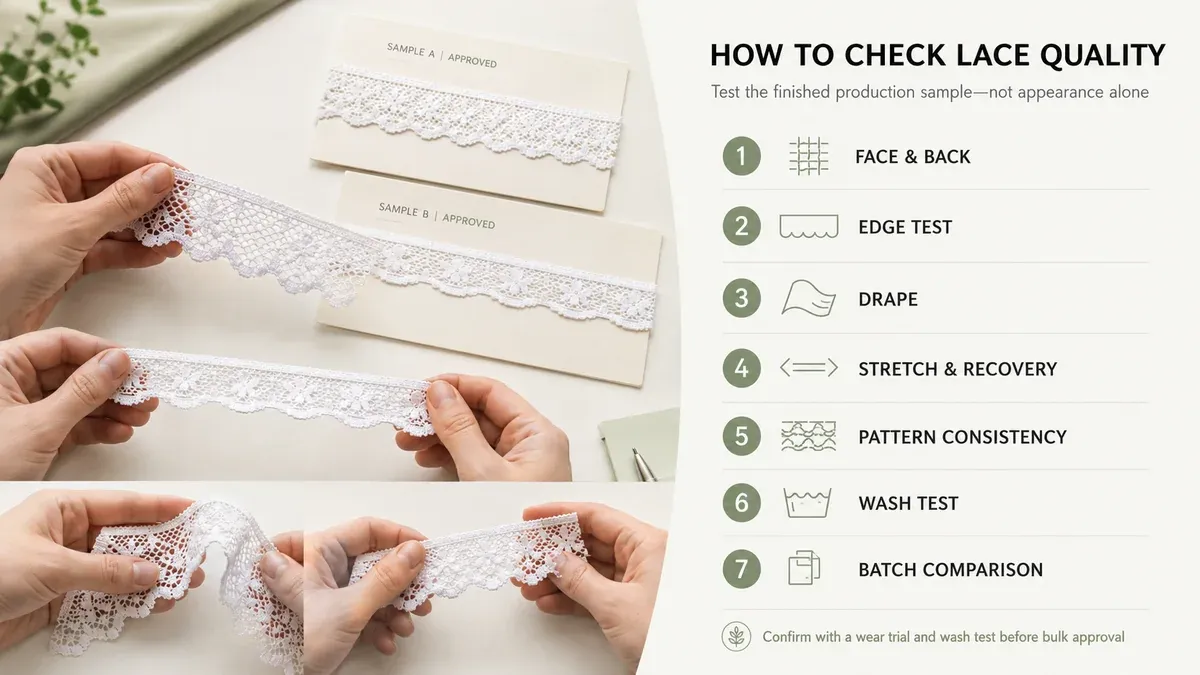
Use these checks:
- Touch the face and back. The back should not contain hard knots, raised thread ends, or rough areas.
- Test the edge. Rub the scalloped edge and sewing edge lightly against the inner wrist. A sharp or prickly edge may become more uncomfortable in a finished garment.
- Check the drape. Soft lace trim should fold naturally for its intended use. A lace that holds a paper-like shape may be too heavily finished or too dense.
- Stretch and release it. Stretch lace should return close to its original width without waving, curling, or losing shape.
- Inspect the pattern. Look for even embroidery, clean motifs, consistent width, and stable edges.
- Wash the sample. Recheck hand feel, shrinkage, color, edge shape, and stretch recovery after the required wash process.
- Compare batches. For repeat orders, compare hand feel and color with the approved standard sample.
The wrist test is useful for screening, but a wear trial and wash test give a better picture of how skin-friendly lace trim will perform in the finished garment.
How to Choose Soft Lace Trim
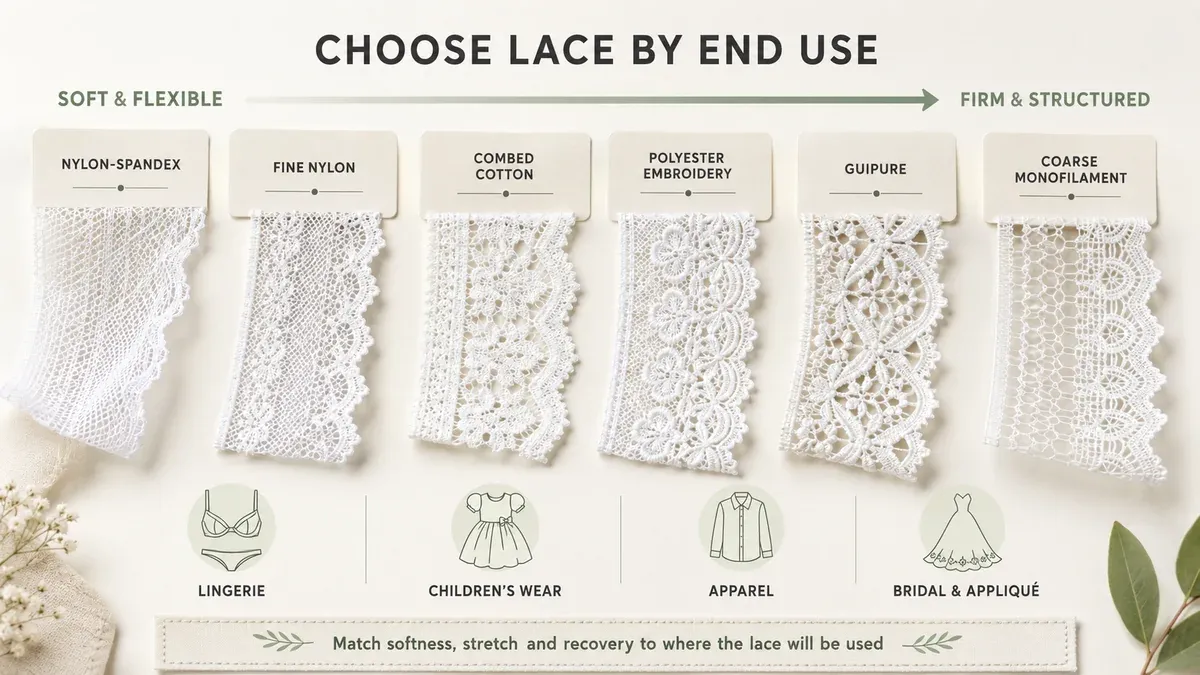
The best lace depends on where it will be used. Lace for an outer bridal appliqué does not need the same softness, stretch, or recovery as lace for a bra band.
Lace type | Typical feel and performance | Suitable applications |
|---|---|---|
Fine nylon and spandex stretch lace | Soft, flexible, good recovery | Lingerie, underwear, fitted apparel |
Fine nylon lace | Lightweight and smooth when properly finished | Bralettes, sleepwear, delicate trims |
Combed cotton lace | Matte, breathable, soft natural hand | Children’s wear, blouses, sleepwear |
Polyester embroidered lace | Stable and durable; softness depends on yarn and finish | Dresses, cuffs, collars, decorative trim |
Guipure or water-soluble lace | Firm, dimensional, structured | Bridalwear, outer decoration, appliqués |
Coarse monofilament lace | Rigid or prickly | Non-skin-contact decoration |
Soft lace for lingerie
For lingerie, look for fine nylon or nylon-spandex lace with a smooth back and controlled stretch recovery. The lace should move with the body without creating a hard edge.
Check both stretch directions, recovery, edge softness, and comfort after washing. A lace that feels soft before sewing may still cause irritation if the elastic tension or seam construction is too tight.
Skin-friendly lace trim for clothing
For necklines, sleeves, cuffs, and other areas worn against the skin, choose a clean edge and a soft back. The lace should match the base fabric in weight and flexibility so that the seam does not become rigid.
For children’s wear and sensitive-skin products, use low-bulk structures, controlled finishes, and verified colorfastness. Cotton lace can be a suitable option, but it should still be tested for yarn quality, shrinkage, and edge feel.
Structured lace for decoration
Guipure, corded lace, and dense embroidery are useful when the design needs shape and definition. They are better placed on outer layers, panels, collars, or appliqués unless a soft lining separates them from the skin.
The goal is not to make every lace equally soft. It is to match the lace structure to the garment.
Can You Soften Itchy Lace?
If the lace is stiff because of surface sizing or production residue, washing may improve the hand feel. Follow the care instructions and test a small piece first.
Use a mild detergent, cool water, and gentle handling. Do not wring the lace. Reshape it and dry it flat. Avoid untested softeners or high heat, especially on stretch lace, because they may affect elastane, color, or finishing performance.
If the roughness comes from coarse filament, hard embroidery, or exposed edges, washing will not solve the main problem. The practical options are:
- Add a soft lining or binding.
- Move the lace away from direct skin contact.
- Cover the rough attachment edge.
- Replace it with a softer lace trim.
For garment production, it is more reliable to approve a washed sample before bulk ordering than to try to soften finished garments later.
Sourcing Soft Lace Trim for Bulk Production
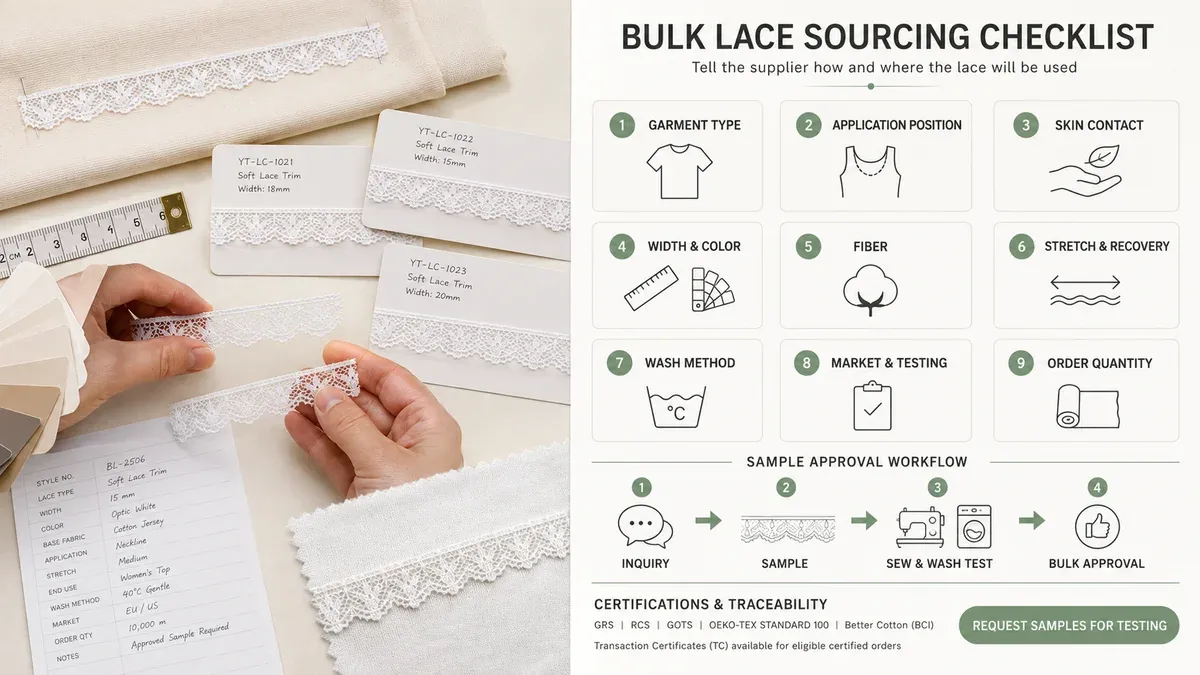
When requesting soft lace trim from a manufacturer, “soft” is not enough information. The supplier needs to know how the lace will be used.
Include the following details in your inquiry:
- Garment type
- Position on the garment
- Whether the lace touches the skin
- Required width and color
- Fiber preference
- Stretch direction and recovery requirement
- Wash method
- Target market and testing requirements
- Order quantity
Ask for a sample in the intended color and finish. If possible, sew it to the actual base fabric and complete a wash and wear test. This checks the lace, seam, elastic tension, and garment construction together.
Yi Tuo produces cotton, polyester, nylon, embroidered, and stretch lace trim for lingerie and clothing. We hold valid GRS, RCS, GOTS, and OEKO-TEX certifications and participate in the Better Cotton (BCI) program. Applicable Transaction Certificates (TC) can be provided for eligible certified orders. Buyers can compare different yarns, structures, widths, and finishes before approving bulk production.
Need soft lace trim for direct skin contact? Send us the garment type, application position, width, stretch requirement, color, and order quantity. We can recommend suitable options and provide samples for testing.
FAQs
Why is lace itchy even when it looks soft?
Lace has an open structure, so more yarn surfaces and thread ends touch the skin. Coarse yarn, heavy finishing, rough edges, or a hard seam can make delicate-looking lace feel itchy.
Why is new lace stiff?
New lace may contain sizing, resin, or another finishing treatment that helps it keep its shape during production and transport. Washing may reduce surface stiffness, but it will not change a coarse yarn or dense structure.
How can I tell if lace is good quality before buying?
Check the front, back, and edges for rough areas. Test the drape and stretch recovery, then wash the sample and check it again. For bulk production, compare the sample with the approved quality standard.
What is the best soft lace for lingerie?
Fine nylon lace and nylon-spandex stretch lace are common choices because they can provide a smooth hand, flexibility, and recovery. Final comfort still depends on the yarn, finish, edge, elastic tension, and seam construction.
Is cotton always the best lace for sensitive skin?
No. Combed cotton lace can feel soft and breathable, but low-quality cotton yarn or dense embroidery can still be rough. Fine synthetic microfiber lace may feel softer than poorly finished cotton lace. Always test the finished sample.
How do I soften itchy lace?
If surface finishing causes the stiffness, a gentle wash with mild detergent may help. If the problem comes from coarse filament or rough edges, use a lining, cover the edge, move the lace away from the skin, or replace it with softer lace trim.
Is all synthetic lace itchy?
No. Fine microfiber nylon and well-finished nylon-spandex lace can be soft enough for lingerie and close-fitting clothing. Fiber thickness, construction, and finishing are more useful quality indicators than the word “synthetic” alone.
Discuss a real requirement
Turn the reading into a practical next step.
Send a short note, product reference, photograph, swatch or tech pack. Technical feasibility, sampling, documentation and production terms are confirmed after review.
Start an inquiry