That request is rarely an aesthetic objection. It means the artwork arrived without the four conditions that decide platform feasibility: whether the pattern runs unbroken, what its repeat has to reconcile with, whether it lands on yardage or on a finished item, and how many colours change in one pass.
Settle those four before anyone opens a digitising file. Schiffli is not the premium default and multi-head is not the volume default. Each becomes the wrong platform the moment one of the four conditions goes against it, and neither can be judged from a picture of the motif.
Four Motif Properties Decide the Platform
What the platform name will not tell you
Pattern continuity, repeat relationship, placement mode and colour plan decide the platform. Working width and head count do not, because those are model-level numbers that no platform name carries.
| Motif property | Continuous Schiffli route | Multi-head route | What the factory needs from you |
|---|---|---|---|
| Pattern continuity | Built for a pattern running unbroken across the ground | Runs one design per head, each head on its own piece | Continuous run, or separate units |
| Repeat geometry | Nominal repeat is a multiple of needle spacing | Motif spacing follows head distance and framing | Repeat length, seam position, how the two sides join |
| Placement | Suits yardage; a fixed coordinate is a constraint | Places a motif on a cut panel or made-up item | What the motif lands on, and where |
| Colour changes | Colour count is a setup value entered before preparation | Automatic colour change handles multi-colour work | A locked colour plan, not a suggestion |
| Ground and post-process | Ground stays as fabric, or dissolves away afterwards | Ground is the garment or panel itself | Base cloth, its finish, any dissolving step |
When the design contradicts itself
A continuous border that also carries an isolated crest gives you two rows pointing in opposite directions. The platform choice is then no longer available from the drawing. Split the design, or accept two operations.
Continuous Patterns Live or Die on Repeat Geometry
Repeat is machine arithmetic, not a drawn width
A Schiffli repeat is a multiple of the machine's needle spacing. Digitising software will not calculate a nominal repeat until four setup values are entered: needles per head, distance between heads, colour count, and how many needles are actually in use. Change one and the repeat changes with it.
A width taken off a tech pack is therefore a target, not a repeat. The machine grid either accommodates it or refuses it.
The join is what gets redrawn
Where the pattern crosses the frame, the two sides of the repeat have to meet without a visible break. A motif drawn as one self-contained unit carries no join logic, so the redraw request lands on that boundary rather than on the motif.
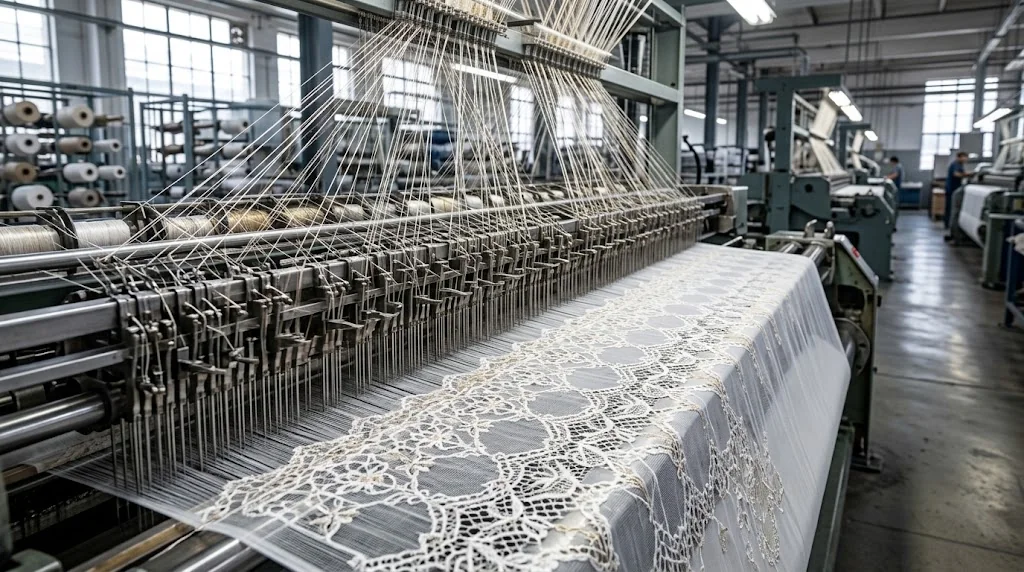
Continuous mesh and tulle embroidery lace is the natural output of this route, since the ground stays in place and carries the pattern across the full run. It qualifies once the repeat resolves against the actual needle configuration and the join holds when the finished ground is stretched by hand.
Naming the craft settles nothing. are technique labels, and each still faces the same repeat arithmetic.
Isolated Placement Is a Frame Question
A single crest on a finished shirt front is a framing problem, not a head-count problem.
Multi-head names a family, not a work envelope
Head count, needles per head, maximum embroidery field and available frames are model-level entries on a specification sheet. Two machines both called multi-head can differ on every one of them. Ask which model will run your order, then ask for its field dimensions in the frame you actually need — a border frame and a one-point frame do not give the same usable area.
Repeated placement is where alignment cost hides
Repeated small motifs across a made-up garment turn into a re-hooping exercise, and registration tolerance is set by the frame rather than by the machine. One-point frames exist for shirts, bags, trousers and pockets precisely because hooping those shapes by hand does not hold alignment.
The sit downstream of this: how the piece was held during embroidery shapes the finished trim more than the look suggests. Treat frame availability as a quotation line item, not a detail the factory absorbs.
Most Late Revisions Are Specification Failures
The redraw request came from a missing line in the brief, not from the limits of either machine.
The digitiser fills every blank you leave
Send artwork alone and someone has to assume the ground, the repeat, the placement coordinate and the colour count. Each assumption that turns out wrong returns as a revision, and revisions get billed as sampling rounds. That is the whole mechanism behind the sampling charge nobody budgeted.
Water-soluble designs raise the stakes
Water-soluble chemical lace is the sharpest case, because the base dissolves after embroidery and every connection point then carries load alone. Specify the dissolving step at brief stage. A motif with floating elements that never connect is producible on neither platform without a redraw, and the sample shows it as a collapsed edge rather than a missing stitch.
With those lines settled, our turns a complete brief in one to three days. An incomplete brief spends that time in email.
Treat Every Published Machine Number as a Test Condition
Embroidery speed on a specification sheet is a test result. Equipment builders qualify it against the machine specification, the embroidery field, frame use, the material and the thread type. The same qualifier travels with stitch density, throughput and delivery estimates.
What you can hold a factory to
No defensible platform-level figure exists for working width, density ceiling, sampling cost, break-even quantity or lead time. A number quoted without a named machine and a trial on your ground is a hope.
Three commitments are reasonable to demand:
-
The model that will run the order, in writing
-
A sample stitched on your ground with your thread
-
A confirmed repeat and usable width after that sample, not before it
Setup and sampling cost is decided here, before digitising. per metre more sharply than most buyers expect, but that is a separate conversation once the platform is fixed.
The Brief That Prevents the Redraw
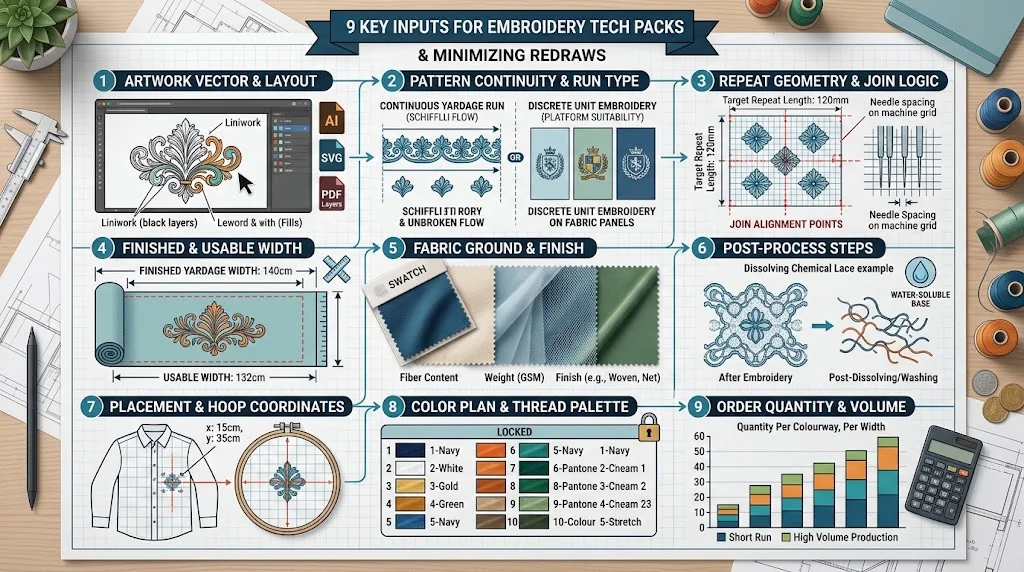
Nine inputs, sent together
| Input | State it as | What breaks if you omit it |
|---|---|---|
| Artwork | Vector or layered file, linework separated from fills | Your intent gets interpreted |
| Pattern continuity | Continuous run, or discrete units | Wrong platform assigned before costing |
| Repeat and join | Target repeat length, and where the sides meet | Repeat is recalculated and the motif redrawn |
| Width | Finished width and usable width, measured separately | Yield estimate collapses at bulk |
| Ground | Fibre, weight and finish of the base cloth | Density and hand feel move off target |
| Post-process | Dissolving, cording, beading, or none | Connection points fail once the base is gone |
| Placement and frame | Coordinate on the finished item, plus frame type | Registration drifts across units |
| Colour plan | Locked colour count and sequence | Setup is redone |
| Quantity | Per colourway, per width | The recommendation flips at another volume |
Send them before the quotation, not after
A brief arriving in instalments generates one revision per instalment. Put all nine in the first message, then ask for the machine model and the sample in the same breath. The platform answer costs nothing at that point and cannot be reversed cheaply later.
Which Platform, and When to Stop Guessing
Choose the Schiffli route when the pattern has to run unbroken across yardage, the repeat reconciles with the machine's needle spacing, and the colour plan is fixed. Choose multi-head when the motif lands at a defined position on a cut panel or a made-up item, or when the colour plan varies between units. When one product needs both, accept two operations and decide which carries the pattern and which carries the accent.


 WhatsApp Us