"Can you match this Pantone chip?"
We get that question every week, and the honest answer is yes — followed by one question back: which stage are we agreeing on? Because "matching a color" isn't one event. It's three, and each one settles something different.
We run the lab, build the shade bands, and dye the bulk in-house, so we see exactly where color programs go smoothly and where they get tangled. Almost every tangle comes down to the same thing: two of the three stages happened, and the third got compressed to save a week.
The lab dip asks can this recipe hit the color? The shade band asks what range are we both signing for? The bulk lot asks did this batch land inside that range? Run all three in order and color stops being a topic of discussion — it becomes a document.
Here's how each stage works, what we need from you at each one, and why lace behaves differently from flat woven fabric.
The Short Answer: All Three Stages at a Glance
| Lab Dip | Shade Band | Bulk Lot | |
|---|---|---|---|
| What it is | Small swatch dyed in a lab beaker to match your standard | A card showing the agreed range: light limit, standard, dark limit | The production dye lot, run on full-scale equipment |
| Question it answers | Can this recipe hit the color? | What range are we both signing for? | Did this lot land inside the range? |
| Typical size | 10–20 g swatch, submitted as 2–3 options (A/B/C) | 3–5 swatches, often full width | 300–3,000 m per lot |
| Who signs | Your designer or color manager | Your technical team and ours | Our QA at dispatch, yours on receipt |
| Typical lead time | 3–7 days | 7–14 days after lab dip approval | 2–4 weeks after shade band |
| What it protects | The recipe direction | The definition of acceptable | Delivery, with nothing left to interpret |
| Approved against | Your color standard | The approved lab dip | The sealed shade band |
Read that last row twice, because it's the row that prevents disagreements. Bulk is never judged against the lab dip. It's judged against the shade band. A lab dip is a target; a shade band is the contract that says how close counts.
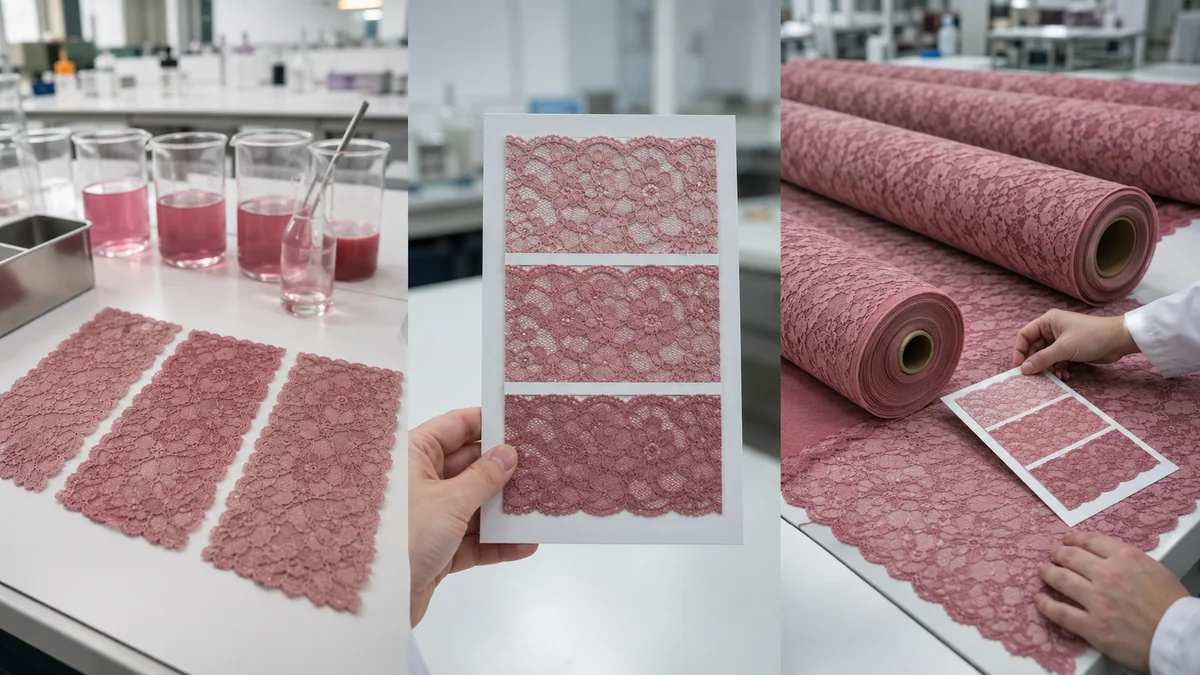
What Are Lab Dips, Shade Bands, and Bulk Lots?
Lab Dip: The Recipe Test
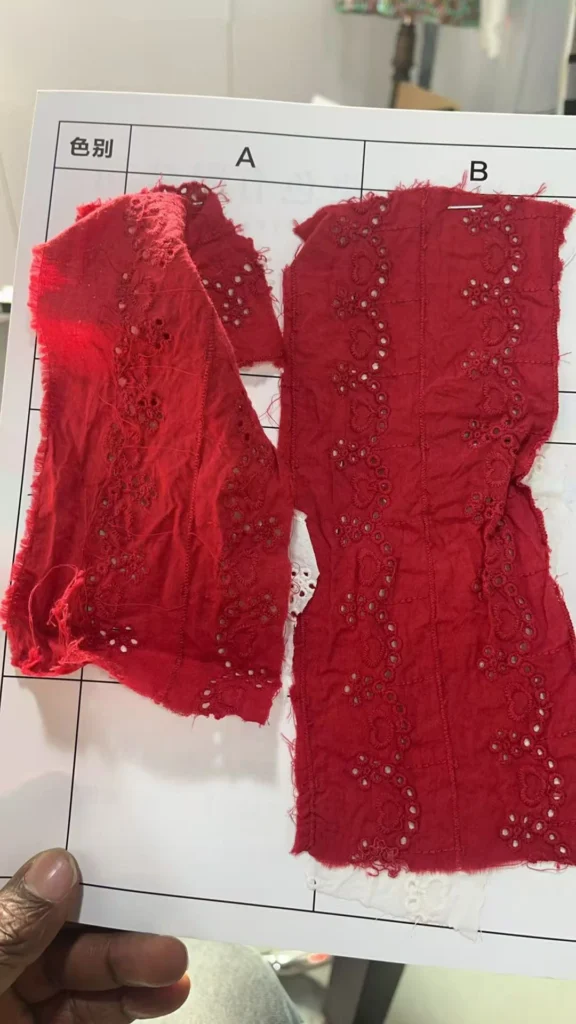
A lab dip is a small piece of your actual lace, dyed in a laboratory beaker to chase a specific color. We submit two or three options — labeled A, B, and C — so you can pick a direction instead of just telling us "closer."
Each option carries a full recipe: which dyes, what percentages, what temperature and time. The result? When you approve option B, you're approving a formula our production floor can scale, not just a swatch that happens to look right.
We dye lab dips on the same base lace you're ordering, and we finish them the same way. A recipe proofed on plain nylon tricot won't behave identically on an 88/12 nylon-spandex jacquardtronic lace, so we don't take that shortcut.
Shade Band: The Tolerance Agreement
A shade band is a physical card holding three to five swatches: the agreed standard in the middle, with a light limit and a dark limit on either side. We usually add the acceptable side-to-side and end-to-end variation within a roll.
This card defines commercially acceptable in physical form. Anything between those limits ships without a conversation, and anything outside them never leaves our floor.
Across the industry, most color disputes trace back to a program that never built one. Without a shade band, bulk gets compared to a 20-gram beaker swatch — and a beaker sample dyed under laboratory conditions is a target, not a tolerance.
Bulk Lot: The Real Production Run
A bulk lot is one dyeing batch on production equipment. Same approved recipe, now running 500 kilos in a jet dyeing machine instead of 20 grams in a beaker, with a different liquor ratio, agitation pattern, and heating curve.
We number every lot, and we measure every lot. The shade band is what defines the window each one has to land in, which is why we won't schedule bulk until that card is signed and sealed.
Why Lace Takes More Care Than Woven Fabric
Lace is a different problem from flat fabric, and knowing why makes the approval steps make sense.
Mixed Fibers Take Dye Differently
Stretch lace is nylon plus spandex, sometimes with polyester or cotton in the pattern yarn. Nylon takes acid dyes, spandex takes almost none, and polyester needs disperse dyes at higher temperatures.
One bath, several fibers, several outcomes — unless the recipe accounts for it. We select dye classes and auxiliaries for the specific blend, and on high-spandex constructions we adjust the finishing route so the elastane doesn't read pale against the nylon. That's the difference between a deep navy that looks solid and one that looks dusty.
Meaning: tell us the exact blend and we'll build the recipe around it. A 90/10 and an 82/18 lace in the same shade are two different jobs on our side, even when they look like one job on the tech pack.
The Open Ground Changes the Color You See
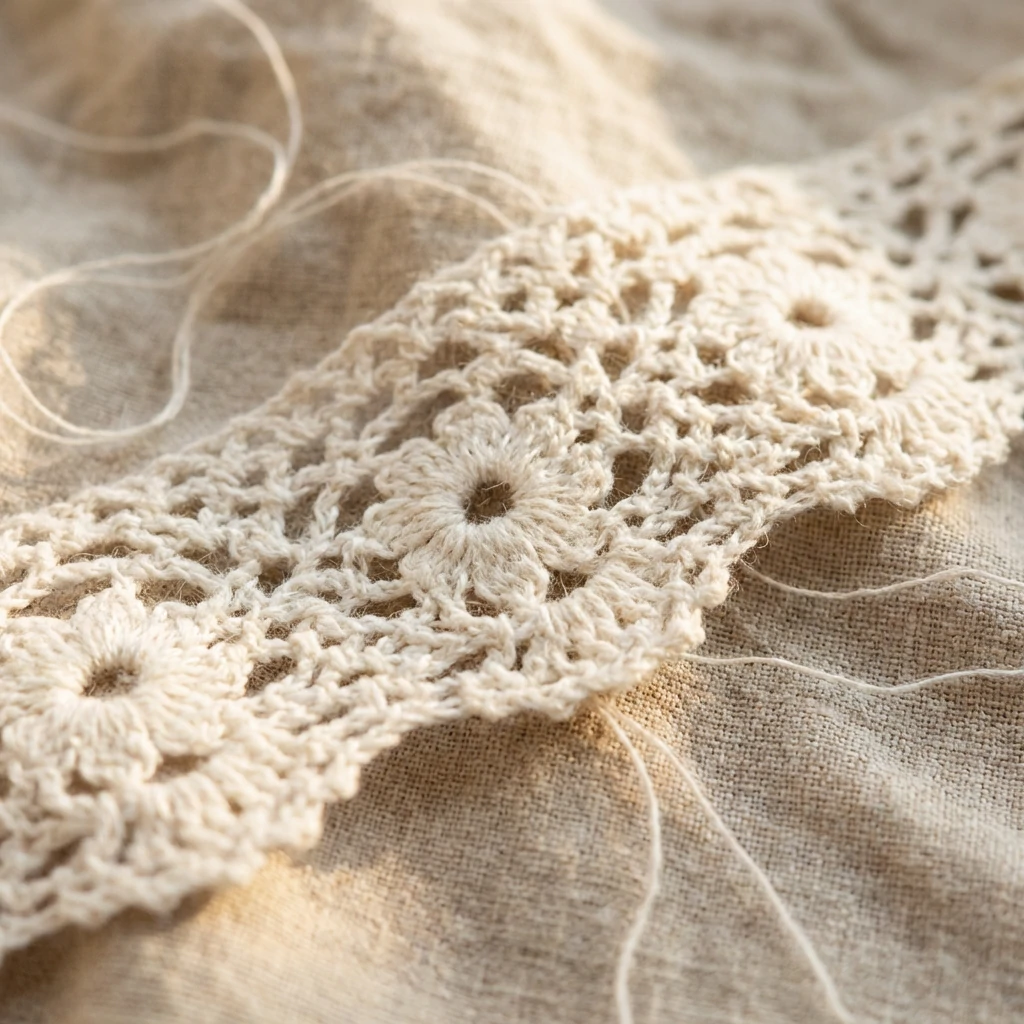
Lace is mostly air. Hold ivory lace over a white card and it reads pale; hold it over your hand and it reads warm and deeper. Your eye is reading the backing as much as the yarn.
So every measurement and visual check specifies the backing. We fold to a set number of plies or lay the swatch on a standard white tile, and we print that method on the shade band. The result? You and our lab measure the same lace the same way and land on the same number.
Ground and Motif Read as Two Tones
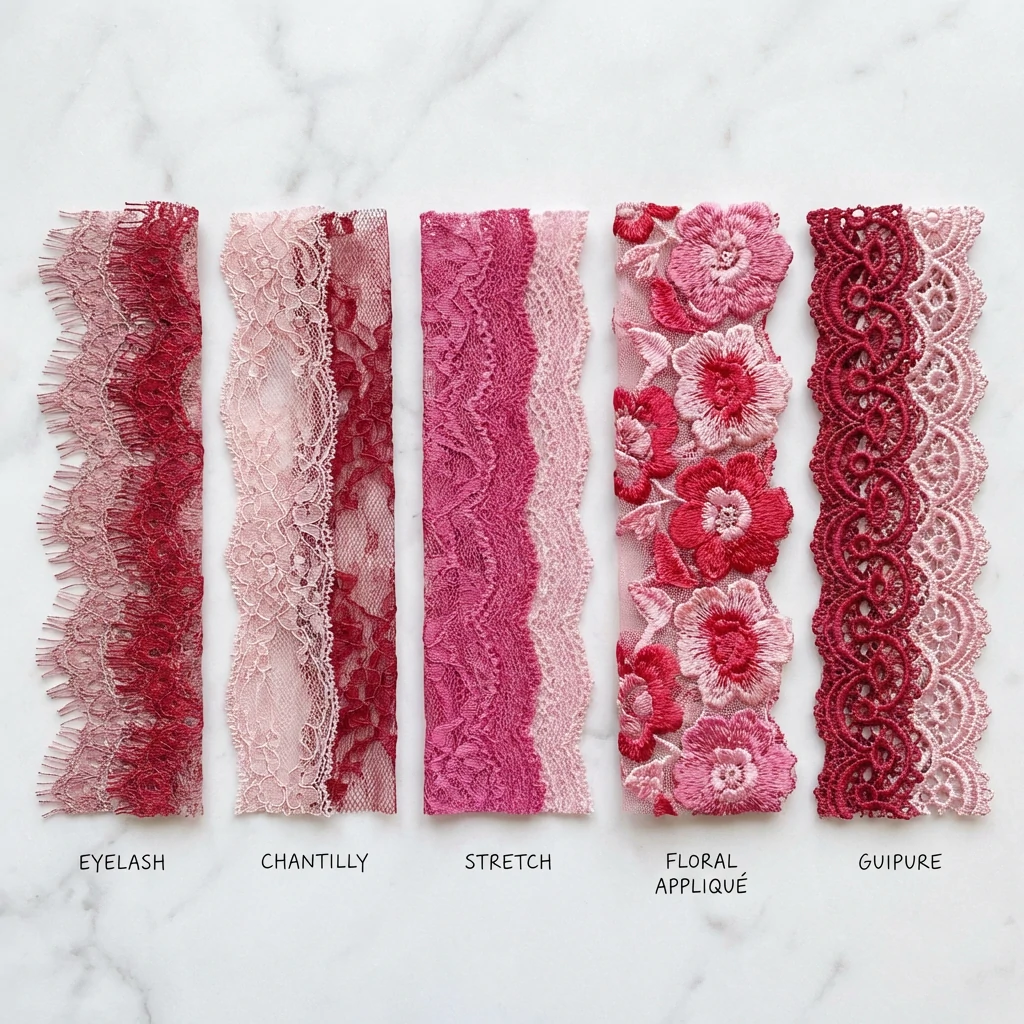
A scalloped floral lace has a fine hexagonal ground and a dense satin motif. Identical fiber, identical bath — but the dense area reflects less light, so it reads deeper. That's optics, not unevenness.
We evaluate the overall visual effect at arm's length, which is how the finished garment gets seen. Judging one square centimeter of motif under a loupe measures the wrong thing.
Heat Setting Is Part of the Color
Lace gets heat set to lock the width and stabilize the stretch, and nylon shifts slightly warmer under heat. A shade judged before finishing isn't the shade that arrives after it.
That's why we submit lab dips and shade bands on finished lace — heat set, at final width, off the same route as bulk. You approve what you'll actually receive.
How to Approve Lace Color: The Workflow
Step 1: Send a Physical Standard
Send us one of three things: a Pantone TCX cotton swatch, a physical fabric swatch, or measured L*a*b* values with the illuminant stated. Screen colors and photos shift with every monitor and camera, so they give our lab nothing to aim at.
If the lace has to sit next to another component, send that component. Matching lace to a bra cup laminate is a different job from matching to a Pantone chip, and knowing which one changes how we build the recipe.
-
Best: a physical swatch of the adjacent material, plus the Pantone reference
-
Good: a Pantone TCX chip (TCX, not TPG — fabric and paper read differently)
-
Workable: L*a*b* values with illuminant and observer noted
-
Not enough to dye from: a photo, a hex code, or "same as last season"
Step 2: Agree on the Lighting First
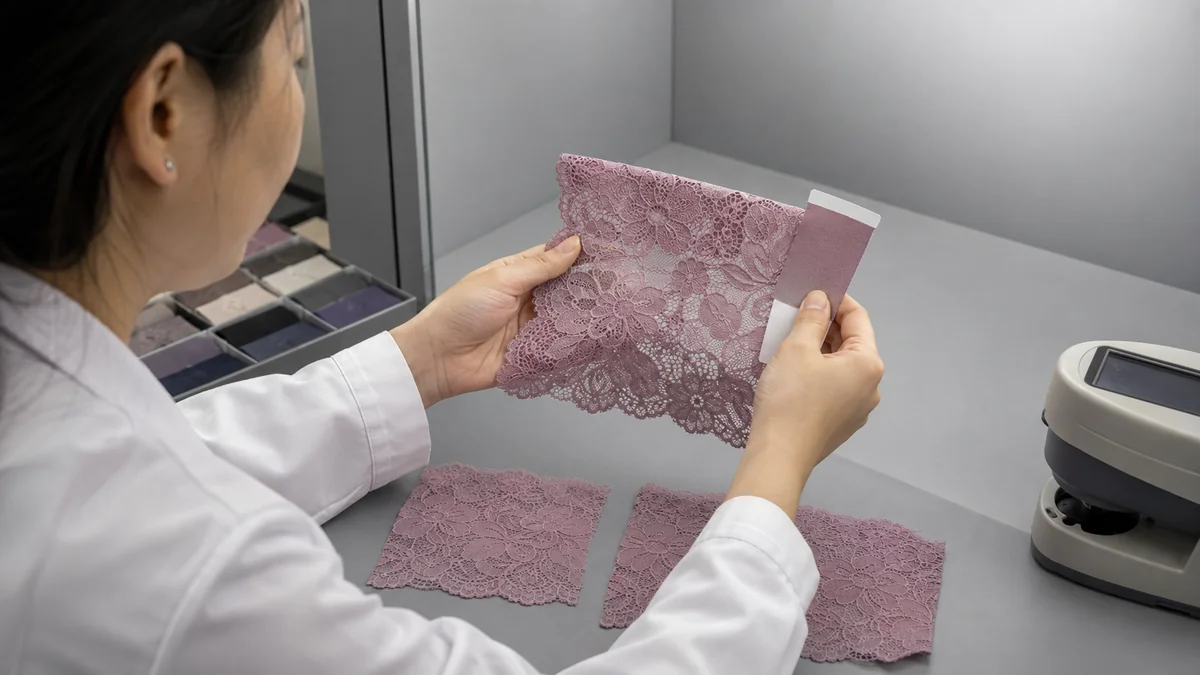
Two colors can match in daylight and separate under store lights. That's metamerism, and naming your light sources up front is the cheapest insurance in the whole process.
Most lingerie and apparel programs run D65 daylight as primary, with TL84 or CWF as the retail check and Illuminant A as a third look. Our recipe software flags metamerism risk while we're still choosing dyes, so we can steer toward a combination that holds across all three.
Both sides then judge in a light booth, at 45 degrees, against a neutral grey surround. Same swatch, same light, same answer.
Step 3: Give Directional Feedback on the Lab Dips
Pick the closest option and describe the gap as a direction and an amount. "Option B is closest, needs about 2% less red and a touch lighter" gets you a hit on the next round. "Not quite right" costs everyone a cycle.
Send back the swatch you compared against, marked with the style or lot number. Two rounds is normal on most shades, three on the hard ones — deep blacks, optical whites, fluorescents, and pale pastels where a small hue shift is instantly visible.
Step 4: Seal the Shade Band
Once the lab dip is approved, we run a small production trial and build the shade band from it. Your job at this stage is to sign off on the range, not to hunt for a single perfect swatch.
We set the tolerance in numbers so it never becomes a matter of opinion. Typical windows for lace programs:
-
Delta E ≤ 1.0 (CMC 2:1) — tight; used where lace sits directly against another material
-
Delta E ≤ 1.5 (CMC 2:1) — the common working standard for lace
-
Delta E ≤ 2.0 — suitable for linings, hidden trims, and single-material pieces
-
Within-roll: side-to-side and end-to-end held to the same window, so edges read like the center
We confirm the exact figure per program, since the right tolerance depends on the shade depth and what the lace sits next to. Then both sides sign, both keep a copy, and we archive ours flat in a sealed opaque envelope. Reference swatches left in daylight fade, and a faded standard quietly moves the target for everyone.
Step 5: Every Lot Gets Measured Against the Sealed Band
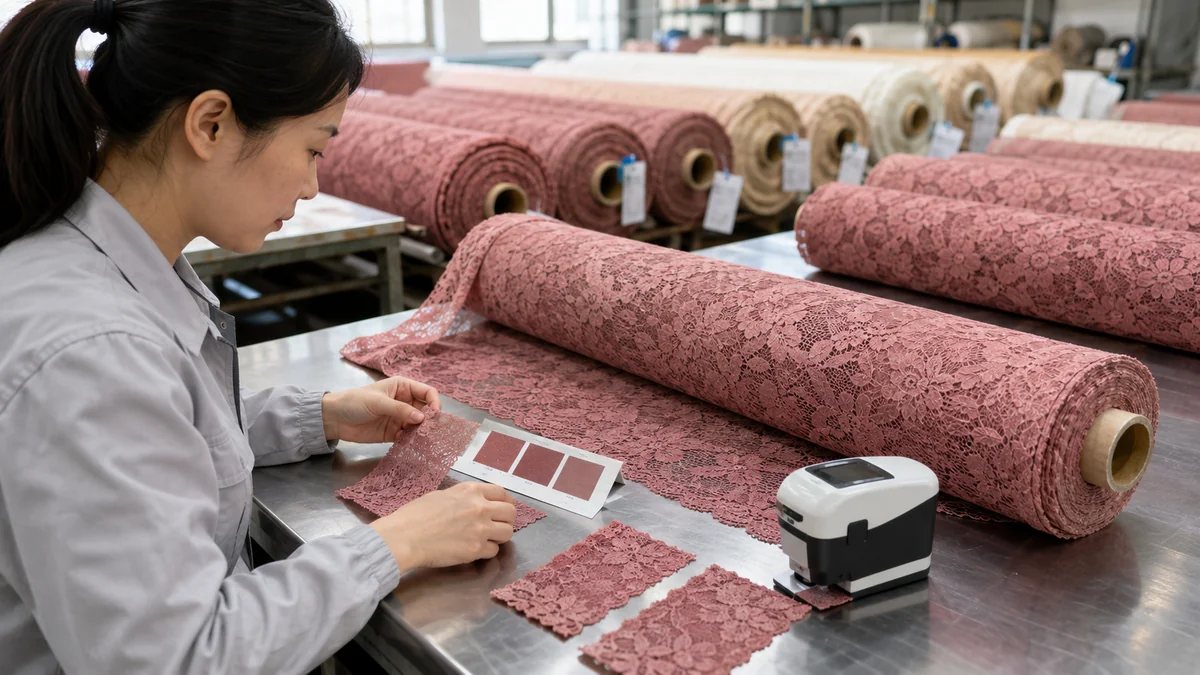
We measure each production lot against the sealed shade band — not against the lab dip, and not against whichever previous lot happened to look good. Readings come from the roll center and both selvedges, so edge behavior is caught on our floor rather than in your cutting room.
Each reading is logged against the lot number and available to you on request. The result? Continuity across a season is something you can see in a record, instead of something you have to take on faith.
Step 6: Tell Us How You'll Cut
Even inside tolerance, two lots aren't identical. If a bra uses lace on the cup and the wing, both pieces should come from the same lot, because two in-tolerance shades sitting side by side still read as a mismatch to the customer.
Share the cutting plan before we schedule dyeing. We can allocate one lot per style or reserve extra meterage from a single batch — both are straightforward, as long as we know before the batch is set.
From Grey Scales to Spectrophotometers: How Color Control Evolved
Global Origins
For most of textile history, color approval was one dyer's eye against another's. Mills kept pattern books of dyed swatches, and a master dyer's judgment was the standard — which worked while the dyer, the weaver, and the tailor lived in the same town.
Long supply chains needed something portable. Once the dyehouse sat an ocean from the cutting room, the trade needed numbers instead of eyes.
Grey scales came first, rating change on a 1-to-5 scale. Then the CIE published L*a*b* in 1976, turning color into three coordinates and difference into a single figure. Delta E meant two people on two continents could finally discuss the same number.
CIELAB's arithmetic didn't quite match perception, though — the eye forgives lightness shifts more readily than hue shifts. The industry answered with CMC 2:1, weighting lightness twice as loosely as chroma, and it's still the working formula for textiles today.
Inside Our Color Lab
The lace clusters in Fujian and Guangdong built their color labs during the fast-fashion years, when a three-week lab dip cycle simply lost the order. Speed drove the investment, and the equipment stayed.
Our lab runs a benchtop spectrophotometer with recipe prediction software, an infrared sample dyeing machine holding a dozen beakers at once, and a multi-source light booth. The software reads your L*a*b* target and proposes dye combinations ranked by cost and metamerism risk, which is why the first submit usually lands close.
That setup is also why we send A/B/C options rather than one attempt. Three recipes in a single beaker run costs us the same cycle and saves you a week of back-and-forth.
Digital color trims the front end further. E-lab dips send measured L*a*b* data ahead of the courier, so a direction can be confirmed or redirected in a day. The physical swatch still makes the final call — a spectrophotometer can't show you how the motif reads against the ground, or how the lace looks over skin.
Six Things We Flag at Program Kickoff
These are the process gaps that cost the most time, so we raise them before the first beaker:
-
Judging outside a light booth. A window plus a desk lamp is two uncontrolled sources, and it produces approvals that don't hold.
-
Sending a screen color as the standard. We need something physical or something measured; a JPEG can't be dyed to.
-
Compressing the shade band to save two weeks. Those two weeks come back later, in interpretation.
-
Comparing bulk to the lab dip. A beaker sample and a full production batch are different scales. The tolerance window is what bridges them.
-
Approving pre-finish swatches. Heat setting is part of the color, so approve finished lace.
-
Splitting one garment across lots. Two in-tolerance lots side by side on the same piece read as a defect, even though both passed.
FAQs
What is a lab dip?
A lab dip is a small swatch of your lace dyed in a laboratory beaker to match a target color. It proves the recipe before anyone commits to production, and it normally arrives as two or three options so you can choose a direction rather than approve or reject a single guess.
How long does a lab dip take?
Three to seven days for the first submit on most shades. Add a round for each revision, with three rounds common on deep blacks, optical whites, fluorescents, and pale pastels where small shifts are highly visible.
What is a shade band in textiles?
A shade band is a card of swatches showing the agreed standard together with the lightest and darkest acceptable limits. It turns "close enough" into a signed physical document, and it's the reference every production lot is measured against.
What Delta E is commercially acceptable?
Delta E ≤ 1.5 using CMC 2:1 is the common working window for lace, tightening to 1.0 where the lace sits directly against another material and opening to 2.0 for linings and hidden trims. Always state the formula — a Delta E figure without CMC 2:1 or CIEDE2000 attached is ambiguous.
Why is bulk checked against the shade band instead of the lab dip?
Scale changes the chemistry. A 20-gram beaker and a 500-kilo jet dyeing machine have different liquor ratios, agitation, and heating curves, so the shade band is built from a production trial and carries a defined window that reflects real equipment. It's the reference that matches what bulk actually is.
Do I need a new shade band for a reorder?
No — reorders are dyed against the sealed original, which is exactly what it's kept for. A fresh band makes sense when the base lace or fiber blend changes, or when a long-running program is due for re-verification.
Can lace color be approved from digital data alone?
Measured L*a*b* data confirms or redirects a lab dip in a day, so it's genuinely useful early. Final approval stays physical, because no reading captures how the motif reads against the open ground or how the lace looks over skin.


 WhatsApp Us