
Introduction
Your motif is approved, the colour card is signed, and the bulk date is booked. Do not release the trim yet.
Choose lace by duty cycle before motif. Three inputs set that duty cycle: how much daylight the finished edge takes, how often the product is laundered, and how many metres of continuous edge the trim has to hold. Style is the last filter, not the first.
Use the bench order that keeps the decision honest: inspect, sew to the actual base cloth, run the customer's exposure or wash route, measure against a retained control, then seal. Until then, the trim is a preference, not a decision.
Start With the Duty Cycle, Not the Motif
Home-textile lace faces a different load from apparel: fixed daylight at a curtain hem, abrasion and pressing at a table edge, or repeated laundering against skin on bedding.
Write three lines down before you touch a swatch:
- Daylight exposure — direct, filtered or none, and for how much of the day.
- Laundering route — hand or machine wash, tumble or line dry, and how often.
- Continuous run — finished edge length, plus every corner, mitre and hem the trim crosses.
A trim that fails the dominant duty-cycle check is out, however well the motif reads on the card.
Match Construction and Fibre to the Product
Sample the dominant risk first
Product | Dominant risk | Sample this first | Limiting condition |
|---|---|---|---|
Curtains and long panels | Prolonged daylight on a fixed hem | Polyester Lace Trim in the actual colourway | Shape and colour stability still have to be proven on the dyed article |
Table linen and runners | Abrasion, spills, pressing | Crochet Lace on a cotton ground | Check the open structure against cutlery and storage hardware |
Bedding and pillow edges | Repeated laundering against skin | Cotton Embroidery Lace | Cotton can move dimensionally; measure it against the base cloth |
Cushions and covers | Daylight and washing together | Poly Cotton Blend Lace | Two duty cycles means two test routes, not one |
If more than one fibre remains, keep it as a sampling variable until the test route identifies the safer finished article.
When two duty cycles apply at once
A cushion cover on a sunlit sofa is the hard case: it faces both curtain-like exposure and bedding-like washing. A blend ground offers a compromise, not a pass. Record and run both routes on the sewn panel.
Light Exposure Is a Colour Test, Not a Fibre Test
A fibre name carries no light-fastness result. AATCC TM16.1 applies to textile materials together with their colourants, finishes and treatments, so test the dyed, finished article. Laces on the same polyester ground can respond differently after different dyeing and finishing routes.
Name the method, then name the article
ISO 105-B02 gives a xenon-arc route under artificial light representative of D65 daylight, covering textile colours including white textiles. Keep an off-white article in the test plan rather than treating its colour as an exemption.
Neither method hands you a pass mark. The buyer sets the acceptance grade, and the specification records which method produced it.
The window check you can run this week
Cut the palest and darkest colourway of the same article. Sew each to the base cloth, mask half of every panel, and put them in the window the product is destined for. Pull them on the agreed schedule and compare the exposed half against the masked half under one light source.
If either colourway exceeds the buyer's approved limit, hold that article regardless of its fibre name.
Check the Joined Seam After Repeated Laundering
On my bench, the seam is the first place I inspect after laundering. When trim and base cloth move by different amounts, the shorter component pulls the joined edge into a wave even if both pieces remain intact. The edge can then curl and distort the motif along the pull line.
Name the wash route and the dry route
ISO 6330 specifies domestic washing and drying as a pair. A complete test needs a washing procedure and a drying procedure; machine type, detergent and tumble drying can affect the result. So "washed" is not a test condition. "Machine washed on the agreed programme, tumble dried on the agreed setting" is.
What the standards give you, and what they do not
ISO 5077 defines dimensional change after a suitable wash-and-dry combination for fabrics, garments and other textile articles. Use that measurement logic on the joined panel, not on loose trim alone. The method does not give a lace-to-base-cloth acceptance tolerance; the buyer must set and record one.
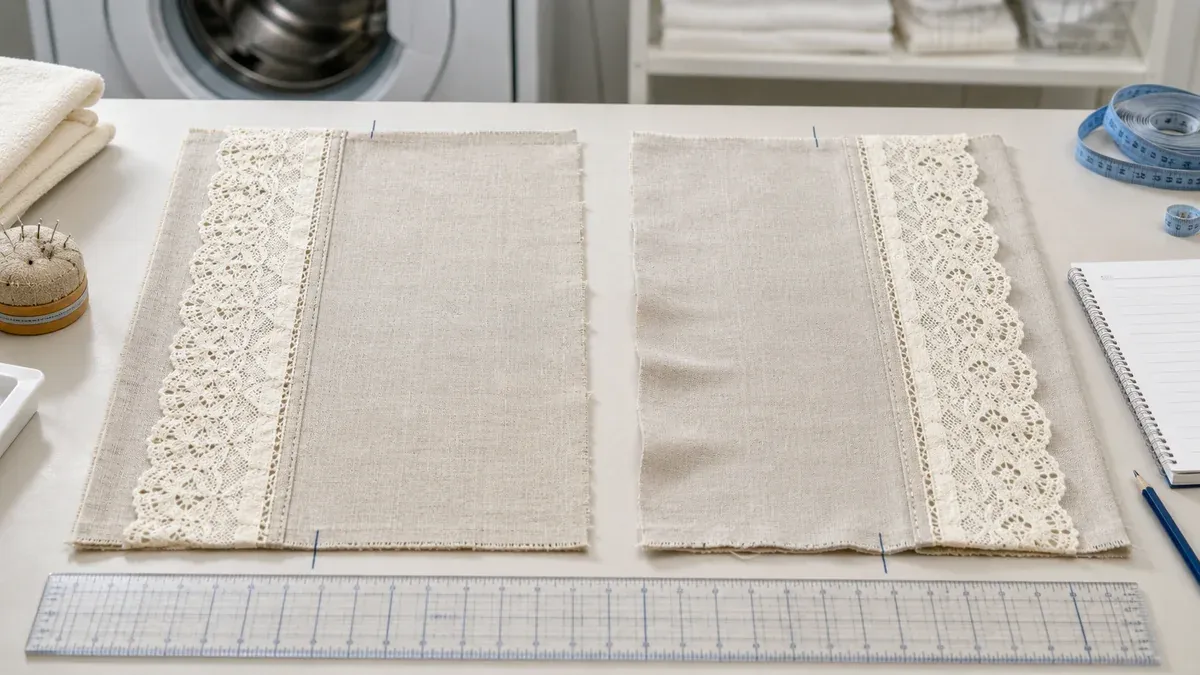
Mark the panel, measure it, launder it, measure it again, and compare both components against the retained control.
If the differential pulls the hem out of line, stop the article before adjusting the seam around a material mismatch.
Width Behaves Differently on a Long Continuous Run
Do not approve trim width from a catalogue band or a small swatch. Neither shows how the selected article will behave across the intended edge. Use a full-length bench check instead.
Hang or lay the full run
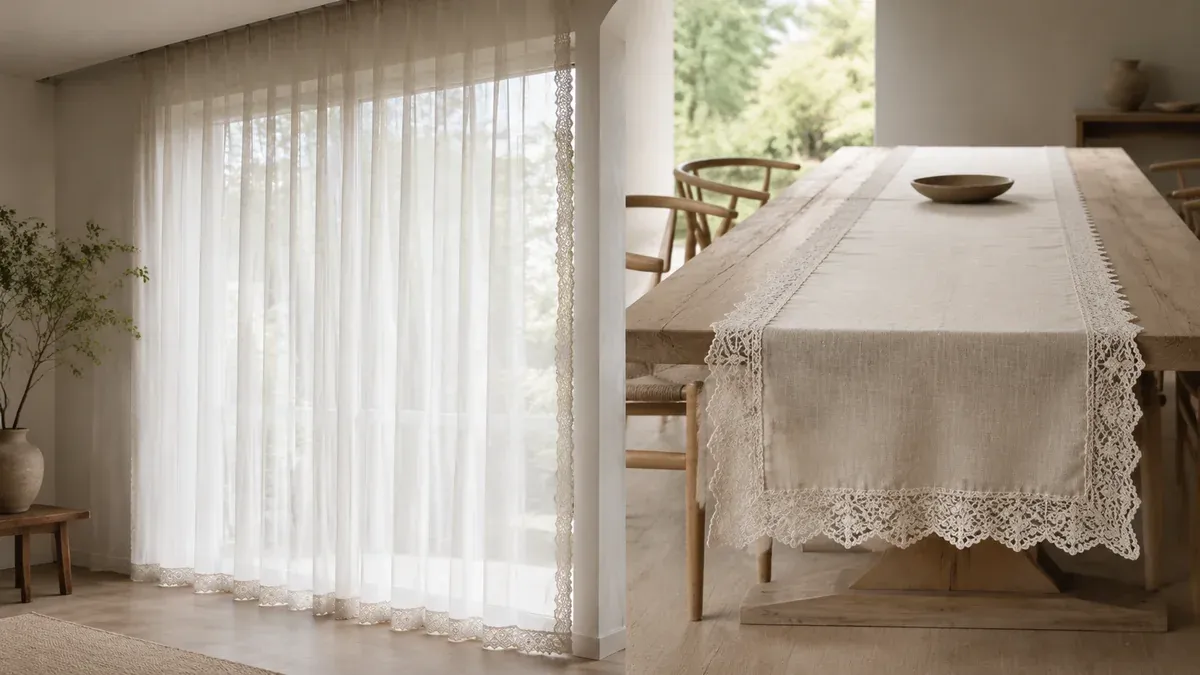
A lace that reads balanced on a hand sample can look heavy across a full curtain drop because the eye reads it against the whole panel. Sew the intended width along a full-length section, hang it as the product will hang, and inspect it from the customer's viewing distance. On table linen, lay the run flat and check for ripple where the edge leaves the table.
Corners, hems and gather density
Long runs expose stretch and uneven fullness. Sample a Rigid Lace Trim when the edge must hold its outline, but plan the corner allowance because rigid trim will not ease into a mitre. For a gathered cushion or bedding edge, judge a pre-gathered ruffle at finished width before sewing; it starts with factory-set fullness.
Suitable Lace Applications Across Home Textiles
Once the duty cycle, fibre and finished width have been narrowed down, match the lace to the part of the product where its construction can work without adding unnecessary bulk or distortion. The same motif may be suitable for several home-textile categories, but its placement should follow the way each finished article hangs, folds, washes and comes into contact with the user.
Curtains and window treatments
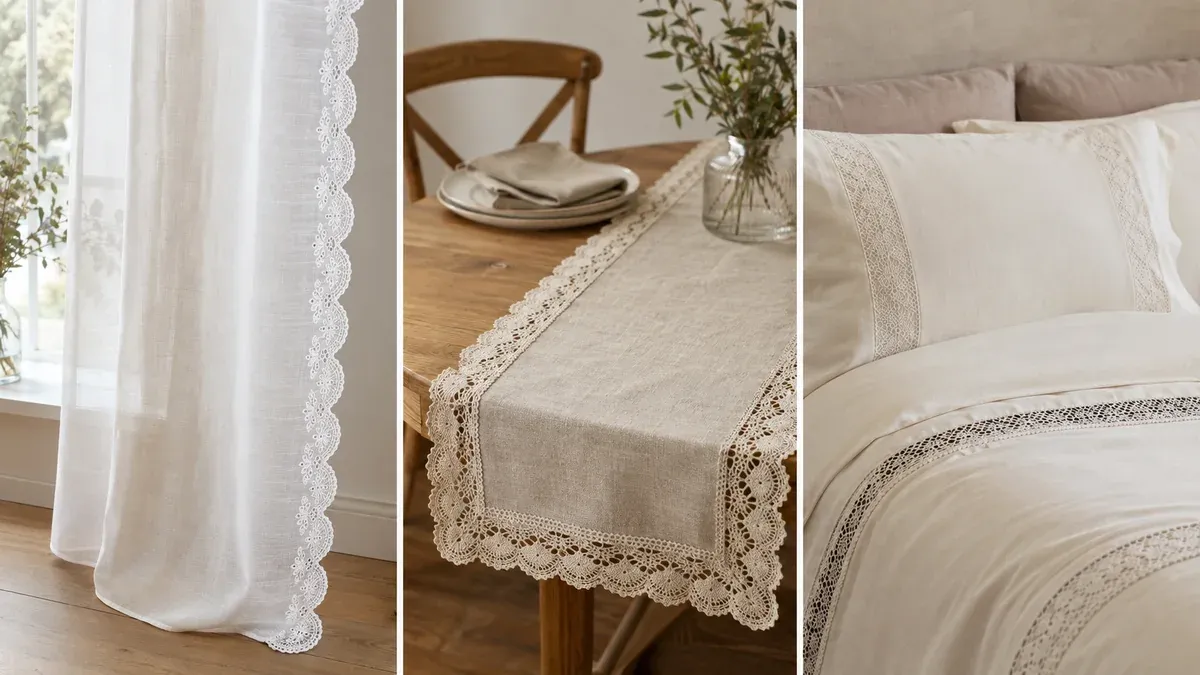
- Sheer curtains and café curtains — Fine polyester lace or lightweight embroidered lace can be applied along the lower hem, leading edge or as a horizontal inset. Keep the construction light enough to preserve the drape of the curtain panel.
- Full-length curtains and decorative panels — Medium-width rigid lace works well as a vertical border or controlled lower-edge trim where a clean outline is required. Test the complete hanging length because even a small weight difference can change how the panel falls.
- Valances, pelmets and tiebacks — Decorative guipure, scalloped lace and denser embroidered motifs can be used where visual impact matters more than fluid movement. For tiebacks, check abrasion resistance at the repeated contact point.
Table linen
- Tablecloths and table runners — Crochet lace, cotton embroidery lace and stable scalloped trims can finish the perimeter or form a lengthwise inset. Select a construction that will lie flat after laundering and pressing.
- Placemats and coasters — Narrow, firm lace is easier to control around compact edges and corners. Avoid very open structures where cutlery or serving pieces may catch.
- Napkins — Soft narrow lace, delicate edging or a small corner motif adds detail without making the folded napkin bulky. Confirm that the trim tolerates the intended wash and pressing routine.
Bedding and bedroom textiles
- Duvet covers and top sheets — Flat embroidered lace or a soft insertion lace can be positioned across the upper face or near the turnover edge. The lace and base fabric should be checked together for differential shrinkage.
- Pillowcases and pillow shams — Soft cotton, poly-cotton or fine raschel lace can be used at the opening, flange or as a front-panel inset. Keep raised or rigid elements away from areas that rest directly against the face.
- Bed skirts and decorative bed runners — Wider lace, gathered lace and scalloped borders suit areas where drape and decorative depth are desirable. Approve the finished drop rather than judging the trim from width alone.
Cushions and decorative soft furnishings
- Cushion covers — Narrow lace can define seams and panel joins, while wider lace can form a centre band or front overlay. A gathered trim may suit romantic or vintage styling; a flat guipure or geometric lace gives a cleaner, more structured result.
- Chair covers and slipcovers — Stable lace is suitable for skirt edges, back panels and decorative ties, provided it can tolerate friction and repeated handling.
- Storage baskets, fabric organizers and decorative covers — Cotton or crochet-style lace can soften the edge of low-contact accessories. Match the lace weight to the ground fabric so the trim does not pull the opening out of shape.
Choose placement as carefully as the lace
Use softer, flatter constructions where the finished article touches skin or must fold easily. Reserve wider, firmer or more dimensional lace for visible borders, overlays and low-contact decorative zones. If one article combines several placements, such as a cushion with a flat front inset and a gathered outer edge, treat each placement as a separate sewing and performance check.
Before You Approve Bulk, Sew the Panel and Write the Spec
Skipping the panel test can turn a trim choice into a reorder dispute.
The bench sequence
- Inspect the sample card — face, back, edge stability, hand feel.
- Cut two identical lengths and sew both to the actual base cloth with the actual seam and allowance.
- Retain one panel untouched as the control.
- Mark and measure the second panel, run the named wash-and-dry route or the agreed exposure, then measure again.
- Compare both panels side by side for hem line, edge lie, colour and motif shape.
- Seal the approved article and file the control panel with it.
The specification lines that make a reorder match
Field | What to record | Risk if omitted |
|---|---|---|
Construction and fibre | Article reference, ground, fibre content | Substitution at reorder |
Actual width | Measured finished width, not the catalogue band | Hem geometry changes |
Colour and finish | Approved lab dip and applied finish | A rematch on another dye route |
Base cloth | Fibre, weight and finish of the cloth it is sewn to | The panel result may no longer apply |
Placement and seam | Edge position, seam type, allowance | Puckering returns |
Wash and dry route | Both procedures, named | "Washed" means nothing |
Light exposure method | The method, and the article tested | Fibre-level guesswork returns |
Retained control panel | Holder and date | No physical reference in a dispute |
Confirm destination scope before quoting a flame requirement
Flammability rules follow the market and finished-product category. The UK regulations often quoted in home-furnishing enquiries cover domestic upholstered furniture supplied in the United Kingdom, not window treatments. Confirm the destination and product scope in writing before adding any flame test to the trim specification.
Your Approval Checklist
- Write the three duty-cycle lines — daylight, laundering route, continuous run length.
- Pick the construction whose dominant risk fits the product, and treat fibre as a variable to sample.
- Sew two identical panels onto the actual base cloth and retain one as the control.
- Run the named exposure or the named wash-and-dry route on the other.
- Measure both components on the joined panel and compare against the control.
- Record construction, measured width, colour and finish, base cloth, placement, both test routes, and where the control panel lives.
Give the retained control panel priority. It turns "this batch looks different" into a side-by-side comparison of the approved assembly and the reorder. Without it, the team may have to recreate an approval that should already be settled.
Discuss a real requirement
Turn the reading into a practical next step.
Send a short note, product reference, photograph, swatch or tech pack. Technical feasibility, sampling, documentation and production terms are confirmed after review.
Start an inquiry