
Introduction
A dress already has the right lace edge. For the next collection, the design team wants a recycled-yarn option and a narrower version of the same pattern. Both requests sound small. Together, they change what the buyer needs to sample, document and price.
A real lace reference, with a new purchasing brief
Take YZ1403 scalloped lace trim as the starting reference. The catalogue records a 3.5 cm width, 100% polyester and machine embroidery, and describes it as non-stretch. Its black arch-and-circle pattern has visibly different edges. That makes the choice of the exposed edge part of the sleeve design.
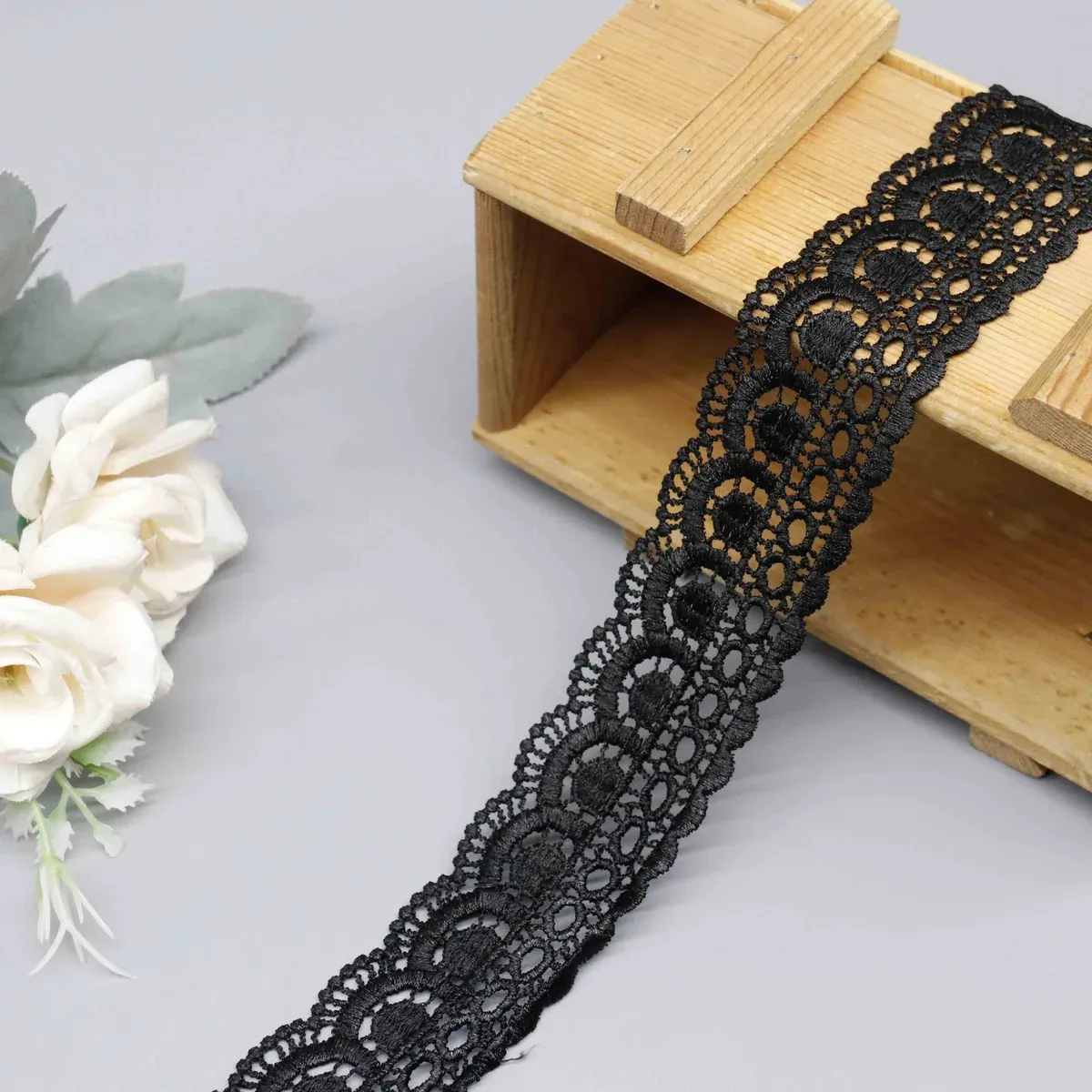
The walkthrough below uses this real product reference. The recycled-yarn and 2.5 cm options are proposed developments, not existing specifications or reported customer test results.
For this dress, the lace will decorate a sleeve opening whose fit comes from the garment pattern. Mark one large arch that should remain fully visible beyond the seam. Keep the main fabric and sleeve opening fixed while comparing samples. If the sleeve needs to stretch over the hand, review the opening or choose a suitable stretch construction before pursuing this non-stretch reference.
A new fibre needs a specific material description
Recycled polyester embroidery threads are commercially available. For this project, however, the useful question is whether a suitable thread can produce the required lace. Ask which yarns would change, the proposed finished composition and the recycled proportion. “Polyester” names a fibre; it does not tell you whether the feedstock is recycled.
If the purchase brief requires GRS-certified material, verify the applicable certification scope and proposed material before ordering, and agree which transaction documents will be supplied and when. A scope certificate records certified scope; a transaction certificate identifies certified products in a shipment. Check the latter against the actual transaction once issued. The quality and documentation page explains the starting checks.
Then compare the actual new lace with the reference. Look at the black shade, surface sheen, hand and edge shape, and sew both to the intended main fabric. Check the assembled pieces before and after the agreed care process. A recycled-content record answers the sourcing question; the sewn sample answers whether the proposed material works in this dress.
Use the drawing to settle what “narrower” means
Reducing a 3.5 cm design to 2.5 cm would make its width about 71% of the original if everything were scaled uniformly. That is a layout calculation, not a production instruction. The embroidered arches, connecting threads and open spaces still need to be reviewed for the new size. Simply trimming 1 cm off this openwork pattern would remove part of the design.
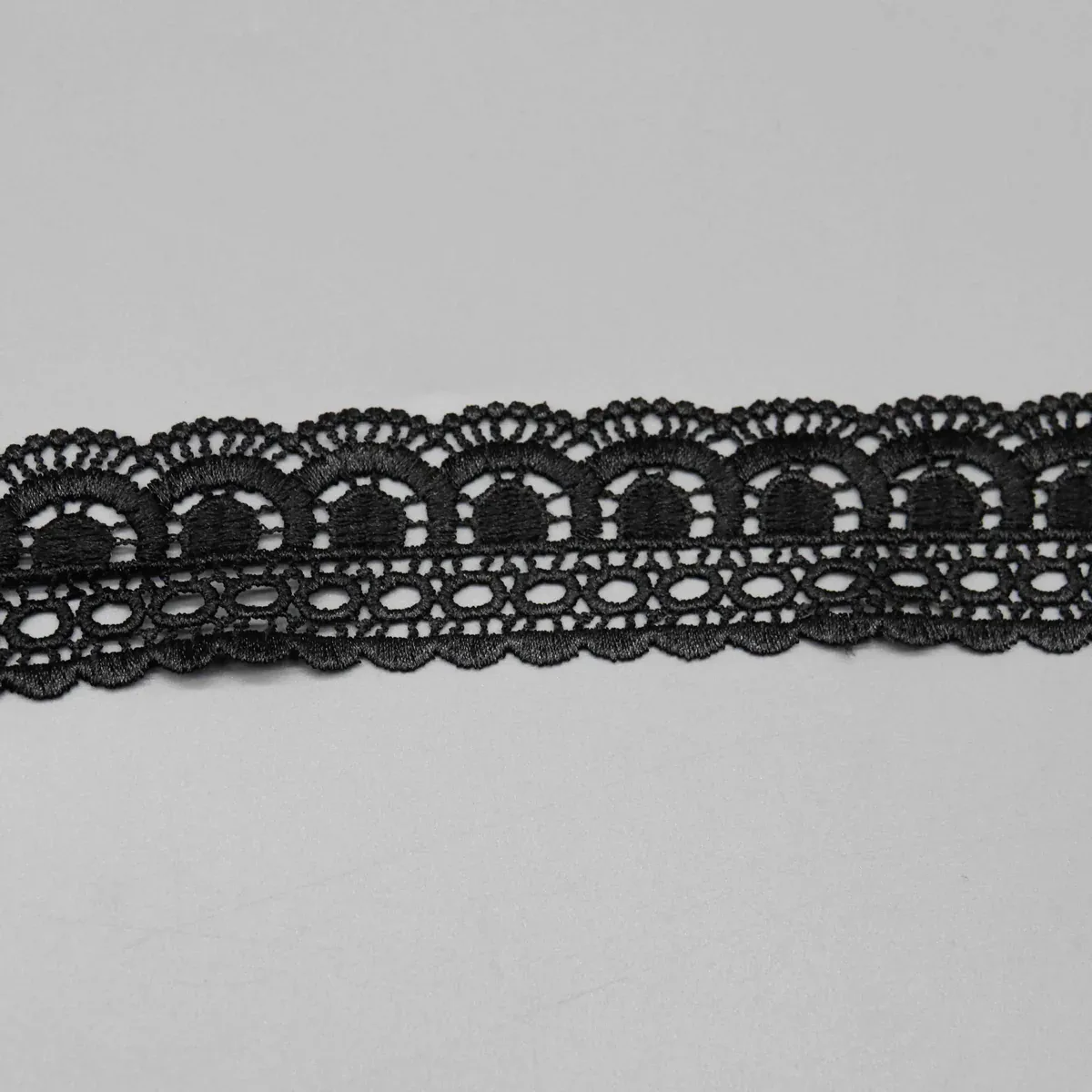
Ask for a dimensioned, actual-size drawing showing the full width, one complete repeat and the proposed seam line. Print it at 100% scale, check the printed dimensions and place it against the sleeve pattern. This helps settle motif size and placement before making another physical sample. Keep the revision number with the sample so the factory and buyer are discussing the same design.
The next step is a physical embroidered sample and a sewn sleeve section. Digital editing can make a revision easier to communicate, but the buyer still needs to see whether the narrow edge lies as intended on the chosen fabric. YiTuo’s sampling process separates the reference, technical review, sample refinement and production handoff.
Make three versions answer three different questions
Version | What it establishes | Buying decision |
|---|---|---|
A · Reference | Current 3.5 cm lace, sewn to the intended fabric. Confirm the starting look and construction. | If this does not work on the sleeve, revise the base design first. |
B · Material change | Keep the 3.5 cm design as the target; evaluate the identified recycled-yarn proposal and its documentation. | Confirm the assembly meets the brief, and verify the material proposal and order-document arrangements. |
C · Narrow version | Use the selected material with a separately revised 2.5 cm pattern and a new sewn sample. | Confirm the narrower design separately. Approval of B does not approve C. |
If B works but C hides part of the arch marked for display, there is a clear choice: keep the approved 3.5 cm version if the design allows, or revise the narrow pattern and sample again. If B lacks the material evidence needed at this stage, it is not ready for that order even if it looks right. Record the choice against the relevant sample; “same pattern” is too vague for approval.
A smaller order still has material and colour minimums
Consider an illustrative order of 600 dresses, split equally across four colours. Assume two sleeve pieces per dress and a cut length of 0.30 m per piece, including its end join. The starting estimate is 600 × 2 × 0.30 = 360 m, or 90 m per colour. Recalculate using the cut lengths confirmed on the approved garment sample; list pattern-matching loss, sampling material and agreed allowances separately.
The current YZ1403 listing shows a 2,000-yard minimum for its listed specification, approximately 1,829 m. That does not establish the minimum for either proposed custom version. It does show why “only 600 dresses” is not a complete ordering brief. Ask separately about design setup, yarn sourcing, colour minimums, sample costs and the production date for the chosen version.
If custom dyeing requires much more than 90 m per colour, check whether the approved material is available in a suitable existing colour, whether the collection can use fewer colours, or whether the new material belongs in a later production run. A single extra setup charge and metres of unused colour stock affect the project differently. Compare the total order cost and material you will actually use before choosing.
Make the next order easier to reproduce
Keep one order record connecting the approved sample, drawing revision, yarn reference, finished composition, colour reference, width and agreed acceptance checks. Include the yarn or production lot used for approval when available. If the original yarn becomes unavailable, compare the proposed replacement before accepting it; an unchanged digital pattern does not establish an unchanged finished lace.
For lace procurement, the useful part of the conversation about 2030 is already practical: trace the chosen material, connect design files to physical samples, and plan custom quantities and repeat orders carefully. In this sleeve example, success means a trim that fits the agreed design and material requirement, in a quantity and schedule the buyer can use. Those are the results worth asking a new material or technology to deliver.
Discuss a real requirement
Turn the reading into a practical next step.
Send a short note, product reference, photograph, swatch or tech pack. Technical feasibility, sampling, documentation and production terms are confirmed after review.
Start an inquiry