
Introduction
Two quotations can show the same goods price and still lead to very different shipping bills. Before accepting either one, check the selling unit, the services included, the agreed delivery point and the documents needed for the shipment. Reconcile those details with the packed goods before dispatch. If the freight line is blank, establish whether the charge is already included or needs a separate quotation.
The product price is one part of the purchase. Packing, carriage and destination charges need their own review, particularly when different companies handle different legs of the journey. For the factors behind the lace price itself, see the lace quotation comparison guide.
Make every cost line understandable
Keep the product reference, color, specification, quantity, selling unit, currency and unit price on one quotation revision. Show development and special packing charges separately. When comparing suppliers, bring the quantities and packing requirements onto the same basis first. Keep the dated quotation accepted for the order so later freight or packing changes can be checked against it.
A forwarder needs the destination, service, packed dimensions, weight and package count to quote the movement. Label estimated packing figures clearly and arrange for the warehouse to update them. Ask the quotation to identify the scope, payer, amount or calculation basis and validity of each charge, including terminal handling, clearance, insurance, taxes and final delivery. The E05 example below puts the packing information on one carton before it is carried into the six-carton shipment record.
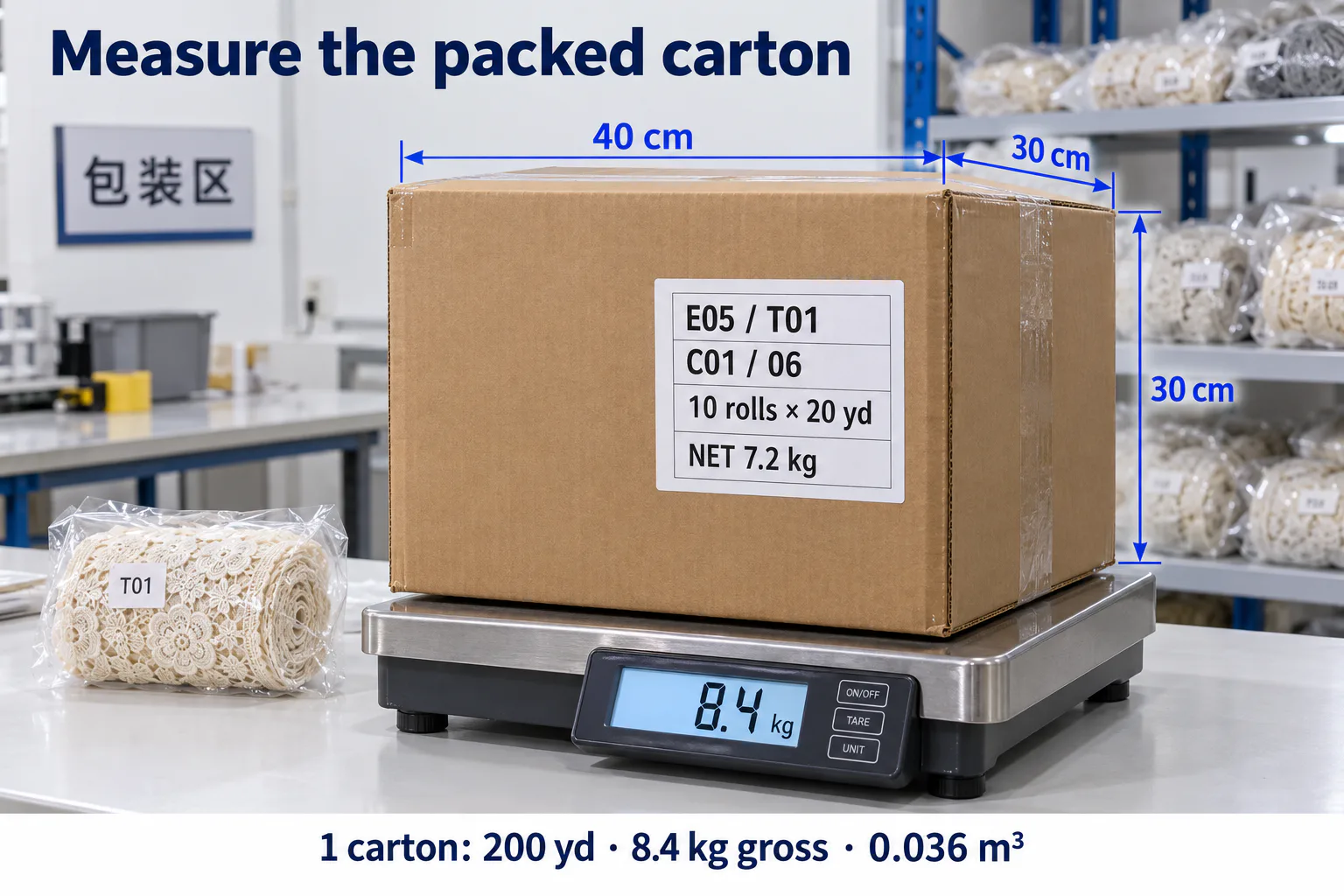
E05 packing example: C01 contains 10 rolls of 20 yards, or 200 yards. Its outside dimensions are 40 × 30 × 30 cm, giving 0.036 m³. The scale shows 8.4 kg gross; the net goods weight on the label is 7.2 kg. Read the box dimensions at the outer edges and weigh it with the final packing included.
Send the forwarder the gross weight, outside dimensions and total number of cartons. Net weight alone omits the packaging that will travel. Request Q02 with the named place and rule version, freight scope and updated packing figures. Use cost notes such as “included in Q02,” “forwarder invoices the buyer directly” or “forwarder to quote after the warehouse supplies packed weights.” Count included charges once. When the buyer books transport, record the nominated forwarder, handover point and documents each side supplies.
Write the rule, the precise place and the version
Write the selected rule, the agreed named place or port and “Incoterms® 2020” together in the order. With FOB, name the agreed shipment port. With DAP, name the destination and precise delivery point. These details connect the rule to the journey being arranged. ICC's Incoterms overview explains the responsibilities covered by the rules.
FOB and CIF are for sea or inland-waterway transport. For terminal handover, air, rail or a multimodal journey, discuss whether FCA, CPT or CIP fits the arrangement. Select the rule around where and how the goods will be handed over. See ICC's rule-selection checklist.
CIF separates cost from risk: the seller pays carriage and insurance to the named destination port, while risk passes to the buyer when the goods are loaded on board at the shipment port. The buyer therefore needs to understand both the insurance provided and the point at which it bears the transit risk. See ICC Academy's explanation of C and D rules.
Under DAP, the buyer handles import clearance and duties; under DDP, the seller does. Before accepting DDP, establish how the seller will fulfill those import obligations at the destination. A door-to-door service description should be checked against the duties assigned by the chosen rule. See ICC's practical selection checklist.
Record the included costs and the risk-transfer point as separate items. Add the insurance documents required and who supplies them. This keeps the arrangement clear even when one party pays the forwarder while another arranges collection or follows up a claim.
Keep the selling unit visible through packing
Use the unit agreed for each product: yards, meters, pieces or rolls. When selling by the roll, define its length or quantity and say whether it is fixed or variable. If another document needs a different unit, retain the original quantity alongside the conversion. Build the packing list from the goods packed for that shipment.
Continuing E05, trim T01 is ordered at 1,200 yards: 60 rolls of 20 yards, packed ten rolls per carton. Six cartons are needed. Using the same example dimensions and weights for each carton gives 0.216 m³, 50.4 kg gross and 43.2 kg net for the shipment. The length converts to 1,097.28 meters. If the invoice draft says “1,200 m” while the transport draft says “5 cartons,” compare them with the six-carton record below.
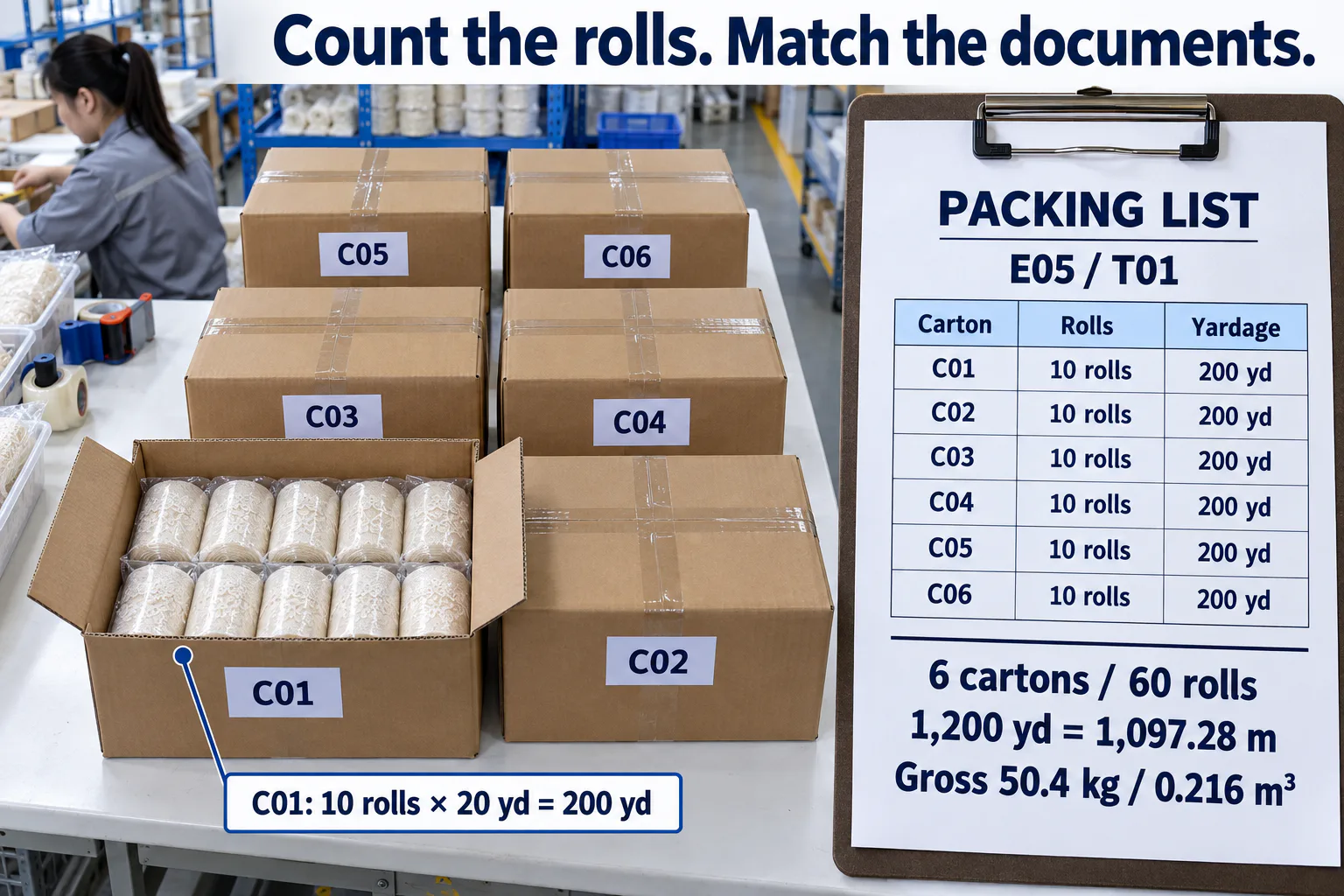
C01 is open so its ten bagged rolls can be counted. C01–C06 each carry 200 yards: 6 × 10 × 20 = 1,200 yards. The list keeps yards as the selling unit and shows the meter conversion separately. Total gross weight and volume use the same six cartons measured in the example.
Check the carton IDs, the rolls assigned to each carton and their recorded lengths against T01. If the warehouse confirms this packing, the invoice issuer corrects “1,200 m” to “1,200 yd” and the transport issuer corrects “5 cartons” to “6 cartons.” Use each carton's actual figures if its size or weight differs from the example. If the count or length is short, identify the missing goods and agree whether to complete or split the shipment before approving revised documents.
Give each document its own job
The commercial invoice records the sale and amount payable. The packing list describes the packed goods. The transport document records the carriage, with its form determined by the mode and arrangement. The U.S. International Trade Administration's common-document guide explains these roles. For a shipment from China, establish the applicable export and destination filing requirements separately.
Compare shared references, descriptions, quantities, units and package counts wherever those fields appear. Record seller, buyer, shipper and consignee against their correct roles. Ask the forwarder to identify the draft the buyer must approve, the person authorizing issuance and the release arrangement needed by the consignee. Once approved, circulate the current versions to the people handling the shipment and withdraw the superseded drafts.
Confirm destination requirements before documents are due
Depending on the goods and destination, the shipment may need an origin document, inspection record or another certificate. Send the importer or broker the product details early so the requirements can be arranged before the document deadline. Check eligibility for any reduced duty separately from the origin document itself. See the ITA's special-document guidance.
Give the customs specialist the composition, construction, product form, relevant use, origin and destination for classification. Keep the resulting HS code, its basis and the current destination requirements with the order. A previous invoice can help the specialist trace an earlier declaration, but the classification must fit the goods being shipped now.
For each required document, agree its issuer, contents, review contact, deadline and accepted format, including whether an original is needed. For certification, identify the products and activities it covers and how they relate to this order. This lets the buyer request the right supporting record before the shipment is ready.
Separate preparation from the journey
Under YiTuo's shipping and supply policy, specifications, quantity and dispatch schedule are agreed in writing before payment. Preparation begins after receipt of the agreed payment and completion of the required approvals. Its agreed working days end when goods are ready for carrier handover; international transit is separate. Confirm the schedule for the order rather than applying a catalog-wide quantity threshold or fixed number of days.
Track the ready date, actual collection, actual departure and current arrival estimate separately. Give document review and booking their own deadlines. A packing list and booking reference can be available while goods remain at the supplier: the handover record establishes collection, and the departure confirmation establishes departure. The trade term separately determines contractual delivery and risk transfer.
Bring the outstanding items into one reply
Please send Q02 for E05, covering T01 at 1,200 yards. Add the agreed shipment port and Incoterms® 2020 rule, the freight service and charges, and the packed dimensions and weights. Identify who arranges collection and issues each required document. Show the ready date separately from collection and the arrival estimate. For any charge that cannot yet be quoted, state the information needed and who will supply it.
Send the product references and existing quotation through YiTuo's contact page. Including the destination and the buyer's forwarder details helps the next reply address the shipment as well as the goods.
Discuss a real requirement
Turn the reading into a practical next step.
Send a short note, product reference, photograph, swatch or tech pack. Technical feasibility, sampling, documentation and production terms are confirmed after review.
Start an inquiry