
Introduction
A blouse cuff calls for one narrow row of ivory flowers. A wedding table runner needs a wider ivory border that will reach from one end to the other without a join. When the supplier asks how much ivory lace to quote, give a quantity for each reference. A single total leaves them guessing how much of each trim to send.
Give each combination of trim reference, approved shade and width its own quotation line. Work out the quantity for that line from the individual pieces you will cut. Two sizes can share a roll if they use the same approved trim. A long table edge adds one more question, even after the total is right. How many unbroken strips can the rolls actually yield?
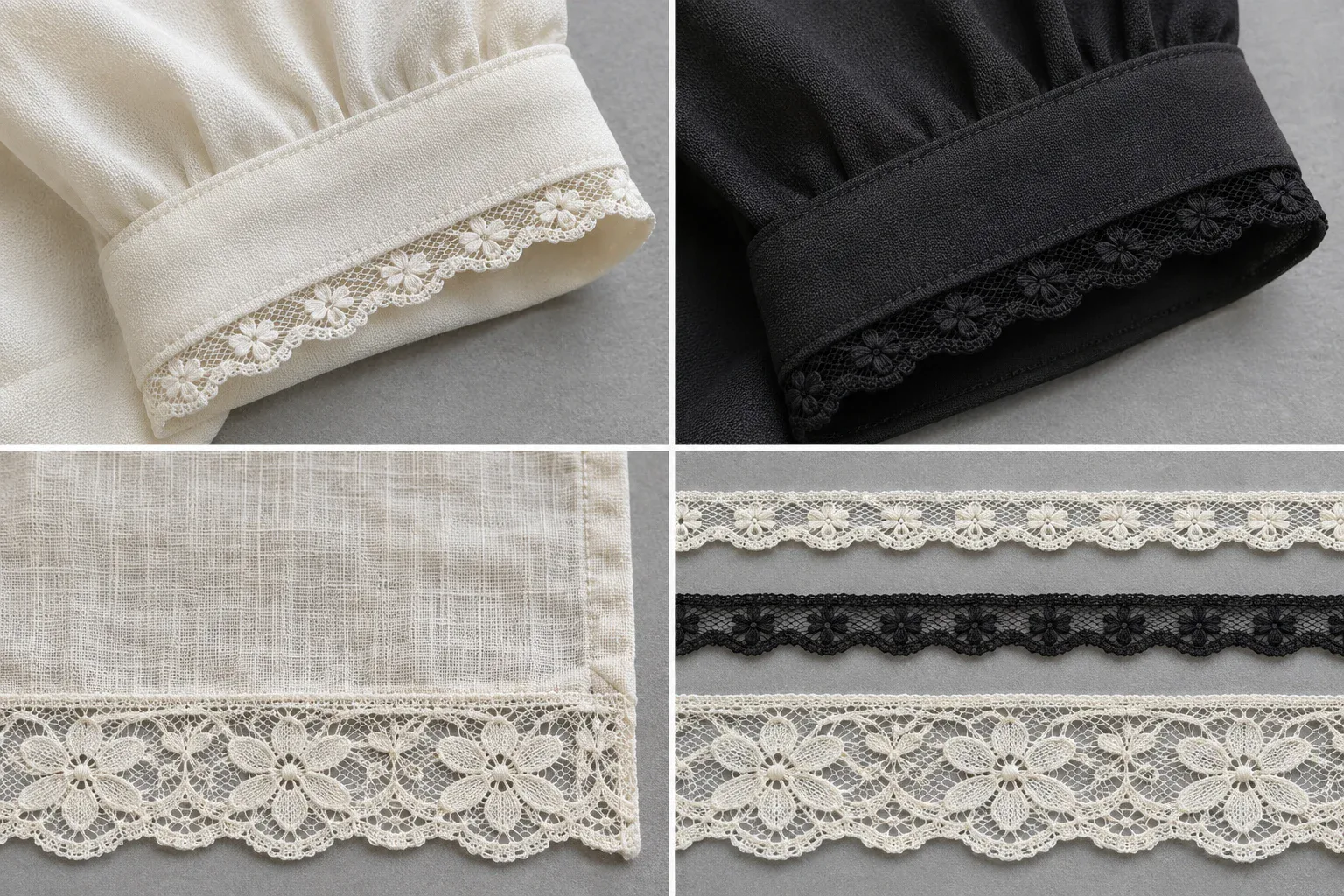
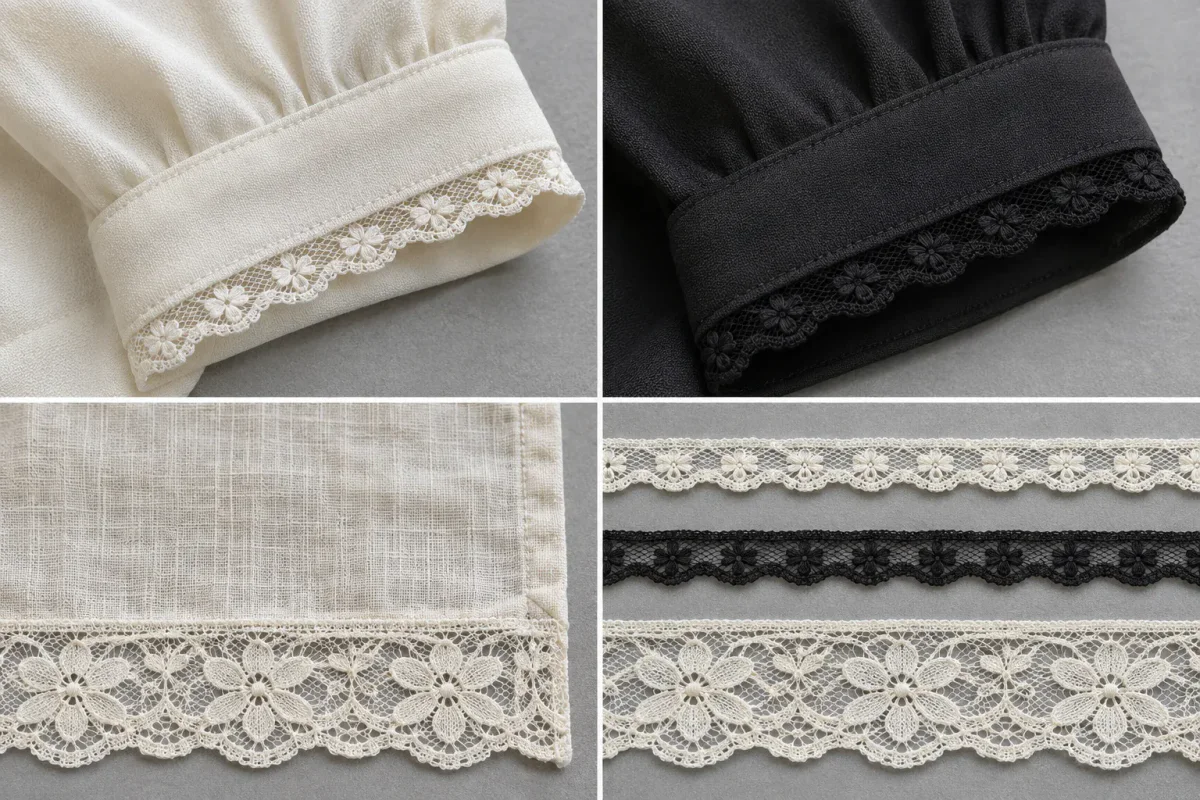
The two cuffs use the same small-flower design in different shades. The runner shares the light color but takes the wider border pictured below the cuff trims. The three swatches become three quotation lines.
Count cuffs and runner edges before adding metres
Ask the sample room for the relaxed cut length for one cuff, including the end join. A shirt may have two cuffs and a size L cuff may take more lace than a size M. If the order sheet counts shirts, multiply by two. If the cutting list already counts individual cuffs, use that count directly.
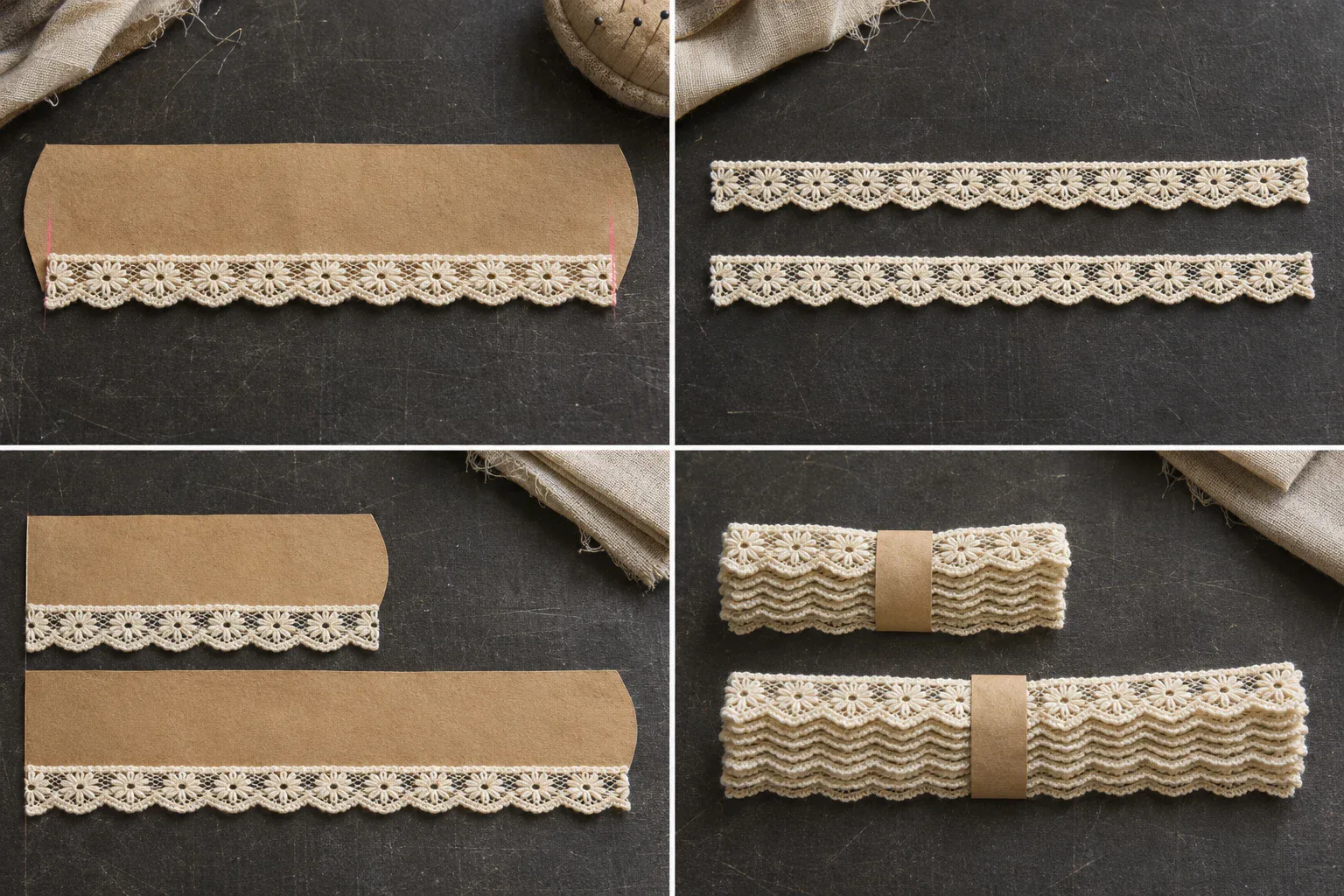
Follow the strip from one chalk mark to the other in the top left. The second strip in the next frame is for the other sleeve. Two sizes can draw from the same roll and still need different cutting instructions, as the lower pair shows.
Four cutting instructions, three lines to price
Suppose the buyer has approved narrow trim N20 for the blouses and wider trim W40 for the runners. The references, shades and quantities below are a worked order. All cut lengths include the specified end treatment. The runner has trim on its two long edges only.
Article and pieces ordered | Approved trim | Pieces × cut length per article | Net trim |
|---|---|---|---|
100 ivory shirts, M | N20 · ivory I1 · 20 mm | 2 × 0.28 m | 56 m |
50 ivory shirts, L | N20 · ivory I1 · 20 mm | 2 × 0.32 m | 32 m |
75 black shirts, L | N20 · black K1 · 20 mm | 2 × 0.32 m | 48 m |
24 ivory runners | W40 · ivory I1 · 40 mm | 2 × 2.40 m | 115.20 m |
The two ivory cuffs share the same approved trim and shade sample, so the buyer asks for 88 m of ivory N20. The black N20 stays on its own at 48 m. The third line is 115.20 m of ivory W40, with enough unbroken length for 48 runner edges. Keep the four cutting calculations on file. If the customer adds ten large ivory shirts, only the first quotation line grows, by 10 × 2 × 0.32 m = 6.40 m.
Give the supplier something they can identify
A real catalogue example is YiTuo’s Floral Scroll trim, reference YT-235T7. The listing gives a width of 5.5 cm and a color of white, quotes by the yard and lists a minimum of 2,000 yards. A buyer who wants this design in a particular ivory would start with that reference, attach the approved shade swatch and ask for the minimum and lead time for the requested color. N20 and W40 in the worked order are example references. View the YT-235T7 catalogue entry
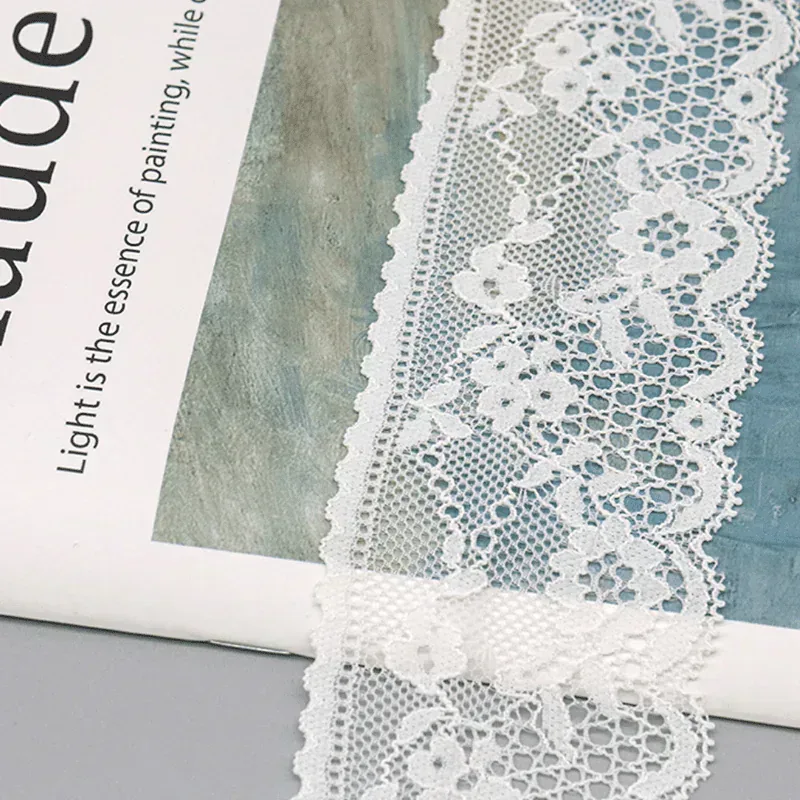
YiTuo catalogue photograph of YT-235T7. The open scroll beside the denser flowers makes the design easier to recognize. For color matching, attach a physical swatch bearing the same shade reference as the quotation request.
If the quote is per roll, how many metres are you paying for?
Take the 88 m ivory cuff line. Suppose the cutting room has recorded 1 m for cutting losses and the workroom asks for another 2 m for sewing trials. That gives 91 m to buy for this example. The cuff cut lengths already include their end joins. Adding another allowance for the same joins would count them twice.
Suppose the supplier sells whole rolls of 25 yards. Each is labelled 22.86 m, so four rolls total 91.44 m on paper. That leaves 44 cm above the 91 m requirement. Another quote for four rolls of 25 metres comes to 100 m. Check the unit, the minimum usable length the supplier guarantees and how the rolls are priced before deciding between the offers.
Say the quote allows each 25-yard roll to run up to 1% short. In that example four rolls could total just 91.44 × 0.99 = 90.5256 m, about 90.53 m even if the whole length is usable. That falls roughly 47 cm short. Ask the supplier to guarantee at least 91 usable metres across the shipment or quote a pack quantity that will cover it. Apply the allowance in the actual quotation when you do this calculation.
If one shade falls below the stated minimum, ask how the minimum is applied and what the supplier can actually offer for that shade. A stock shade, a small-lot surcharge or a different delivery date changes the buying decision. Request a separate price and a sample for any proposed color change before adding it to the order.
When twelve metres will only cut four table edges
From one continuous 12 m length, the cutter can take five 2.40 m runner edges if no further loss is allowed. From two 6 m lengths, the cutter gets two complete edges from each and has two 1.20 m remnants. The remnants total 2.40 m but the approved runner has no mid-edge seam. Four usable edges instead of five is a real difference to the wedding order.
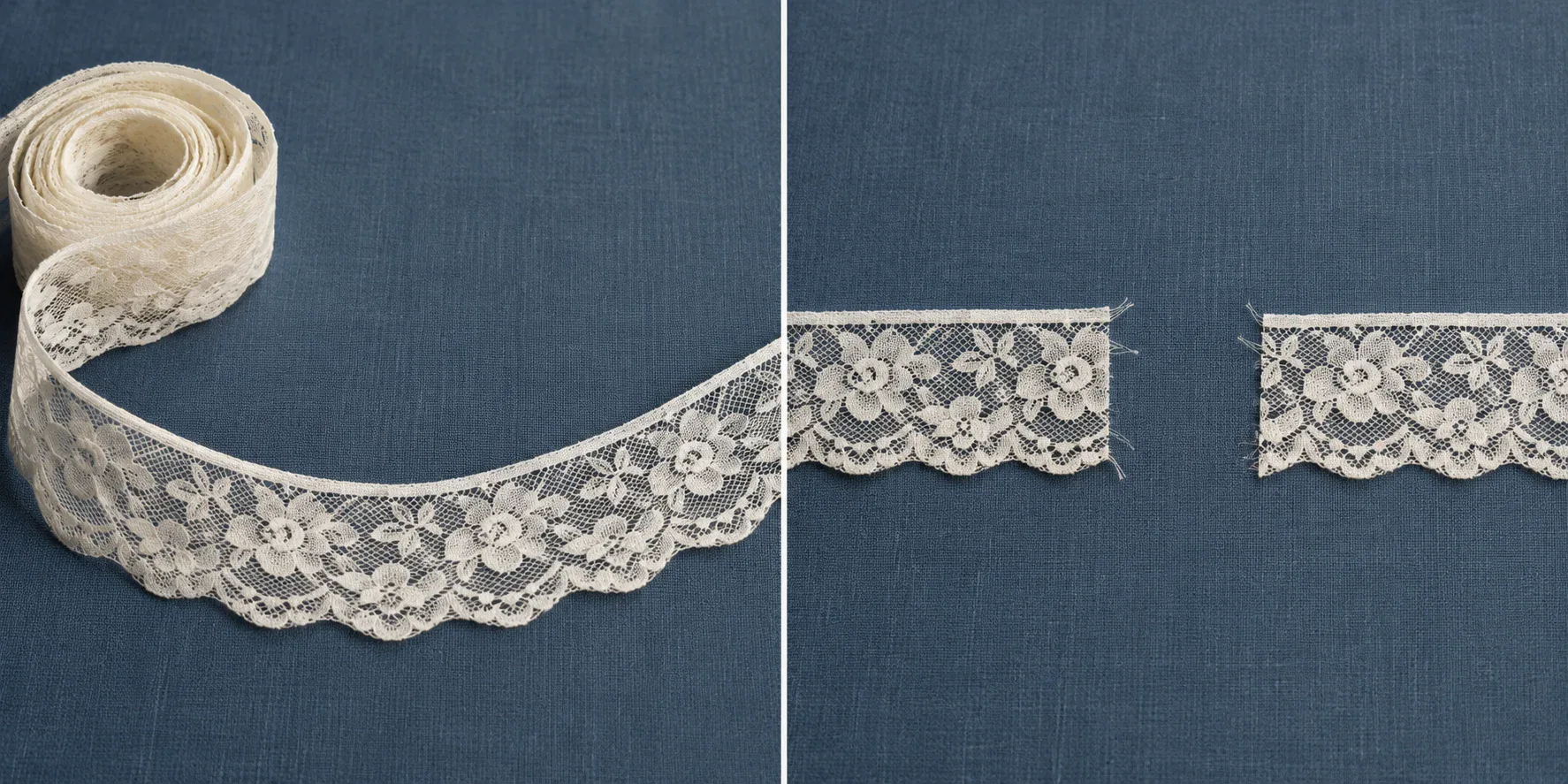
The break on the right is what a total-length figure hides. For the runner, ask how many complete 2.40 m cuts each supplied length will yield. Keep a labeled W40 remnant for a runner color sample if the workshop needs one.
For 24 runners the cutting room needs roll lengths that yield 48 unbroken pieces of 2.40 m. Ask how much usable trim lies on either side of every roll join. If the designer also wants the same flower centre at each finished end, mark those two visible positions on a full-size strip, allowing for the specified end turns. Measure between the marks and check that distance against the full pattern repeat on the relaxed trim.
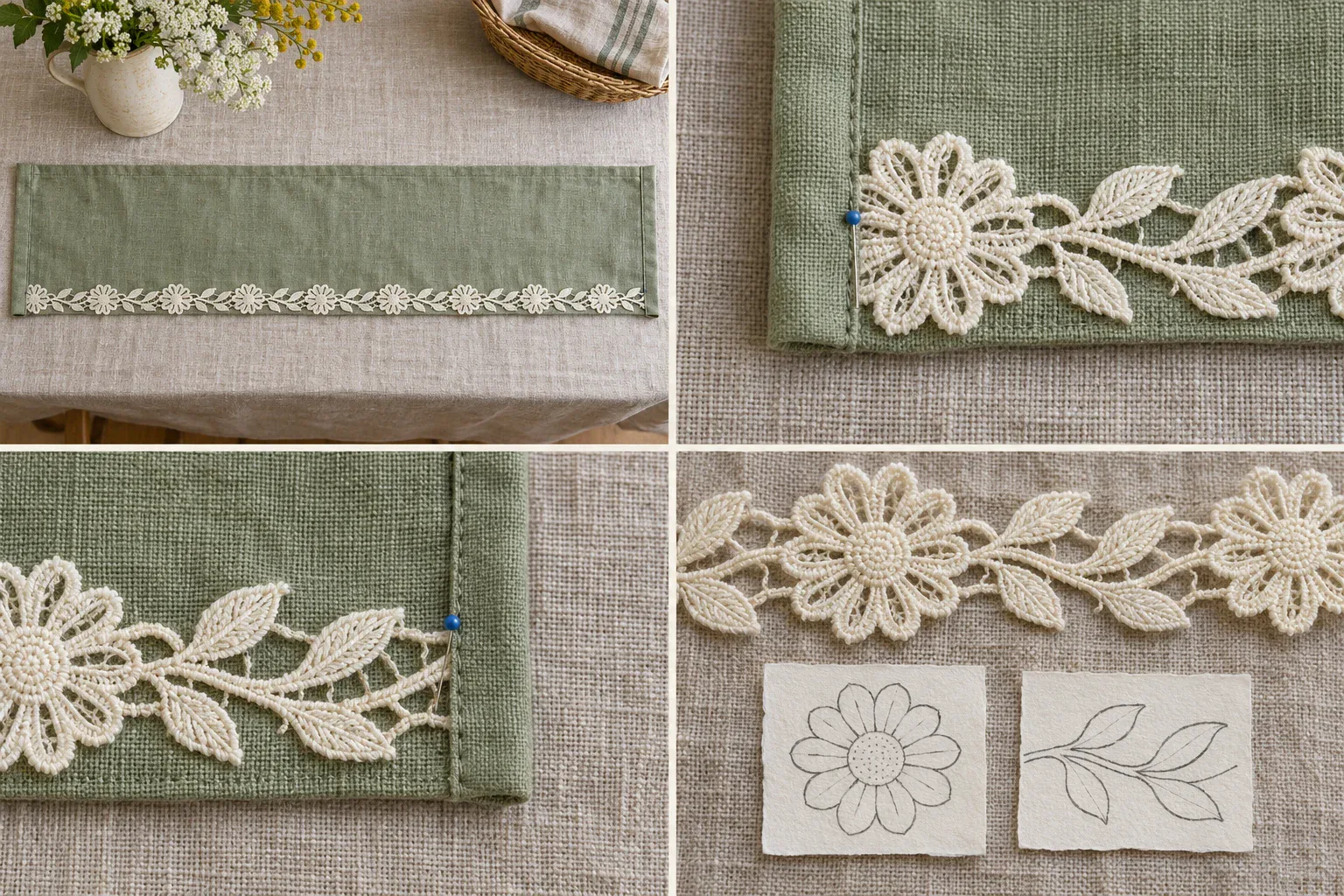
At the left end the border reaches a flower. At the right it reaches a leafy link. Mark the exact point on the flower the designer wants to see at each finished end, then pin the actual trim at both positions before cutting.
When the buyer specifies the same point in the same repeating motif at both ends, the distance between those marks must span a whole number of complete repeats, within the agreed tolerance. Shifting the strip moves both marks together. Extra trim may help you find a starting flower, but it cannot change their separation. If the two marks will not align, ask the designer to accept a different motif at one end, approve a revised finished or cut length as appropriate, or choose a trim with a compatible repeat.
A short request the supplier can quote line by line
Please price the three attached samples separately. Ivory N20, shade I1, 20 mm, needs at least 91 usable metres including our cutting allowance and sewing trial. Please give the minimum usable length your proposed rolls will supply. Black N20, shade K1, 20 mm, needs 48 m net. Ivory W40, shade I1, 40 mm, must come on rolls from which our cutter can get 48 unjoined 2.40 m lengths. For those last two lines, quote the pack quantity and extra metres for approval. For each line please give the sale unit, roll length and tolerance, minimum per color and dispatch date. List short rolls, splices and proposed shade changes separately.
Discuss a real requirement
Turn the reading into a practical next step.
Send a short note, product reference, photograph, swatch or tech pack. Technical feasibility, sampling, documentation and production terms are confirmed after review.
Start an inquiry