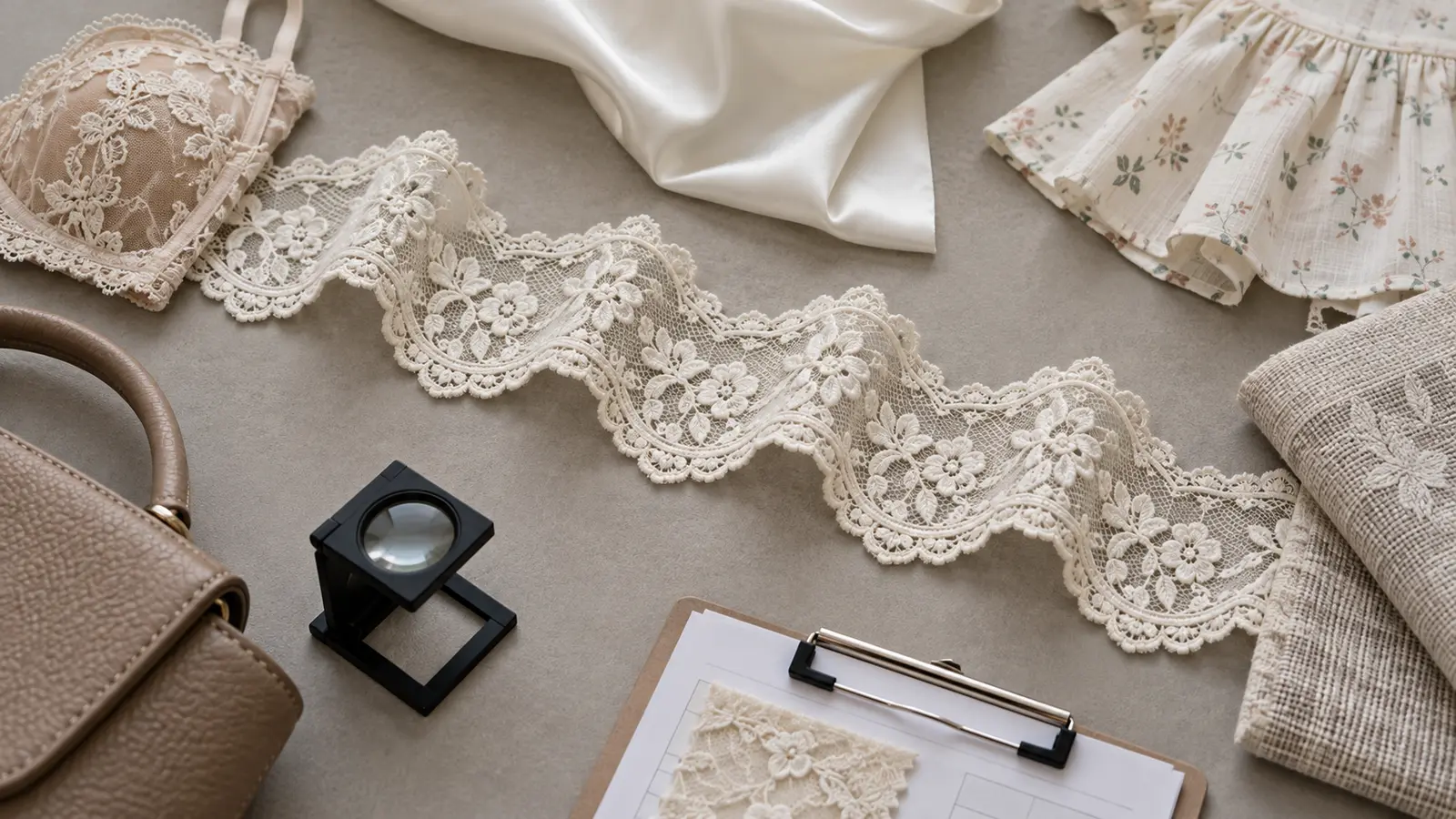
The same lace construction can face completely different acceptance criteria once its end use changes.
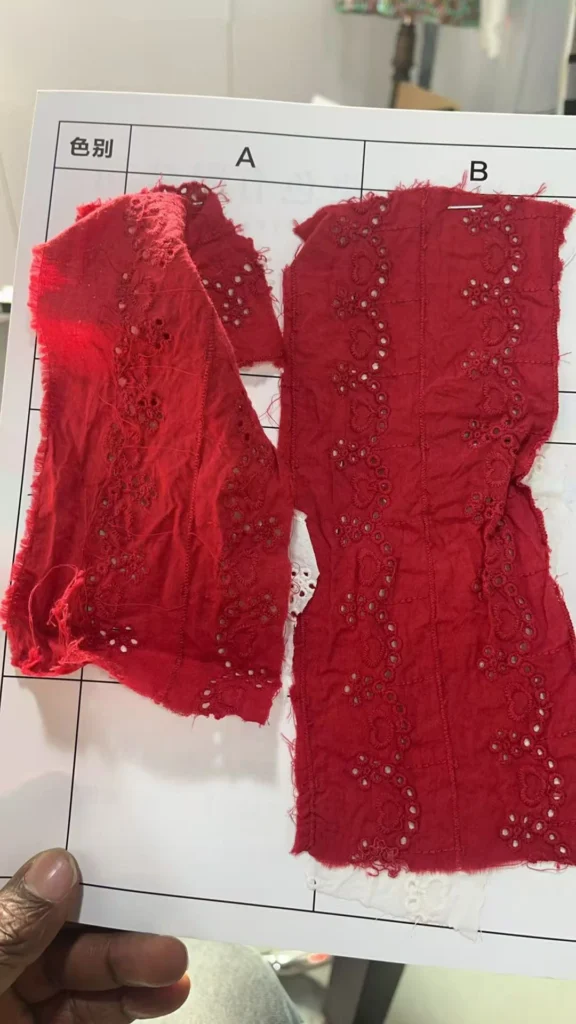
A buyer once sent me a cotton embroidered lace that had run in her blouse program for three seasons and asked for the same article, same width, same shade, for a toddler dress. The lace was fine. The order was not. On a garment for a child under three, two of the embroidered motifs sat on a narrow connecting thread, and once you pull-test that construction the way a children's product has to be pull-tested, a detached motif becomes a choking hazard rather than a trim defect.
Nothing about the lace had changed. The acceptance criteria had.
Buyers treat the difference between lingerie, bridal, kidswear, home textiles and bags as a difference in taste — softer here, whiter there, heavier for curtains. The taste part is real but it is not what kills orders. Each of these five industries tests one specific property to destruction, and in four of the five that property has a hard pass or fail line behind it. It is almost never pattern, and almost never hand-feel, which is what most buyers approve a sample on.
The five industries stress five different properties
Separate the question into fibre, structure, and service condition. Service condition is where the verticals split, and the split is wider than most tech packs assume.
| Industry | Property tested to destruction | Governing reference | What failure looks like |
|---|---|---|---|
| Lingerie and sleepwear | Repeated extension; skin-contact chemistry | ASTM D4964; OEKO-TEX Standard 100 class | Band grows out in two weeks, edge gapes |
| Bridal and eveningwear | Whiteness cast; lot-to-lot continuity | Spectrophotometry, AATCC grey scales | Lace reads blue beside ivory silk; reorder misses the sample |
| Childrenswear | Component geometry; regulated chemistry | 16 CFR 1501, 1120, 1615/1616; CPSIA | Detached motif fits the small-parts cylinder |
| Home textiles | Light exposure; flame propagation | AATCC 16.3, NFPA 701 | Edge fades in a south window; fails fire inspection |
| Shoes and bags | Surface abrasion; bond integrity | ISO 17704, 12947, 5470-2 | Fuzzes at flex points, delaminates from backing |
Read that as five separate axes rather than five levels of the same quality. A lace that survives 60 hours of xenon exposure tells you nothing about whether it recovers after 5,000 extensions. Approval in one column does not transfer.
Lingerie asks how the lace behaves the ten-thousandth time
A bra band and a leg opening do not experience one pull. They experience thousands of cycles, at body temperature, against skin.
ASTM D4964 therefore tests elastic fabrics on a constant-rate-of-extension machine, with specimens conditioned at 21 ± 1 °C and 65 ± 2 % relative humidity for at least four hours first. Skip the conditioning and you measure the room instead of the lace, because nylon and elastane both change stiffness with moisture. Single-pull tensile strength is the wrong number here anyway. It tells you whether the lace breaks, and lingerie lace almost never breaks. It grows.
Where nylon spandex stretch lace is the right call, the selection basis is the elongation-to-recovery relationship at the extension the garment will actually hold, not maximum stretch. A lace that extends 140 % looks generous on the bench and still fails if recovery drops after repeated loading. Ask for both values at the same extension, or the figure means nothing.
The second requirement is chemical. OEKO-TEX Standard 100 assigns product classes by degree of skin contact, and direct-skin articles fall into a stricter class than decorative or outerwear articles. A certificate covers a specific article, mill, and validity window — it is not a property of lace in general. Confirm its scope covers the article number and class you are buying for.
Bridal fails on cast, not on brightness
The hardest colour problem in lace is not matching a colour. It is matching a white.
Whites in lace are almost always optically brightened, and optical brightening agents fluoresce under UV so the fabric returns more visible light than it receives. The whiteness you see therefore depends on the light source. A lace can hit its numeric whiteness target and still look wrong beside the main fabric, because the error is cast — a shift toward blue, green or pink — rather than brightness level. Optical white carries a blue cast by construction, which is why it refuses to sit quietly next to an ivory satin.
Translucency compounds it. Open ground reflects and absorbs light unevenly across its own surface, so visual assessment drifts between assessors and viewing conditions. Spectrophotometric measurement exists in bridal supply chains for that reason, not as a formality.
The consequence is about lot continuity rather than first approval. Bridal styles carry for years on reorder, so the real question is whether lot four still matches the gown sampled from lot one. Approve the white against your actual main fabric under showroom lighting, and hold a retained physical reference for every reorder.
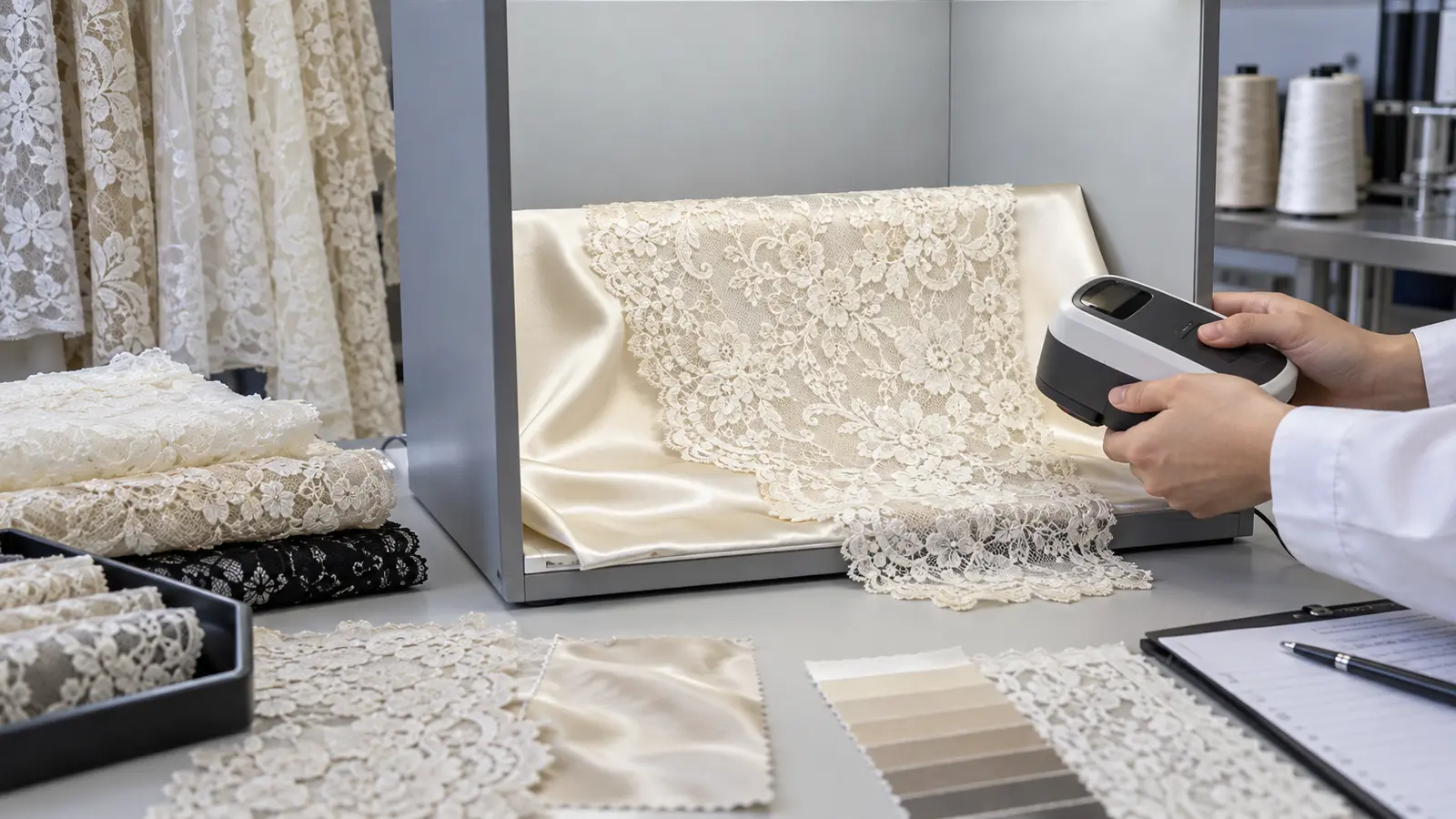
For bridal programs, white approval is a controlled comparison against the actual main fabric—not a judgement made from the lace alone.
In childrenswear, lace stops being a trim
This is the vertical where the rules change most, and the one most often missed, because the lace looks identical to the adult version.
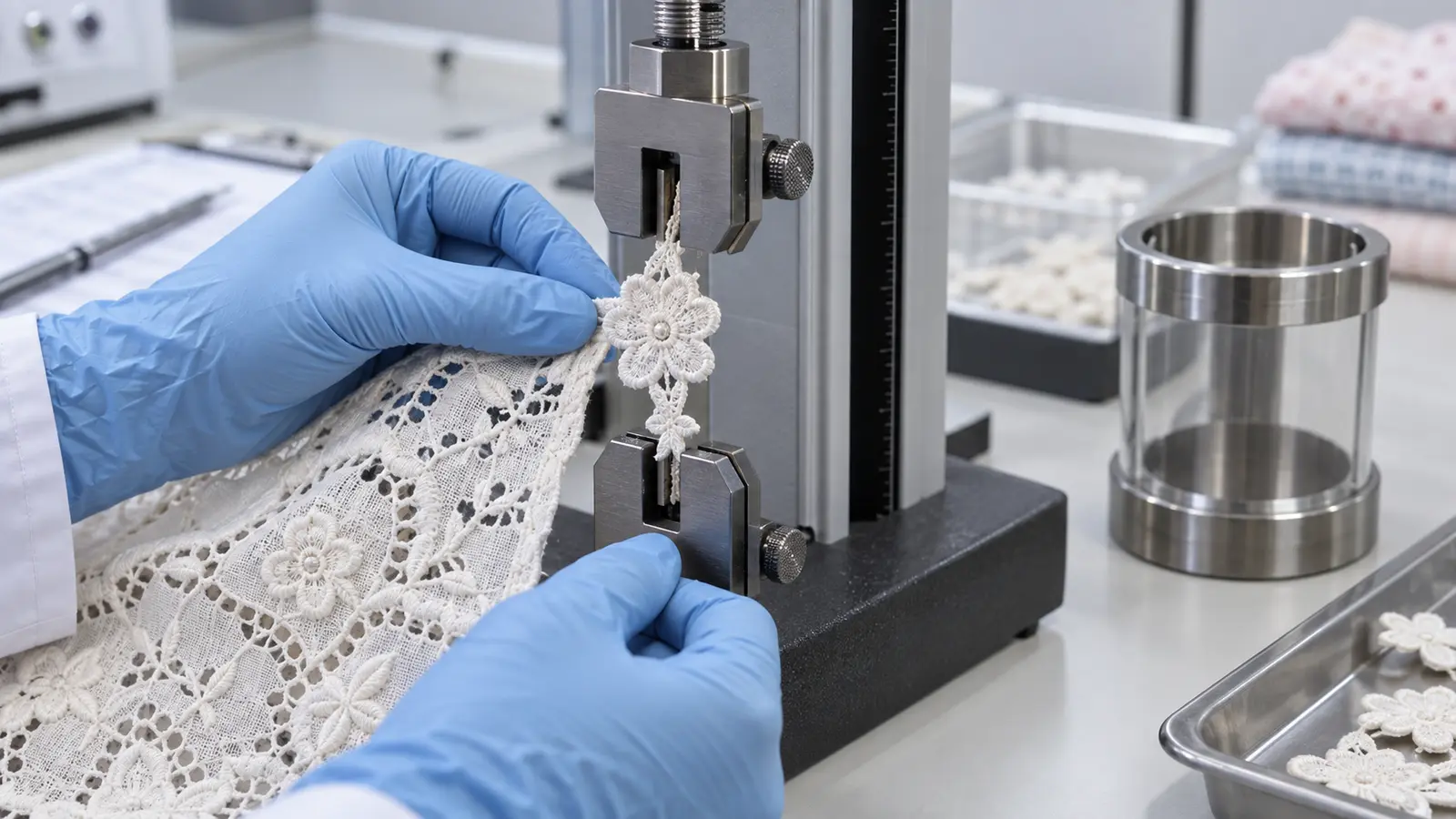
A childrenswear lace component must be assessed after simulated use and abuse, not only as received.
For products intended for children under three, any component that fits entirely inside the small-parts cylinder of 16 CFR 1501.4 is a small part. The cylinder is 1.25 in in diameter, with a depth of 1 in on the short side and 2.25 in on the long side. Components are assessed after simulated use and abuse — pulling, twisting, dropping — not as received. So the question about a beaded or appliqué lace is not whether the bead is attached. It is whether the bead survives the abuse sequence, and what size it is if it does not.
Two more requirements sit alongside it. Waist and bottom drawstrings in children's upper outerwear are limited to 3 in outside the channel when the garment is expanded to full width in sizes 2T to 16, and neck or hood drawstrings in sizes 2T to 12 are named by the CPSC as a product hazard subject to recall — a lace tie or lace-threaded casing can fall inside that definition. Children's sleepwear flammability is evaluated on the finished garment with trims and seams in place, so a compliant base fabric still produces a failing garment once the wrong lace goes on.
Soft cotton lace is usually the right structure here, and softness is why buyers choose it, but softness is not what gets checked. Screen the construction for detachable elements first, confirm CPSIA lead and phthalate limits for any metallic yarn, coating or bead, then evaluate hand-feel.
Home textiles are graded on light and fire
Curtain lace has an easy life mechanically and a brutal life optically. It hangs in one position for years, in daylight.
Contract-textile practice asks for grade 4 minimum colourfastness to light at 60 hours of xenon exposure under AATCC 16.3 for drapery, against 40 hours for upholstery. Those guidelines are voluntary and written for commercial interiors, so residential programs often set their own equivalents, but the direction holds: drapery is the most light-stressed lace application there is.
Fire performance is where a decorative trim stops a whole project. NFPA 701 Test Method 1 covers hanging textiles at or below 700 g/m² (21 oz/yd²), which takes in essentially all lace curtain material, and building codes reference it for draperies in commercial occupancies. One clause deserves attention while sourcing: when durability to cleaning is claimed, the material must be retested after that cleaning procedure. A topical flame-retardant finish that washes out does not carry its claim through laundering.
Dimensional stability rounds it out. A cotton lace edge that shrinks differently from a polyester panel pulls the hem into a wave after the first wash, and pattern quality does not compensate.
Shoes and bags inherit mechanical standards rather than lace standards
Lace on footwear and bags is the thinnest of the five applications and the least codified. No lace-specific specification exists, so requirements are inherited from component testing.
Abrasion dominates. ISO 17704 covers footwear uppers and linings, ISO 12947 covers the Martindale method for textiles generally, ISO 5470-2 applies once the lace is bonded to a coated substrate, and ISO/TS 20358:2024 sets requirements for footwear accessories such as laces and eyelets. Flex points decide the outcome: a lace that reads beautifully flat fuzzes where the vamp creases.
Bond integrity is the second issue, and it is a compatibility question rather than a quality one. Adhesives and heat lamination interact with fibre type and with any finish on the lace, so a construction that bonds cleanly in one build lifts in another. Test the bond on the real substrate before anyone approves the look.
Approving on hand-feel is the expensive habit
A mill cannot infer acceptance criteria from a photograph or a swatch request. When an inquiry says width, shade and pattern, the mill quotes width, shade and pattern — and the buyer meets the real requirement at inspection, with the season already committed.
Name the end use and the governing test in the inquiry itself. "Children's dress, sizes 2T-4T, must clear small-parts after use-and-abuse" or "commercial drapery, NFPA 701 Method 1, claim must survive laundering" changes what gets sampled. It also changes what gets quoted, because a lace built to survive 60 hours of xenon exposure and one built for a two-season blouse program are not the same cost.
| Moving lace from | Into | Re-test first |
|---|---|---|
| Womenswear | Childrenswear | Small parts after use-and-abuse; CPSIA chemistry |
| Lingerie | Bridal | Whiteness cast against main fabric; lot continuity |
| Apparel | Drapery | 60-hour lightfastness; NFPA 701 with the finish claimed |
| Apparel | Footwear or bags | Abrasion at flex points; adhesive bond on the real substrate |
What to do before the next cross-category order


 WhatsApp Us