I start with the construction, then choose the decoration. A sheer embroidered sprig, a firm guipure leaf, and a flower covered in beads need different handling—even when their outlines look almost identical.
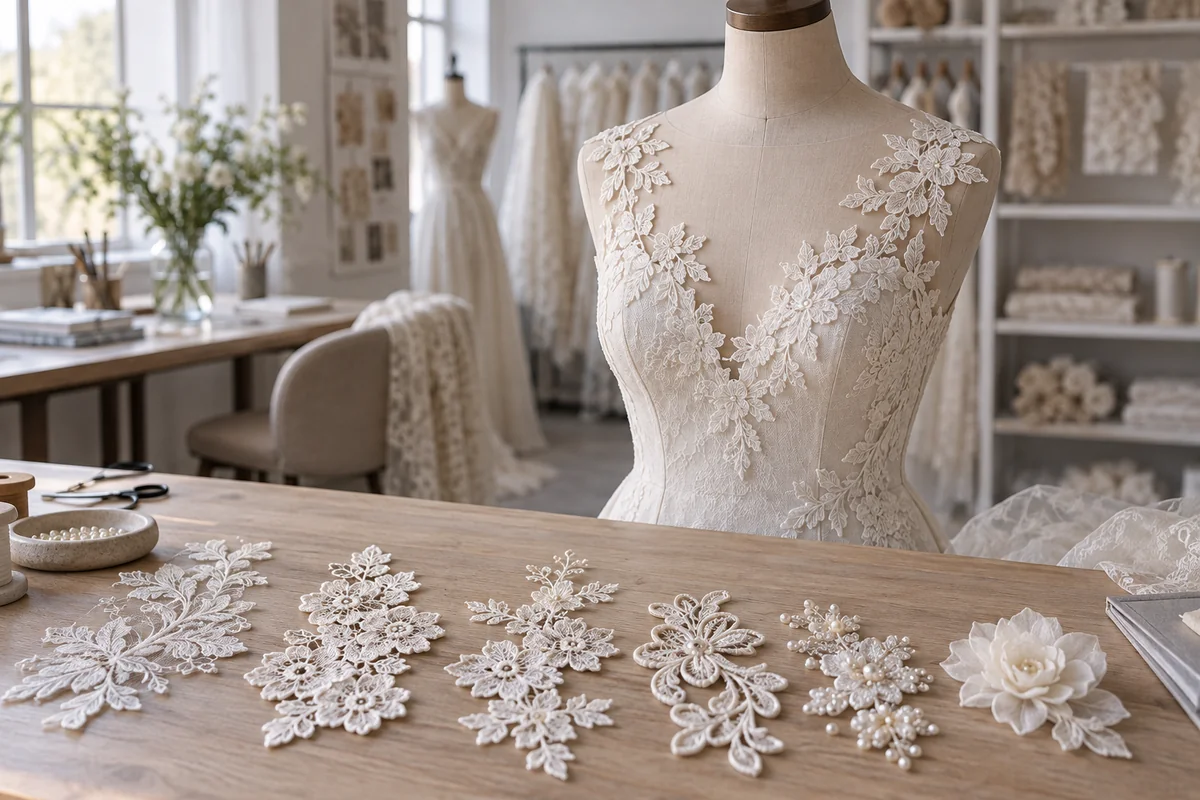
Lace appliques are independent motifs: their foundation, weight and flexibility determine where they can sit successfully on a garment.
What is a lace applique?
A lace applique is a separate decorative motif attached to another fabric. It might be a small flower, a branching vine, a symmetrical neckline piece, or a larger panel shaped for a bodice.
The motif may be made individually or cut from suitable lace fabric. A lace trim usually runs continuously along an edge; an applique gives you a shape that you can position independently.
Embroidery describes how stitches create a design. Applique describes attaching a separate element. An embroidered flower made on tulle and later sewn onto a dress is both embroidered and appliqued. A flower embroidered directly into the dress fabric has no separate motif to position.
When ordering, establish whether the product arrives as loose pieces, paired motifs, continuous trim, or fabric from which you must cut your own shapes. That distinction changes the work in the sewing room.
Six common styles of lace appliques
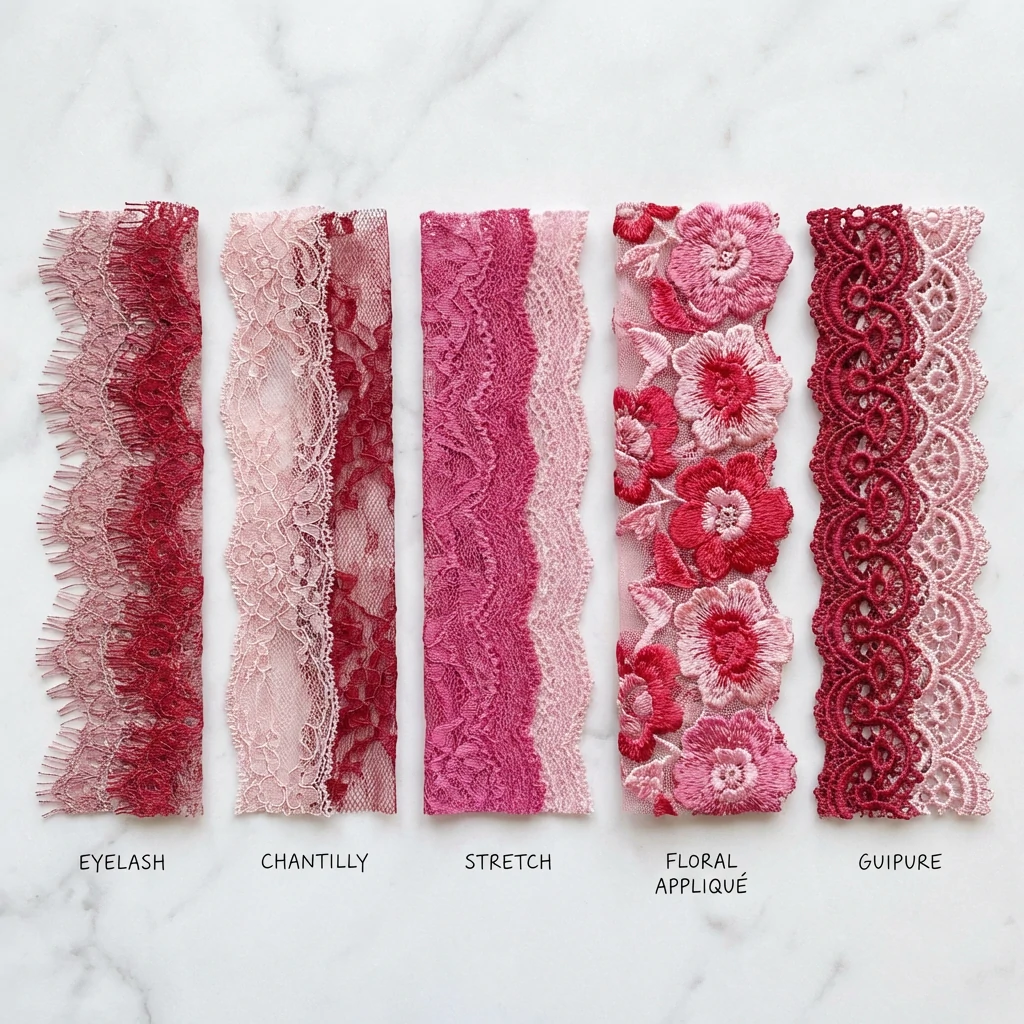
Embroidered tulle, guipure, Chantilly, corded, beaded or sequined, and three-dimensional floral appliques are useful styles to recognize when browsing suppliers.
These labels overlap. Embroidered tulle and guipure describe construction; beads and raised petals describe decoration added to a foundation. A single applique can combine a tulle base, corded embroidery, and scattered pearls. Ask for those details separately.
| Style | What you will notice | A useful starting application | Check before choosing |
|---|---|---|---|
| Embroidered tulle or mesh | Stitched motifs on a visible fine net | Illusion bodices, sleeves, scattered floral layouts | Net color, net visibility, local stiffness |
| Guipure | Open spaces between connected, dense motifs | Defined necklines, collars, bold accents | Connecting bars, flexibility, edge stability |
| Chantilly | Fine net with delicate, shaded patterns | Veils, light overlays, subtle decoration | Cut boundaries and support for fine details |
| Corded | Raised outlines around flowers or other shapes | Motifs that need a clear outline | Cord attachment and bulk where pieces overlap |
| Beaded or sequined | Added sparkle, texture, or pearl detail | Eveningwear and supported bridal sections | Weight, attachment threads, contact with skin |
| Three-dimensional floral | Petals or leaves standing away from the surface | Shoulders, bodices, selected skirt accents | Petal anchoring, crushing, snagging |
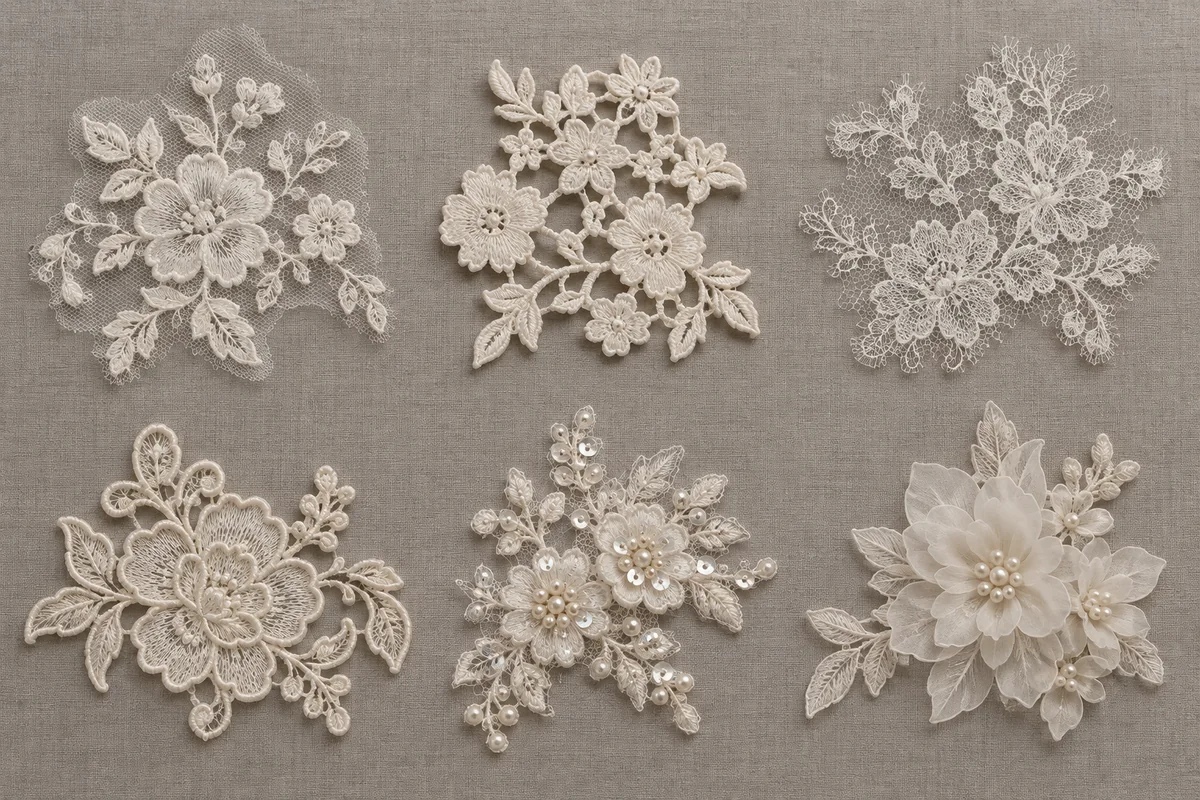
From fine net-backed motifs to raised petals, the visible structure gives the first clues about support, drape and attachment.
1. Embroidered tulle or mesh appliques
Choose embroidered tulle when you want separate flowers or leaves to appear connected by very little visible fabric. The embroidery sits on an existing net foundation, which supports small details and the spaces between them.
Hold the piece against a contrasting background. You should be able to distinguish the embroidery from the fine mesh underneath. The net is part of the finished appliqué, although surplus net outside the design may be trimmed.
This construction gives you useful freedom for branching motifs on an illusion neckline or sleeve. It also introduces another color to match: the net can show even when the embroidery thread matches the dress.
I would shortlist a lightly embroidered version for a soft sleeve, then check the dense flower centers separately. A flexible net does not guarantee that the whole motif will bend easily.
2. Guipure appliques
Choose guipure when you want the motif itself to define the shape, with open gaps between its connected elements. There is no continuous net ground filling those gaps; stitched bars or direct connections hold the design together.
Modern embroidered guipure often starts on a temporary backing that is removed after stitching. This gives the finished piece its open structure. Guipure names the lace construction; water-soluble or chemical lace terminology describes a production route used to make it.
The pronounced outlines can work well around a collar or across a supported bodice. But guipure ranges in firmness, and a dense piece can resist a tight curve or pull on a light foundation.
Look closely at the connections between flowers and leaves. If you plan to divide a larger piece, identify which connections you would cut and how the remaining sections would be secured. A firm outline is useful only if the motif can follow the garment.
3. Chantilly lace appliques
Choose Chantilly for a fine, relatively flat pattern with delicate shading and a light net ground. Its flowers tend to read as soft changes in transparency rather than thick embroidered shapes.
An appliqué can be cut from suitable Chantilly lace, retaining enough surrounding structure to support the motif. Established French makers produce Chantilly on Leavers machines; the name alone on a product listing does not establish where or how that particular lace was made.
This is a useful starting point for a veil or a light overlay where a heavy outline would interrupt the fabric's movement. The tradeoff is handling: a fine tendril or a loosely connected flower may need more support during cutting and attachment.
Request a complete motif sample if you intend to cut your own appliques. A rectangular swatch may show the pattern beautifully while leaving you unable to judge whether the whole flower can be separated cleanly.
4. Corded lace appliques
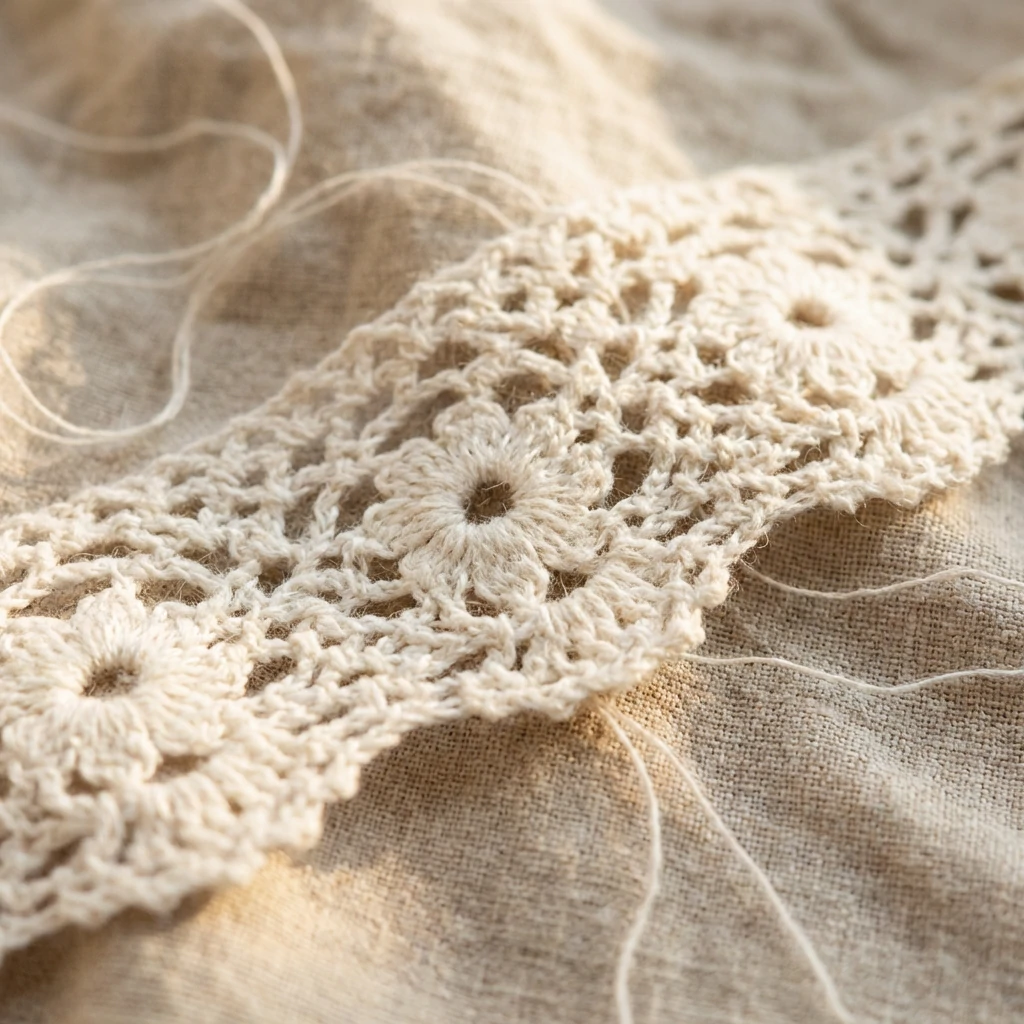
Choose a corded appliqué when the flower needs a more visible outline without covering it in beads. A thicker yarn or cord follows parts of the design, adding relief and definition.
The cord may be incorporated during lace manufacture or secured onto a foundation with stitches. Underneath, you may still find a fine net or embroidered tulle. Check the foundation as well as the raised outline.
Corded motifs suit a neckline or bodice where the design needs to remain legible against fabric of a similar color. Overlapping pieces, however, can leave a noticeable ridge. Position the join before deciding where to sew.
You may encounter corded bridal lace described as Alençon-style. Traditional point d'Alençon is a specific needle-lace craft; a raised cord outline does not prove that heritage or manufacturing method. If origin or handmade construction affects your purchase, ask for it explicitly.
5. Beaded or sequined lace appliques
Choose beaded or sequined appliqués for reflected light and surface texture. Beads, pearls, and sequins can decorate several different lace foundations, so the embellishment name tells you little about the backing.
The decoration may be applied by hand, machine, or a combination of both. Embroidery equipment can stitch sequins and seed beads; a sparkling surface is not evidence of handwork.
For a supported bodice, the extra weight may be manageable. On a fine veil or loose sleeve, check whether the same piece pulls the fabric down or changes its hang. Judge the full arrangement, since several small motifs can add up.
Inspect the reverse for loose threads and the face for insecure ornaments. Where the piece may need trimming, establish whether cutting one attachment thread could loosen a longer run of beads. I prefer a sample with the intended cut already finished, so that the attachment can be examined before ordering.
6. Three-dimensional floral appliques
Choose three-dimensional flowers when you want actual projection from the garment: petals that lift, cast shadows, or move independently of the base.
These pieces may combine embroidered lace with separately cut fabric petals. Some include organza, tulle, chiffon, or satin elements, so a product sold as a 3D lace flower may contain more than lace. Check the component materials when their appearance or care requirements affect the design.
A raised flower can work at the shoulder or on a bodice with room around it. At an underarm, beneath a belt, or where a bag strap rests, the same petals may be repeatedly flattened or caught.
Examine the attachment at the center and any secondary anchor points. Then handle the sample as it will be worn and packed. The flower should regain the intended shape after ordinary handling; an attractive side-view photograph cannot establish that.
How are lace appliques made?
Three production routes explain much of what you see in finished appliqués: embroidery on permanent net, embroidery on a removable backing, and motifs cut from pre-existing lace. Decoration and finishing can follow any suitable route.
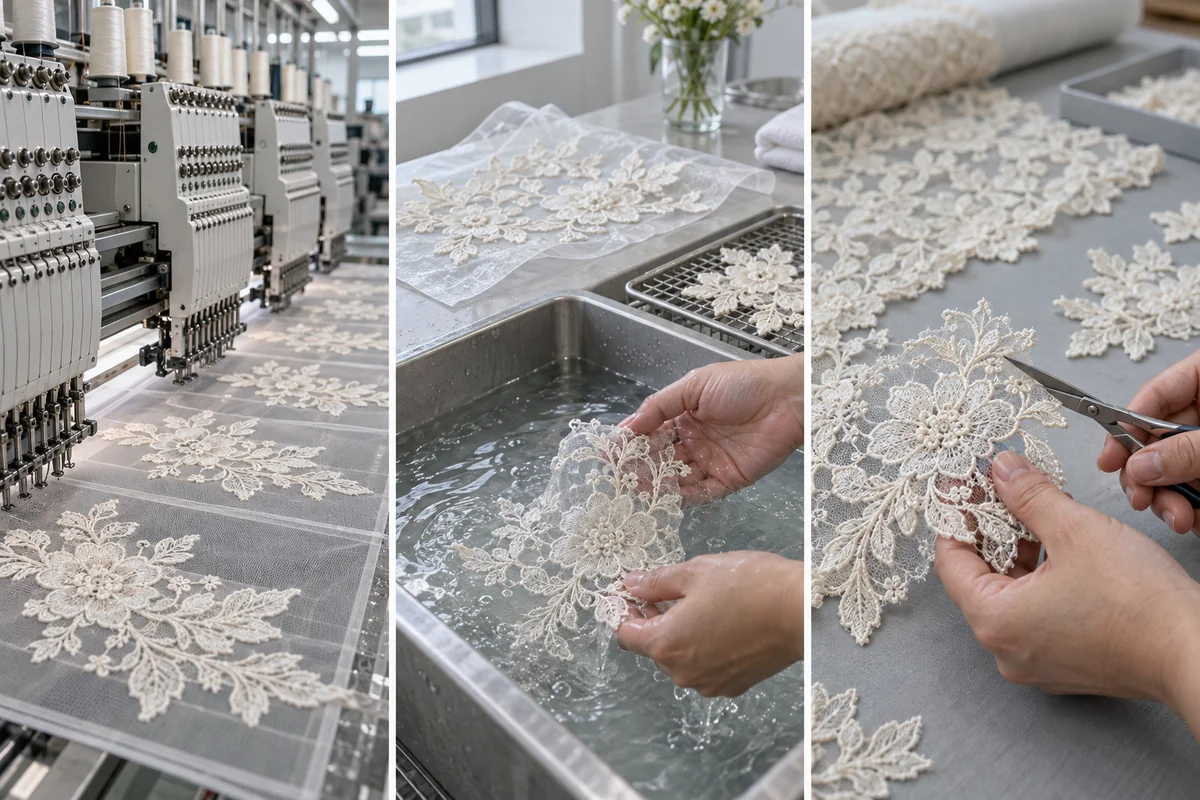
The foundation may remain in the finished piece, dissolve after embroidery, or come from an existing lace fabric that is cut into motifs.
Embroidery on a permanent net foundation
A digitizer prepares a stitch design for the required motif and size. The embroidery machine then stitches onto supported tulle or mesh, building outlines, fills, and fine details in a planned sequence.
After embroidery, the maker separates the motifs and trims unwanted threads and surplus material. Temporary embroidery support may be removed, but the structural net stays wherever the design needs it.
This distinction is easy to miss when an appliqué arrives with a transparent margin. Some of that material may be surplus for handling; net between disconnected leaves may be the only thing keeping them in position. Confirm the trimming boundary before removing it.
Embroidery on a removable backing
For freestanding embroidered lace, the stitch design must form a connected structure. The backing supports the thread during manufacture, but the finished design must remain intact after that support disappears.
With a water-soluble backing, the maker stitches the design, separates the pieces, removes the backing with water, and dries the lace. The process and materials determine the appropriate removal conditions.
The dissolving stage removes the temporary support, not the finished lace thread. An ordinary embroidery design with disconnected sections cannot simply be stitched onto wash-away material and expected to become stable freestanding lace.
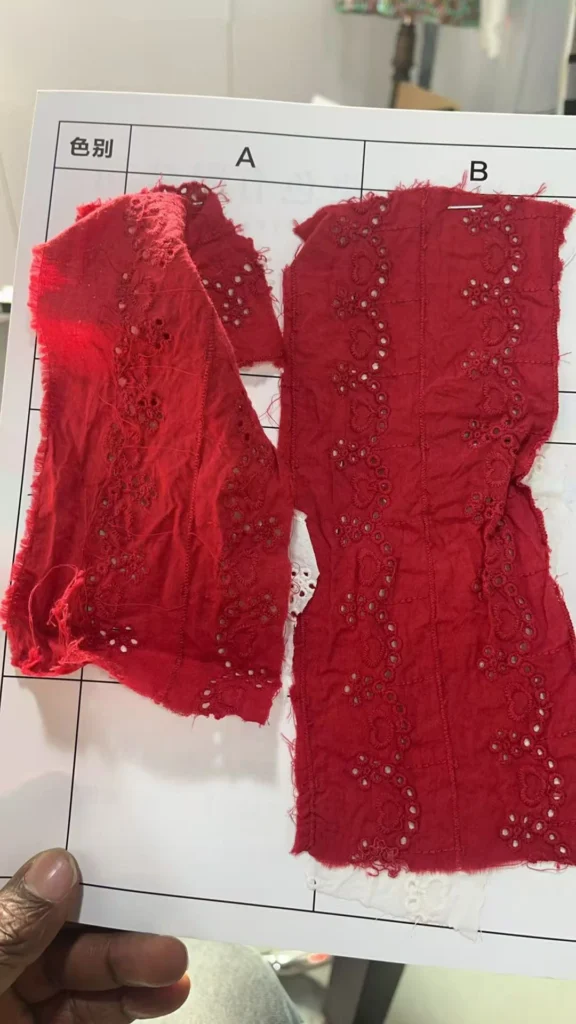
Inspect the finished, dried sample for intact connections and the required feel. Residual stabilizer can contribute stiffness, while dense stitching or a deliberate finish can also make lace firm. Ask whether this is the finished condition to expect in production.
The distinction between is particularly useful when the design depends on open spaces without a visible net.
Cutting motifs from existing lace
A maker can also select motifs from lace produced as fabric or trim, then cut around the shapes for individual placement. Suitable Chantilly, corded lace, and other patterned constructions can be used this way.
The cutting plan follows the lace structure. Some motifs have a firm, stitched boundary; others depend on a fine surrounding ground. Closely spaced flowers may share connections, limiting how many complete pieces you can obtain.
For production, count usable motifs in a planned layout before comparing fabric and ready-cut prices. Include cutting and edge-securing work in the comparison. A cheaper length of lace is not automatically a cheaper source of finished appliques.
Adding decoration and finishing the pieces
Cording, beads, sequins, and separate petals may be incorporated during embroidery or added in later operations. The sequence depends on the design and equipment; there is no single finishing order for every style.
The completed pieces need trimming, inspection, and preparation in the agreed supply format. Check their dimensions after finishing, including any washing or shaping that forms part of manufacture.
Approve the appliqué in the condition in which it will arrive at the sewing room. A sample awaiting backing removal or final petal assembly leaves part of the result untested.
How to choose lace appliques for your garment
Start with the application fabric and placement. Then narrow the choices by movement, transparency, scale, and care requirements.
Match the weight to the support underneath
Place the full motif on the intended fabric and hold both in the direction they will hang. Look for dragging, sagging, or a stiff patch that interrupts the drape.
For a floating veil, I would begin with fine Chantilly or lightly embroidered tulle. For a defined neckline on a supported bodice, guipure or cording deserves a place in the shortlist. Treat these as starting choices: the physical sample decides.
A small fabric square will not show how a long vine behaves across a seam or around a curve. Where possible, try the actual panel shape with the planned underlining or lining in place.
Check movement across the whole decorated area
A stretch fabric can become locally restricted when you attach a rigid motif. Dense embroidery, cording, and continuous attachment stitches may limit movement even when the underlying net stretches.
Baste the applique in place and test the movement the garment needs. A sleeve must bend; a fitted top must allow dressing and wearing; a neckline must retain its intended opening.
If the decorated section pulls or puckers, consider a more flexible construction, a smaller motif, or a different placement. A stretch-capable attachment stitch cannot make a rigid appliqué elastic.
Judge transparency and color as a layered combination
Compare the applique over the actual outer fabric, lining, and intended background. An ivory embroidery thread on pale net can look quite different over white satin, a nude lining, or skin.
Look at both the net margin and the spaces inside the motif. If either creates an unwanted outline, test another net shade or a construction without that continuous ground.
Check the combination in daylight and the lighting relevant to its use. Photographs help record an approved arrangement, but use physical samples to agree the color match.
Fit the motif to the placement
Lay out the entire neckline, sleeve, or bodice before counting pieces. Long leaves can point into a seam, large flower centers can sit awkwardly on a curve, and an attractive flat arrangement may change on the body.
For balanced left and right placement, request mirrored motifs. Turning an asymmetric piece over may expose its reverse; rotating it may send the flowers in the wrong direction. Confirm that a quoted pair contains the orientation you need.
Check the layout on the garment sizes you plan to make. The same motif can cover a different proportion of a smaller bodice, so one approved arrangement may need placement adjustments across the size range.
Include touch and care in the choice
Feel the reverse, edges, cord ends, and ornament attachment points where they will touch the wearer.
For , assess the sewn combination: lining and attachment stitches can change the contact surface.
Follow the intended care procedure on a representative sewn sample, using instructions compatible with all its components. Compare its shape, color, hand, and decoration afterward. Do not assume that every lace, bead coating, petal fabric, and adhesive tolerates the same treatment.
If a washable blouse needs a motif that only passes a different cleaning process, resolve that mismatch before approving the design.
How to attach lace appliques neatly
Baste the motif on the actual fabric before permanent stitching. The attachment method needs to hold the design without flattening its intended texture or distorting the foundation.
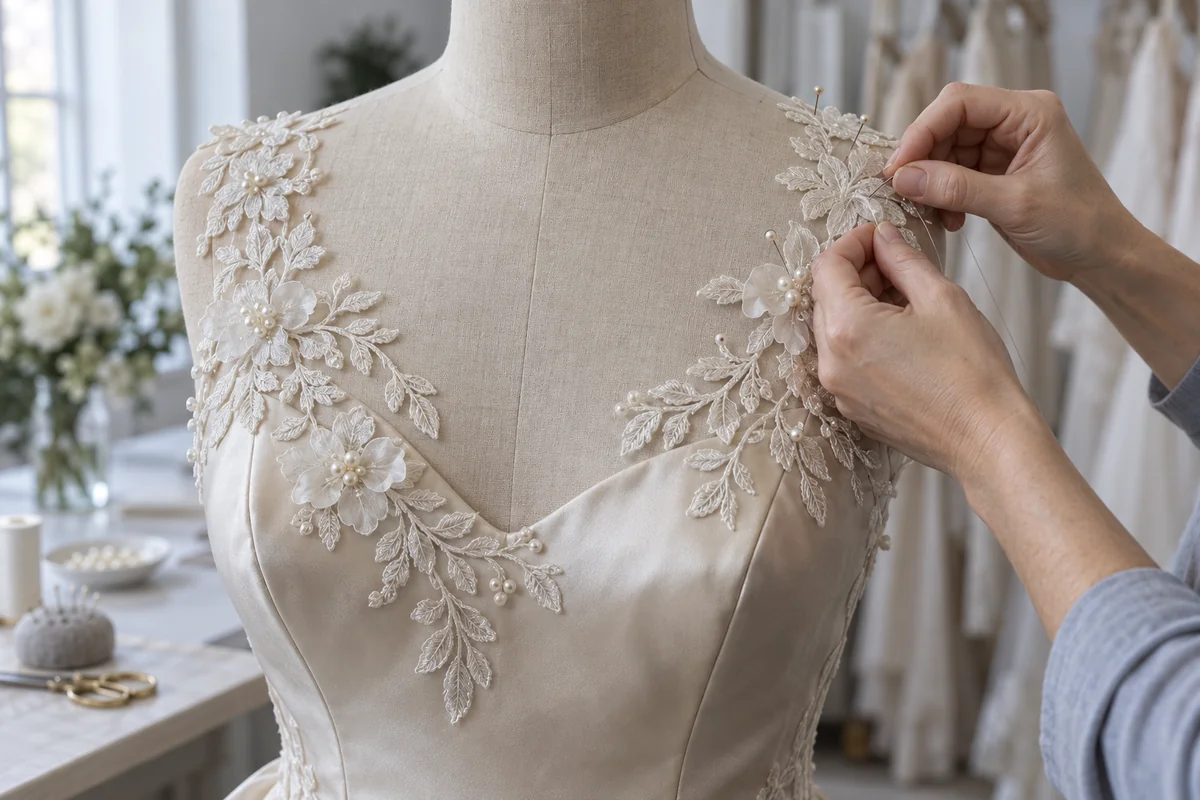
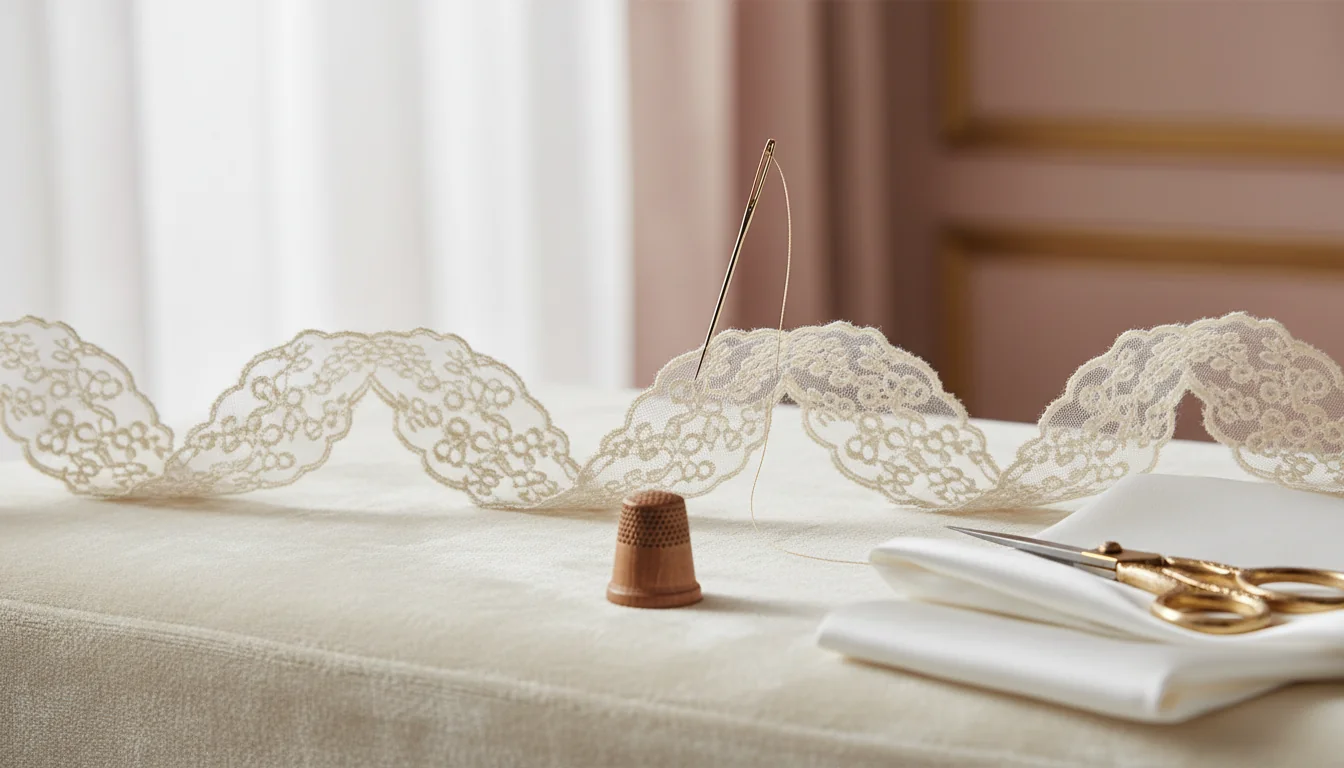
Basting on the garment’s real curve helps confirm symmetry, placement and fabric behavior before permanent stitching.
Position the garment in its intended shape
Mark the placement and support curved sections on a dress form or tailor's ham where useful. Check left and right alignment, seam positions, and the direction of the pattern before sewing.
Keep the fabric and motif relaxed unless the construction specifically requires a tested amount of stretch during application. Pulling one layer to make the outlines meet can leave ripples when it is released.
Choose stitching that suits the motif
Hand stitching gives close control around delicate details, raised flowers, and beadwork. Use small stitches through sound parts of the motif and its intended supporting layer, adding internal anchors where an edge-only attachment would leave a large area loose.
Machine stitching suits accessible, relatively flat motifs. An open-toe foot helps you see the edge; a tested narrow zigzag can secure suitable lace outlines. Set the needle, thread, stitch, and temporary support for the actual materials rather than copying a universal setting.
Keep beads and hard ornaments out of the needle path. Where an ornament must be removed for sewing, secure the surrounding attachment threads and replace the detail afterward.
Finish edges without cutting structural threads
Trim surplus net only after identifying which material is expendable. Fine scissors offer control around an irregular motif; stop short of cutting the stitches or ground that hold its details together.
If you use an adhesive for temporary positioning, test for visible residue, stiffness, and compatibility with the planned care process. I would use sewing as the starting attachment method for garments unless a specified adhesive system has passed the required tests.
Check the finished piece from the front and back, then hang or wear the sample. Inspect for lifting edges, trapped petals, puckering, and attachment stitches that show through.
Questions that come up when working with lace appliques
Can I cut appliqués from any lace fabric?
No. Choose a lace whose desired motifs can be separated while retaining enough structure for attachment. Test a complete motif first, especially where flowers share connecting threads or the design depends on a fine net ground.
Will water-soluble lace dissolve when washed?
The term normally refers to the temporary backing removed during manufacture. The finished lace consists of the remaining stitched structure. Its cleaning requirements still depend on the thread, finish, decoration, and garment construction.
Can I iron on a lace applique?
Only use an iron-on method when the appliqué has a specified fusible backing and the application fabric tolerates the required conditions. A loose lace motif does not become iron-on simply because it resembles a patch. Test the specified application process on matching materials first.
Can lace appliques hide a seam or repair?


 WhatsApp Us