

Introduction
How far back you need to start depends on what you are buying. Replenishing a familiar stock ribbon has fewer decisions than developing a new printed design. The examples below show how to build a schedule and what to change if it will not fit. Their quantities and durations are hypothetical, not YiTuo lead times.
Start with the kind of order you are placing
Ask about the exact width, color, finish and quantity you need. An online listing may remain visible when your chosen combination is unavailable. If the date matters more than the design, say which details you can change; the supplier can then check useful alternatives.
Order | Dates to establish |
|---|---|
Stock ribbon | When the required quantity can be processed and dispatched |
New custom ribbon | When artwork and samples can be approved, then when production and delivery can finish |
Unchanged repeat order | Current stock or production availability, plus any reference check still needed |
Pre-cut ribbon or finished bows | When the complete prepared item will be ready to ship |
For custom ribbon, find out what starts the production clock. The supplier may need the approved sample, final quantity and a payment arranged under the order terms. Put each unfinished requirement into the schedule. Time spent waiting for artwork belongs before production, even when it starts after the inquiry.
The artwork guide and sample guide explain what those approvals involve. For scheduling, give each one an owner and a due date.
Put delivery, preparation and the event on separate dates
For the wedding above, write “checked and ready for Thursday packing” in the brief. Arrange delivery early enough to receive and inspect the ribbon before then. Give the address where packing will happen; sending it to the wedding venue is unhelpful if the gifts are assembled elsewhere.
For a retail launch, central-warehouse arrival is an intermediate date. Add the time to sort ribbon by store, send it onward and let each team prepare its display. The last shop’s setup date is as important as the warehouse delivery.
Put actual dates against quoted durations. Check whether they mean working days or calendar days and which holidays or closures apply. The factory, carrier and receiving team may follow different calendars, especially on an international order.
For a fixed event, decide what can change
When a wedding, graduation or anniversary cannot move, a late personalized ribbon may have little use. Choose a fallback while there is still time to obtain it. Start with the parts of the finished gift that matter most: the names, a particular color, or the overall presentation.
A wedding planner could put the names on a separate card and use plain satin in the approved color. A school could reserve printed ribbon for presentation gifts and use matching plain ribbon elsewhere. Make one complete example and check the availability of all its parts. This lets you protect the message or visual theme without depending on one late component.
If the exact printed design is essential, keep it in the specification and ask for a feasible schedule. When it cannot be ready for the event, changing the packaging is a more useful decision than accepting a date that leaves no time to finish the gifts.
New launches need time for decisions as well as production
A skincare gift set with an undecided box, ribbon width and logo layout is still in development. Finalize the box first, then trial the wrap and approve the print. Assign one person to collect the final response, so conflicting comments do not keep reopening the design. Include this work before the production start date.
For a bilingual Canadian promotion, have both language versions reviewed together. If one version remains unfinished close to launch, consider using an already approved packaging design for the first release and introducing the new ribbon later. Keep the units displayed together consistent.
A name correction after sample approval can still require new printing preparation. A new width or color may require another physical sample. Ask which work must be repeated and update the dates before accepting the change.
Check which part of a late order can actually be shortened
Faster shipping helps when transit is the delay you can remove. It does not make production finish earlier. Compare the ready-to-ship date and delivery estimate separately, then add the time your team needs to receive and check the ribbon.
Here is a ten-working-day example, with the ribbon needed by the end of Day 10. All approvals are complete before Day 1. Production, transit and receiving run in sequence on the same working-day calendar; the receiving allowance includes checks before use. The figures are illustrative. The middle column adds those three stages in that order.
Plan | Working days | Ready to use |
|---|---|---|
Original | 6 + 3 + 2 = 11 | End of Day 11: one day late |
Faster transit | 6 + 1 + 2 = 9 | End of Day 9: one day spare |
Later production, faster transit | 8 + 1 + 2 = 11 | End of Day 11: one day late |
The faster-transit plan leaves one working day spare only while production remains at six days. If production moves to eight days, the order misses the deadline again. Pay for the faster service when it produces a usable arrival date, not simply because it is labeled express.
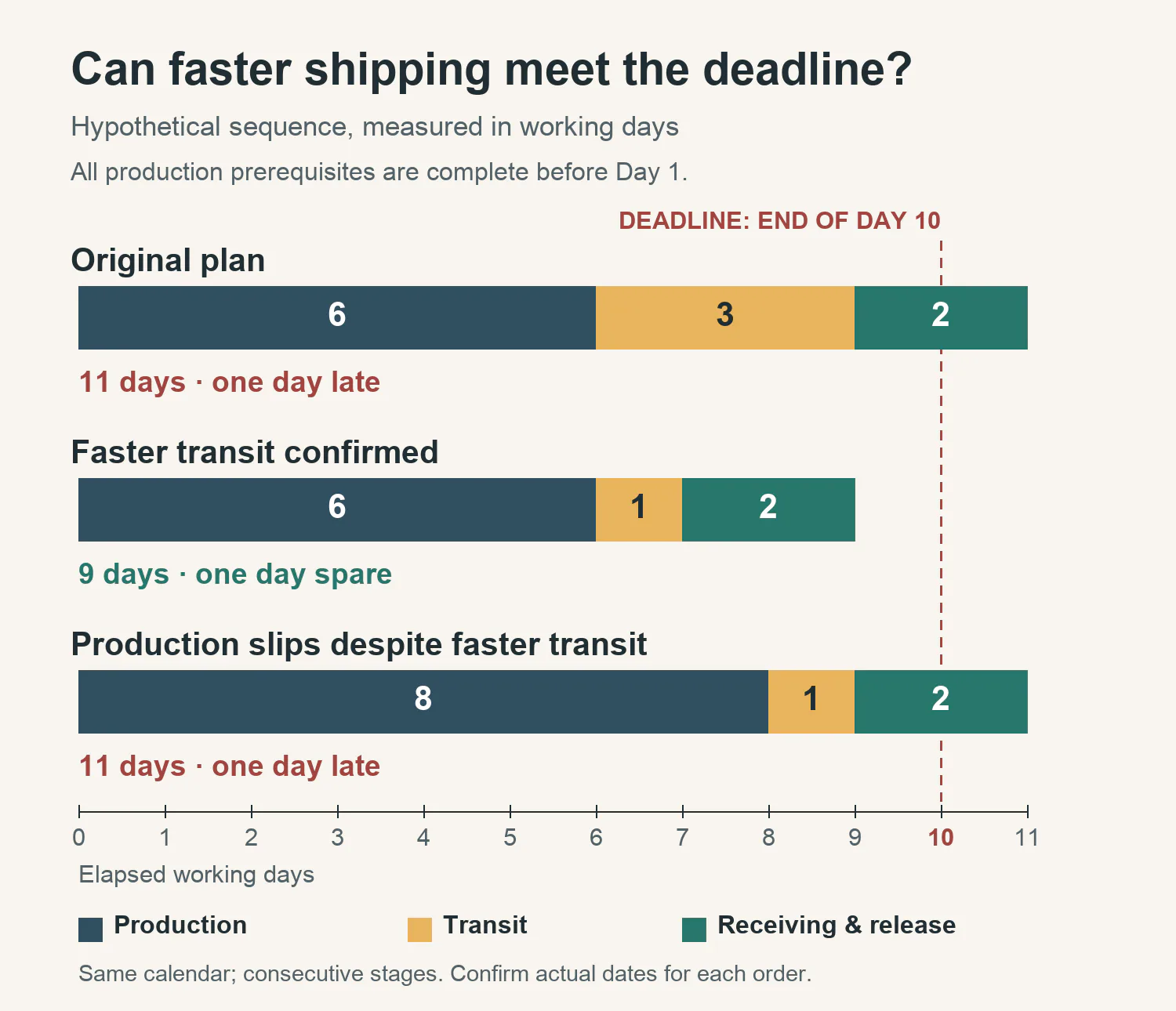
Hypothetical working-day comparison. The deadline is the end of Day 10; actual durations and operating calendars must be confirmed for the order.
If the latest production date makes the plan late, ask about an available alternative ribbon, a first delivery that covers the earliest work, or a different packaging arrangement. Keep the receiving allowance in the calculation; staff still need to check what arrives.
A one-day margin is more workable when an acceptable local stock ribbon is available as backup. It is much less forgiving when every gift must carry a specific printed message. Reserve the fallback if necessary and confirm how late you can switch to it.
For several stores, give the first delivery a clear job
Four shops each need 200 m for a planned display: 800 m in total. Two open first, so the first delivery needs to cover 400 m. Sending 300 m still leaves those shops short unless they reduce the display. A 400 m first shipment and a later 400 m shipment divide the order around real jobs.
Ask when the first batch can finish production. Splitting freight alone does not make any ribbon ready sooner. List the colors, widths and prepared lengths each early shop needs, so the first shipment contains a usable set.
Direct deliveries can save the central sorting and onward transport step. They also need accurate allocations and a receiving contact at every shop. Compare the extra freight in the bulk purchasing guide, then choose the route that gets complete supplies to each team in time.
Reorder everyday ribbon before the remaining stock becomes urgent
For a florist, bakery or year-round gift service, watch how many weeks of work the remaining ribbon covers. Exclude stock already promised to another job and count each important color and width separately. A cupboard full of navy ribbon does not cover an ivory order.
A florist has 600 m of usable satin, uses 150 m a week and has no replenishment on order. That is four weeks of stock. Replenishment, including delivery and receiving, takes three weeks in this example. Choosing another week as a buffer gives a reorder trigger of 150 × (3 + 1) = 600 m. The florist should order now.
This tells the florist when to reorder; it does not set the purchase quantity. Choose the buffer and quantity around actual demand, supply reliability and storage. A large new wedding booking changes the calculation, as does a later replenishment date. Include incoming stock only against its expected arrival and the work due before then.
Give the supplier the previous order and the references you want to retain. Establish current availability and any review needed for this repeat. A changed color or print may add a sample stage even when most of the order is familiar.
Include the preparation that happens after delivery
Ribbon rolls can arrive on time while the hotel has nobody available to cut and tie them. A display team may have only one evening to install its decorations. Plan around when the finished gifts or display will be ready, including who will do the preparation.
Compare rolls, supplier-cut lengths and bows ready to attach by their complete schedules. Pre-cut ribbon saves local cutting time only if the prepared lengths can arrive soon enough and fit the package. Use the sample trial to settle the method before assigning staff and dates.

Display preparation illustration. Leave time to unpack, arrange and install the selected decoration before the venue opens.
Wired velvet bows still need unpacking, reshaping and attaching. Arrange site access and a named receiver for the materials, so the installer’s evening is spent on the display rather than locating a parcel or waiting for a door to open.
Check where the delivery estimate ends
For an overseas order, ask what “five days shipping” includes. Does the estimate start at collection and finish at your address? Is import clearance included, and is there an onward journey after that? Request dates for the actual destination and service so those steps appear in the plan.
For a remote event, send ribbon to the packing team first unless the venue can receive, inspect and prepare it. Direct-to-venue delivery may remove a transfer but moves those jobs to the event site. Confirm receiving hours and a person who can take the shipment.
Keep a schedule you can update when something changes
Keep four milestones visible. When artwork approval slips, update production and arrival dates together. Then decide whether to change the order, use the fallback or move the work that depends on it.
Milestone | Detail to keep beside the date |
|---|---|
Approval and production start | Final version, quantity and remaining prerequisites |
Ready to ship | The whole order or the identified first batch |
Arrival | Receiving address, service and receiving hours |
Ready for packing or installation | Checks, preparation, staff and buffer |
Give the receiving team the order details and approved references before arrival. The inspection guide covers what to use and what to hold while a problem is resolved.
When you contact YiTuo, send the date packing or installation must start, the receiving location, quantity and specification. Add what is already approved and which details can change. Those details let us discuss a schedule for your project.
Discuss a real requirement
Turn the reading into a practical next step.
Send a short note, product reference, photograph, swatch or tech pack. Technical feasibility, sampling, documentation and production terms are confirmed after review.
Related products: Factory Direct Christmas Velvet Ribbon for Holiday Gift Wrapping and Crafts · Christmas Theme With Snowflakes Trees and Velvet Ribbon for Gift Wrapping · Factory Direct Gold Star Velvet Ribbon for Apparel Trim and Festive Decor
Start an inquiry