
Introduction
A short swatch can help you choose a shade; a long bouquet tail needs a longer trial. Request the sample that answers your remaining question. The projects and dimensions below are illustrative examples, with practical ways to decide whether to approve, adjust or try another ribbon.
Keep the proposed specification and quotation beside the sample. If the supplied material or finish is an alternative, label it clearly. The supplier guide covers what to establish before requesting samples.
What does this sample actually show?
Identify the product, width and color first, then the artwork version for printed ribbon. A plain stock purchase may need only a material and color check. A custom design needs a reference that shows your printing as well.
Reference received | Useful for | Still unresolved |
|---|---|---|
Digital artwork proof | Text, dimensions and proposed layout | Physical color, texture and drape |
Stock swatch or an existing printed ribbon | The material, color or print it actually shows | Your design or any changed specification |
Physical sample made for your project | The combination made in that sample | Any differences from the intended order or use |
For example, Australian Printed Ribbon offers swatches of existing prints with assorted brands and designs. Those can help you compare ribbon and print colors. To judge the fine lettering in your own logo, you need a sample that includes it.
Is the sample long enough to try your project?
RibbonBazaar offers 6-inch samples for color matching. That is 15.24 cm: enough to compare a shade, but too short for many finished wraps. Ask for enough ribbon to complete the item, including the bow and tails.
If your chosen wrap uses 0.9 m per box, three trials take 2.7 m. Add a 0.3 m piece to keep untouched and request 3 m for this trial. You can then compare the handled ribbon with a clean reference after tying and untying it.
For a long display tail, specify the continuous length you need. If you have not yet measured a finished wrap, the quantity guide explains how to establish the cut length.
Compare the sample with the things it will sit beside
Place the sample beside the real box, invitation or fabric. An ivory ribbon can look quite different beside cream stationery than it does on its own. Compare it with the physical color reference under the lighting chosen for approval, then look at a finished package in the shop or venue lighting. For satin, turn the folds; for velvet, look along and against the pile.
If the combination works under one light but disappoints under another, decide which setting matters to the project and record the viewing conditions. A phone photo can show the arrangement, but make the color decision with the physical pieces.
Read names, dates, accents and logos at the size customers will see. Inspect unclear details more closely and photograph them beside the whole ribbon. Measure suspect dimensions with the strip flat and unstretched. Before approving it, settle any tolerance that matters to the job; a nominal width of 25 mm does not by itself say how much variation is acceptable.
Gift boxes and personalized favors: check the finished wrap
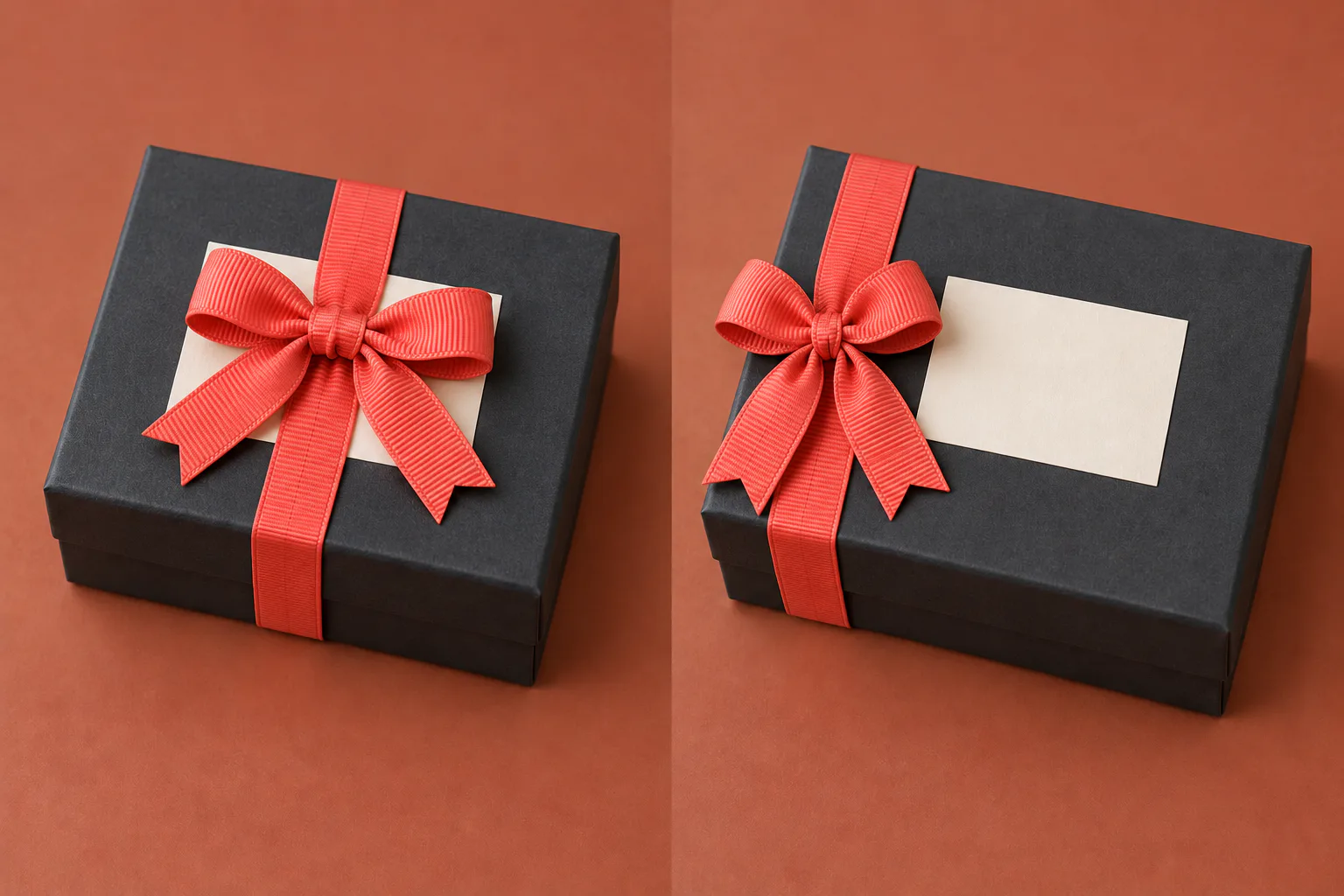
A boutique wants one coral grosgrain ribbon for two boxes: 12 × 12 × 5 cm and 25 × 18 × 8 cm, measured length × width × height. Wrap both with their labels in place. On the smaller box, look for a bow that crowds the label; on the larger one, check whether the same bow and tails still look deliberate. Keep the ribbon if it works on both, or give each box its own cut and tying instructions.
Lift the package, set it down and open it. A band that slides across the label needs a different position or a more secure wrap. A tail that turns over needs to look acceptable on both faces. If staff must reopen gifts for a final check, untie and retie the sample too.
For printed ribbon, see which words survive the knot and folds. Hand-centering a logo on one box may look good but slow every subsequent package. If the trial is fiddly, simplify the wrap or revise the repeat layout before approval. The design guide explains those layout choices.
Personalized favors need one more pass for the text itself. Check the couple’s names and date, the graduation year or the anniversary wording on a completed gift. For a bilingual event, review both language versions in that same arrangement; the longer line or an unfamiliar accent is easily missed on a flat proof.
Bouquets: look at the tails, reverse and contact points
Tie the proposed dusty blue satin around a finished bouquet, lift it and let the tails hang. Watch where they twist. A ribbon with a different reverse may show both faces when carried; if that spoils the effect, compare a ribbon whose two faces suit the design. Choose by the moving bouquet, as well as by the strip on the table.

Bouquet illustration with unwired satin. Check the faces and folds that become visible when the arrangement is carried.
Put the bouquet into its delivery wrap or carrier, take it out and arrange the tails again. A flowing tail that emerges with a stubborn fold may need a different finish, a different packing method or more preparation time. Try the alternative on the same bouquet so you can see which change actually helps.
For ribbon that may touch damp stems, wet wrapping or pale clothing, discuss those contacts with the supplier and arrange suitable checks. Any mark or color transfer in the trial needs an answer before approval for that use. Where colorfastness or outdoor performance matters, ask for product information or testing appropriate to those conditions rather than relying on this brief handling trial.
Wreaths and displays: try a complete decoration
For a mustard velvet bow on a shop entrance, make the full-sized decoration and install it at the intended height. If the design needs wired edges to hold its loops, check that the sample has them: the velvet pile alone says nothing about edge construction.
Look from the pavement as well as close up. If the loops collapse or the reverse dominates the view, adjust the construction or shape before ordering. For decorations made off site, pack the sample in its delivery container and ask the installer to restore it. The trial should include the time and tools available for setup.
For an outdoor installation, also establish the expected exposure and the evidence needed for that use. A good-looking indoor sample settles the appearance; it does not settle weather resistance.
Cut lengths and finished bows: check what arrives ready to use
A hotel considering 0.6 m satin ties should ask for pieces cut and finished as they would arrive in the order. Try those pieces on the actual welcome gift. The shape of the ends, the finish and the way pieces are bundled all affect the work left for staff.
Let someone who will do the packing make a gift from the supplied pieces. Then have another packer follow the same arrangement. Notice where they stop to adjust a tail, turn the ribbon or reposition the print. If the result depends on a trick only one person knows, write it down or simplify the arrangement. A bakery or chocolate shop can do the same trial on its closed outer packaging.
For finished bows, turn the sample over and try its attachment. An elastic loop must fit the box; an adhesive backing needs to suit the intended surface and handling. Approve the complete supplied assembly when that is what you are buying.
A longer cut or different attachment may solve the problem and change the price. Update the quotation and specification alongside the new sample.
Multiple colors, widths and repeat orders need clear coverage
A craft store plans four colors in three widths: 12 combinations. The supplier sends all three widths in navy and one width in each of the other colors. That is six combinations. Mark those six on the order list, then decide which missing combinations need a sample before you commit. If all widths will appear together in a display, include that comparison.
RibbonBazaar notes that dye-lot differences can affect later color matches. When matching matters, ask how the swatch relates to the supply being offered and which reference will be used for the order.
For a repeat order, use a labeled retained piece and the current artwork. A faded window bow is a poor color reference. When changing suppliers, say whether you want to reproduce the old ribbon or approve a new version; “same as last time” leaves that decision open.
What needs checking again after a change?
Recheck the part that changed. A corrected date needs a new text review; a different base ribbon may also change the color, drape and print. Use the following distinctions to decide whether a new proof, a physical sample or both are needed.
Change | What to review before closing it |
|---|---|
Name, date or language | Exact text and its position in the finished item |
Ribbon color or print color | The new physical combination against the agreed references |
Width, base material or finish | Size, print appearance and behavior in use |
Cut length or bow attachment | The supplied piece or assembly on the actual item |
Name the revision used for each sample and mark older versions as superseded. Keep the final text in the artwork file, as described in the file preparation guide, so an email correction does not remain separate from the file used for printing.
Give the supplier a specific revision to work from
Here is a worked revision. A hotel selects 25 mm navy satin printed with “THE WILLOW.” Sample S01, made from artwork v01, has the right material and color, but the knot hides part of the name. The buyer sends a whole-package photo and a second image marking the hidden words.
Keep the navy base ribbon and the finish shown in S01. On Box A, the knot hides part of “THE WILLOW”; see the attached wrap photo. Please propose a revised layout for this tying method and identify any change to the cut length. Send the revised proof before making the next sample. The printed arrangement is not yet approved.
The buyer reviews artwork v02, then tries sample S02 on the same Box A. The wording is visible with the revised wrap. S02, v02 and the wrapping photo now stay together as the reference, including the cut and tying position staff need to reproduce. That last detail matters when packing from a continuous printed roll.
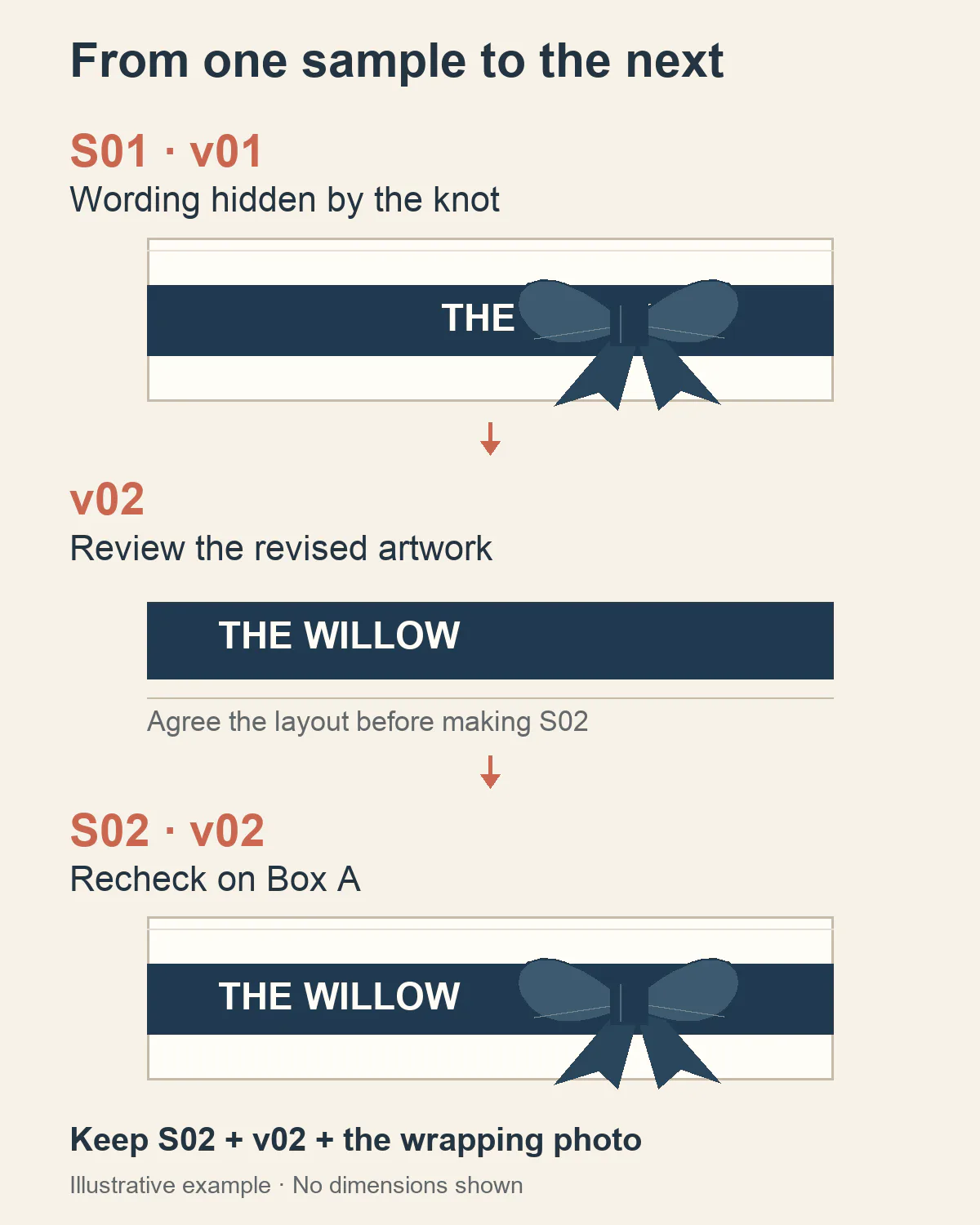
S01 remains unapproved for the printed layout. S02 becomes the retained reference after the revised wrap is reviewed.
Keep a short record of what you approved
Make the decision easy to act on: approve the finished version, request a named change, or leave a specific item pending. If the material is accepted but the print is still being revised, say both.
Example approval: Sample S02 and artwork v02 are approved for Box A using the cut and wrap shown in the attached photo. Keep S02 as the material, color and print reference for this order. Reviewer: [name]. Date: [date]. Please acknowledge the version and let us know what remains before production can start.
Label the retained ribbon and store it with the specification, artwork and photos. If you and the supplier each keep a piece, give both the same sample reference. Use these references to inspect the bulk ribbon delivery against what you approved.
Leave time for a revised sample in the order schedule when the trial calls for one. To discuss a sample with YiTuo, send the ribbon specification and the item it needs to work on, along with the question you still need answered. A marked wrapping photo is often more useful than a request to “make it better.”
Discuss a real requirement
Turn the reading into a practical next step.
Send a short note, product reference, photograph, swatch or tech pack. Technical feasibility, sampling, documentation and production terms are confirmed after review.
Related products: Christmas Trees and Snowflakes Printed Grosgrain Ribbon for Gift Wrapping · Festive Metallic Print Grosgrain Ribbon for Holiday Crafting · Scattered Stars Velvet Ribbon for Gift Wrapping
Start an inquiry