

Introduction
A darker-looking satin strip may simply be turned away from the light. A ribbon printed with the wrong graduation year needs a different response. The examples below show how to tell such problems apart and decide what can be used. Orders, quantities and measurements in the worked cases are hypothetical.
Bring the final order and retained sample to the receiving area
Use the final order confirmation, packing list and artwork alongside the retained sample. An early sample may still show the right material, but a later approved file governs corrected names or dates. Label those roles so the receiving team does not compare the shipment with the wrong version.
The sample guide covers choosing and approving the ribbon. Here, use those decisions to check delivery. Include the order’s requirements for width, print position, length, joins and appearance. If a limit was never settled, record what you find and resolve that point with the supplier before accepting the affected goods.
Count cartons and rolls before checking the ribbon itself
Photograph carton labels and any visible damage before unpacking. Count the cartons, then the rolls or prepared pieces inside. Keep colors, widths and designs identifiable, especially when several jobs share one delivery. This is much easier before new ribbon is mixed with existing stock.
A packing list shows six cartons, ten rolls in each and 50 yards per roll: 60 rolls and a declared 3,000 yards. Six closed cartons establish the carton count. Opening them and counting establishes the roll count. To establish length, use the measurement or verification method specified for the order; the label alone is still the supplier’s declaration.
Use the inspection plan for the order to select cartons and rolls. Record how much you examined: the exposed end, a measured section or the whole roll. If a defect appears farther into a roll, extend the check as the plan requires. Without a plan, settle the coverage with the responsible buyer and supplier before treating the shipment as accepted. Counting and identifying the goods can proceed meanwhile.
Satin and velvet can look different when you turn them
A boutique opens a carton of satin and thinks it is darker than the retained piece. Lay both strips flat, with the same face upward and pointing in the same direction. Compare them under the lighting chosen for the order, then turn them together. If the dark area moves with the reflection, comparing a folded bow with a flat strip was misleading. If the difference remains, document it against the physical reference.
For velvet, align the pile direction too. Loops facing different ways can show light and dark areas even when made from one roll. First compare flat pieces with the pile aligned, then look at the completed bow. This separates a material-color question from the appearance created by folding and assembly.
Apply any color limits already accepted for the order. If a difference falls outside them, hold the identified rolls and send a side-by-side comparison for review. Where no limit was agreed, keep both pieces available for a decision; phone photographs alone are a poor basis for settling the match.
Also compare goods that will be seen together. Three widths on one wedding display need to work as a set. The same widths sold independently in three shops may not have that requirement. Check the combination specified for the job before releasing it to the installer.
Wrong printing and a difficult wrap need different fixes
Read names, years, accents and language versions before cutting. If graduation ribbon ordered as “Class of 2027” arrives with the 2026 design, hold the identified rolls. Send a photo with the final approved wording and the roll references. The supplier needs to see which version arrived and where it was found.
Correct names hidden in a wedding-favor knot are a different problem. Compare the delivered ribbon with the approved sample on the original box using the recorded wrap. A changed print position points to the supplied ribbon. A match on the original box, followed by failure on a taller replacement box, points to the new packaging arrangement.
Try a revised cut or knot position if it makes the existing ribbon usable. Have a second packer repeat the method before starting the batch. If the design itself must change, use the layout guide to review the revision and its cost.
Count complete usable pieces when continuous length matters
A 50 m roll may contain 50 m of ribbon without providing every uninterrupted length you need. This matters for long bouquet tails and also for short ties cut repeatedly from a roll. Check both conditions in the order: whether the roll may contain joins, and whether a join may appear in a finished item.
Suppose a measured 50 m roll has one join, leaving two continuous 25 m sections. Each gift needs a complete 0.9 m piece, including bow and tails, with no join. In this example there is no damage or extra trimming at the join.
Available ribbon | Complete 0.9 m pieces | Ribbon used in those pieces | Length left over |
|---|---|---|---|
First 25 m section | 27 | 24.3 m | 0.7 m |
Second 25 m section | 27 | 24.3 m | 0.7 m |
Total with one join | 54 | 48.6 m | 1.4 m |
Continuous 50 m roll | 55 | 49.5 m | 0.5 m |
Each 25 m section yields 27 cuts; 28 would require 25.2 m. The two sections therefore make 54 gifts, compared with 55 from an uninterrupted 50 m roll. The remaining 1.4 m is cutting remainder. It is not automatically defective ribbon, although the join itself must still meet the order’s conditions.
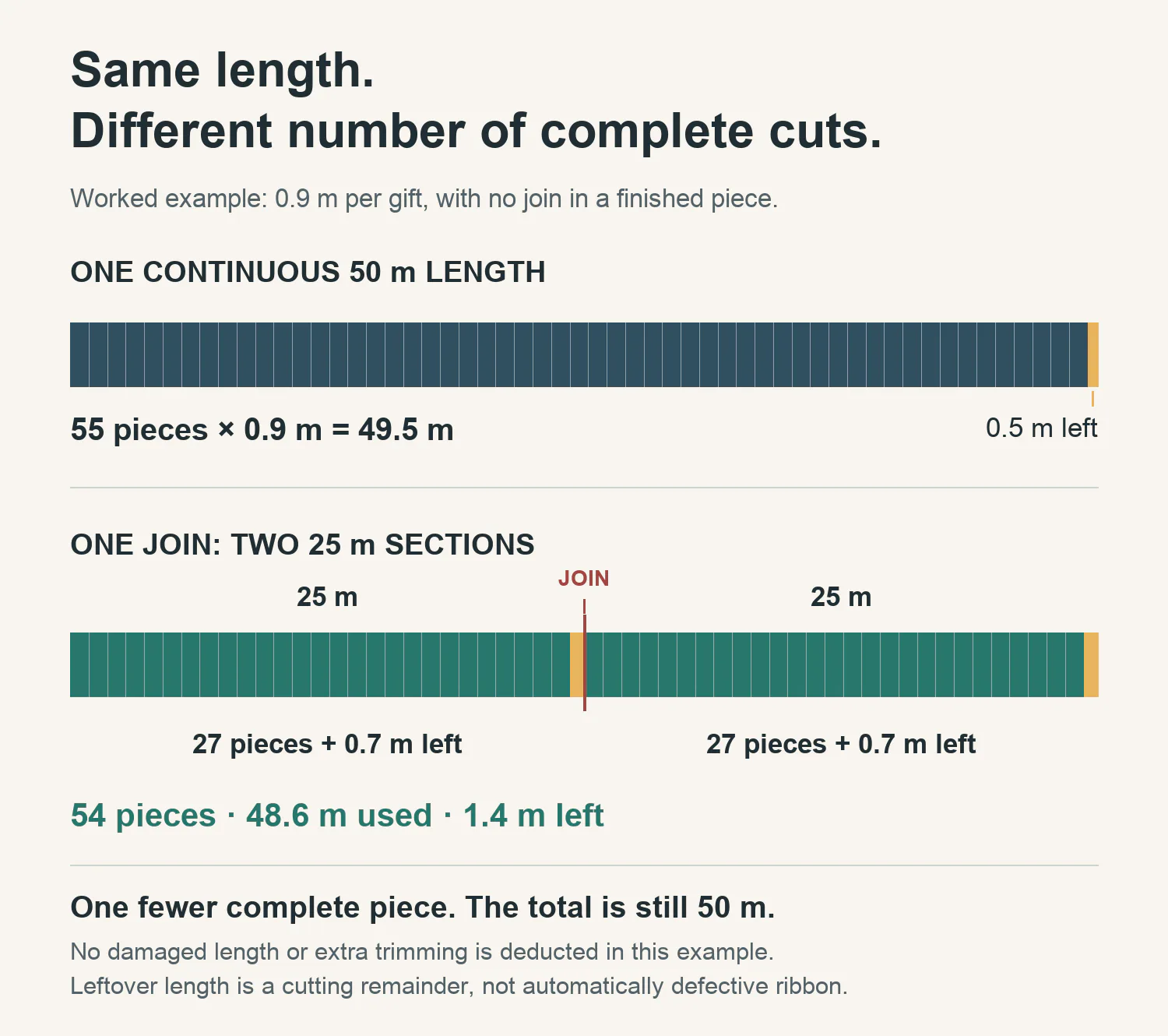
Worked cutting example. No damaged length or trimming allowance is deducted; the 0.9 m cut already includes the bow and tails.
When damage must be cut out, measure it and calculate complete pieces from the remaining continuous sections. Keep removed damage separate from ordinary cutting remainders. The quantity guide covers establishing the cut length for each finished item.
Product terms vary. CraftOutlet’s listing for one royal blue velvet ribbon, for example, explicitly allows splices. Read the terms for the product you bought before treating a join as a delivery fault.
A flattened display bow is different from a damaged edge
An event team unpacks wired velvet bows and finds flattened loops. If the edges, wire and pile are intact, try reshaping one identified bow using the handling method specified for it. When the shape returns and the bow matches the approved sample, allow preparation time before installation.
A torn edge, broken wire or missing pile calls for a damage report instead. Photograph the whole bow and a close view of the affected area, keep the packaging and hold the item apart. Packaging damage is useful evidence, but it does not by itself establish where the damage occurred.
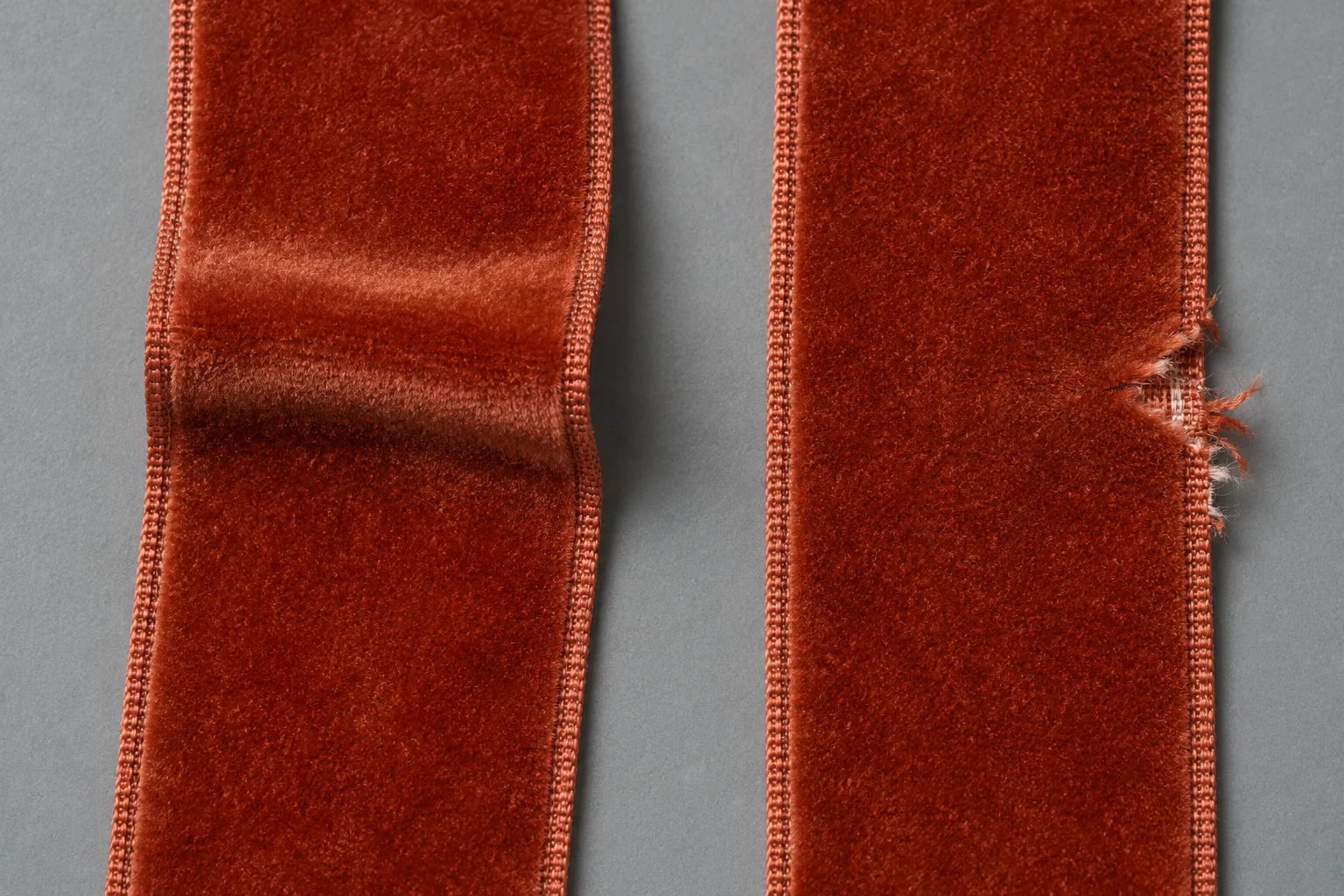
Condition illustration. A crease and a torn edge are different problems. Inspect the actual surface and edges before deciding what can be used; the image does not establish that a crease will recover.
Ask before using heat, steam or chemicals; those treatments can change both the material and the evidence. If acceptable bows routinely take too long to restore, discuss a better packing format for the next order and include reshaping in the setup schedule.
Is the pre-cut piece short, or has the package changed?
A hotel ordered 60 cm grosgrain ties for welcome gifts. Suppose an identified piece measures 54 cm by the specified method: it is 6 cm shorter than the nominal order length. Compare that result with the allowed cut-length tolerance, identify the affected pieces and hold any that fail the requirement. Check the end shape and finish at the same time.
Now suppose the piece measures the correct 60 cm but will not tie on a taller replacement box. Try it on the original box. If the approved wrap still works there, choose a new cut length or a less demanding bow for the new package. Ordering longer pieces is then a packaging change; it is a different discussion from replacing short delivery.
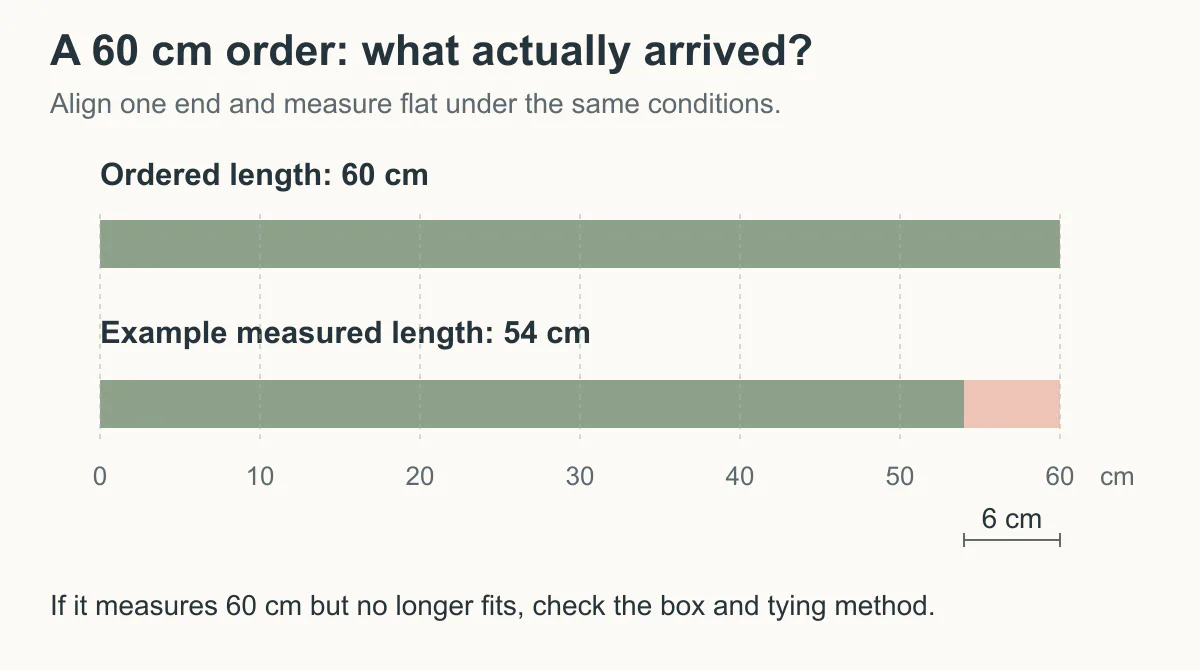
Worked size example. Compare the measured 54 cm with the ordered 60 cm and agreed tolerance. If the piece measures 60 cm but still does not fit, check the box dimensions and tying method.
For finished bows, compare the reverse and fixing too. An elastic loop, adhesive backing and loose tie are different items. Test the fixing on the surface used for approval. If the component differs from the order, report it; if the surface changed, review that new combination. Agree any local alteration and its cost before asking staff to rework the delivery.
Can you use part of the delivery while a problem is resolved?
Yes, when the checked goods can do a complete job on their own. Suppose six cartons go to six separate shops. Five have passed the order’s receiving checks; the sixth has a printing issue. The responsible buyer can release the five identified cartons and keep the sixth on hold, recording exactly which goods were accepted.
For one wedding installation, all six cartons may need to match side by side. If the unresolved question is color consistency, releasing five could leave the installer with an incomplete display. Decide around the finished job, not the number of cartons available.
Keep three stock statuses separate: checked and accepted, on hold for an identified issue, and not yet checked. A clean section from one roll does not settle unopened cartons. Update the affected quantities when further inspection reveals more.
Send a report that gives the supplier something specific to answer
Name the order, reference version and affected items. Show an overview and a close-up, with a scale for dimensional issues, and say how much you examined. Then ask for the next action and a response date. A short, specific report is easier to resolve than “the quality is wrong.”
Order R214, artwork v03, retained sample S02. Part of the letter A is missing on rolls C02-R03 and C02-R04; see the attached photos. We checked 5 m from each roll. The remaining lengths and other rolls are not yet checked. These two rolls are on hold. Please review the comparison and confirm what we should inspect next before further cutting. Packing is due to begin on [date], so we need your response by [date].
This identifies two findings without calling two whole rolls unusable. Record the response and the quantities it covers. Before local sorting or rework, settle the method, responsibility and cost. Replacement or credit should follow the order terms and the solution reached with the supplier.
Finish with a clear decision for the packing team
Finding | What the packing team needs to know |
|---|---|
Identified goods pass the receiving checks | Which goods are released for use |
Goods fail the confirmed requirements | Which items are held and what happens next |
Ribbon matches, but the package changed | The revised wrapping method or cut length |
A check or reference is still missing | What remains open and who will resolve it |
Save the decision with the inspected quantities, photos and reference versions. Keep a labeled piece of the delivered ribbon for future comparison. If a vague requirement made inspection difficult, make that part of the next order more precise.
For a YiTuo order, send us the order reference and the specific finding. Include the confirmed quotation and any later changes so we can review the same material, service and version.
Discuss a real requirement
Turn the reading into a practical next step.
Send a short note, product reference, photograph, swatch or tech pack. Technical feasibility, sampling, documentation and production terms are confirmed after review.
Related products: Snowflake Printed Grosgrain Ribbon for Gift Wrapping · Santa Claus and Gold Foil Christmas Grosgrain Ribbon for Gift Wrapping · Reindeer Christmas Trees and Candy Canes Ribbon for Gift Wrapping
Start an inquiry