
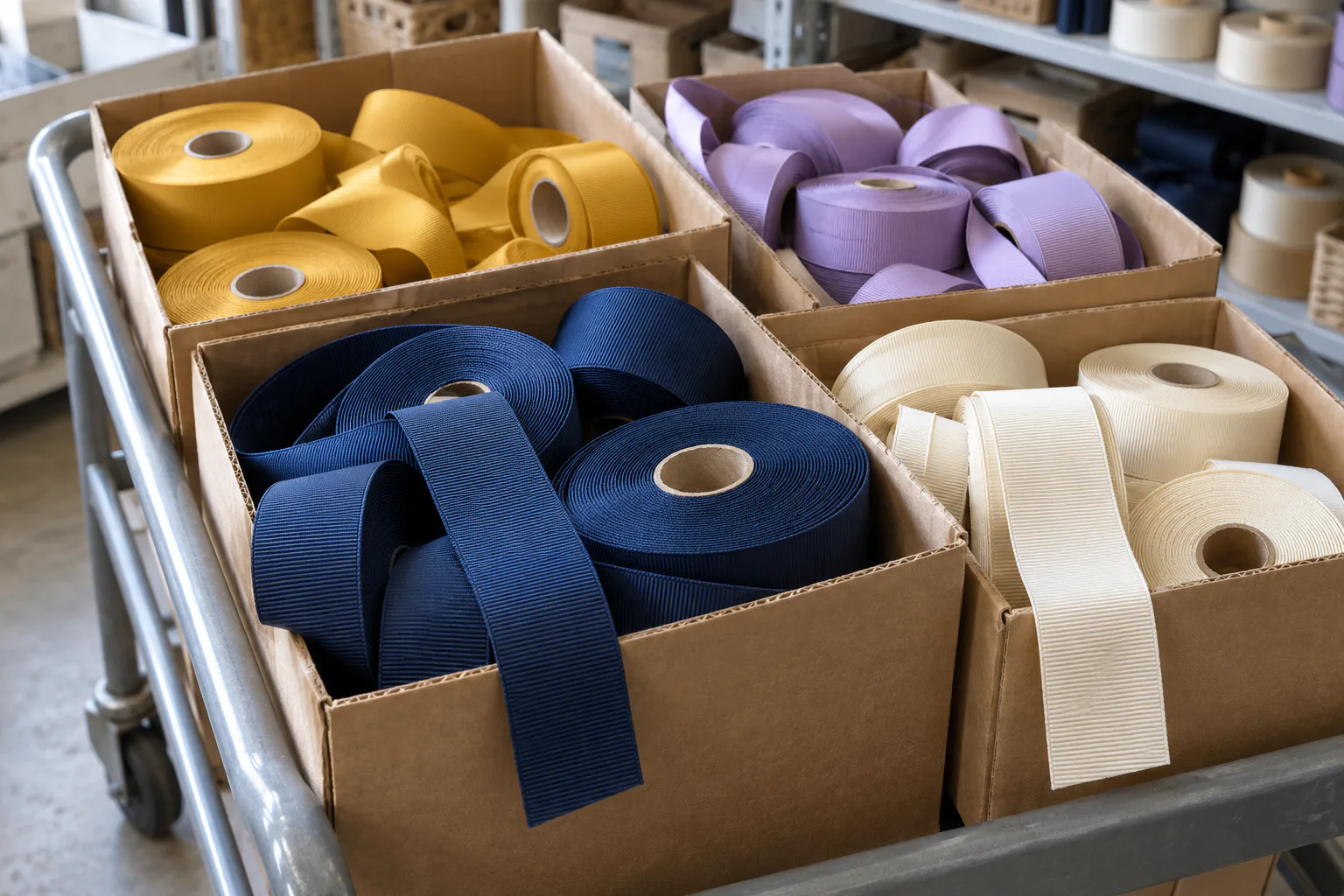
Introduction
A shop replenishing everyday packaging and a couple ordering wedding favors may both search for bulk ribbon, but they have different reasons to accept or refuse extra stock. The shop might use another roll next month. Ribbon printed with the couple’s names may have no use after the wedding. The price comparison needs to account for that difference.
Work out the requirement with the quantity guide before comparing offers. Use the ribbon supplier checklist to check that each offer covers the product and preparation services you need. The calculations below use hypothetical orders and prices in USD; they are not YiTuo quotations. Each comparison states which costs it includes.
Can different colors and widths count toward one minimum?
MOQ means minimum order quantity. Find out whether it applies to the whole order, one item, a color-and-width combination or a printed design. Then note the ordering increment: a two-roll minimum might allow three rolls, or the supplier might sell only in pairs.
A florist needs 25 mm unwired satin in three colors. In this example, the offer requires at least 300 m per color:
Color | Planned use | Quantity under this offer | Extra ribbon |
|---|---|---|---|
Ivory | 600 m | 600 m | 0 m |
Sage green | 300 m | 300 m | 0 m |
Rose pink | 100 m | 300 m | 200 m |
Total | 1,000 m | 1,200 m | 200 m |
The extra 200 m is all pink. If the florist has no likely use for it, first ask for a quote on a smaller stock roll in that color. Buying more ivory does not solve a minimum that applies separately to pink. Keep any different shade or material on a separate quote line so that the cheaper option is visible as a product change.
For printed ribbon, separate the ribbon’s base color from the print color. Nashville Wraps’ ordering information, for example, allows different stock ribbon colors but ties price breaks to the same image and imprint color, with separate conditions for a print-color change. That distinction is useful even when buying elsewhere: ask exactly which changes can share a minimum or a price tier.
The question to send is: “Which lines can be combined for quantity pricing, and what minimum and order increment applies to each?” Mixing base colors does not necessarily allow different widths or artwork versions to share the same price tier.
Is a lower unit price worth buying more ribbon?
You need 500 m. Both options below cover the same specification; the table compares ribbon charges only.
Quantity option | Ribbon price | Ribbon charge | Left after using 500 m |
|---|---|---|---|
Buy 500 m | $0.70/m | $350 | 0 m |
Buy 1,000 m | $0.52/m | $520 | 500 m |
Buying 1,000 m saves $0.18 per meter but costs $170 more now and leaves 500 m. Decide where that remaining half will go before choosing the larger order.
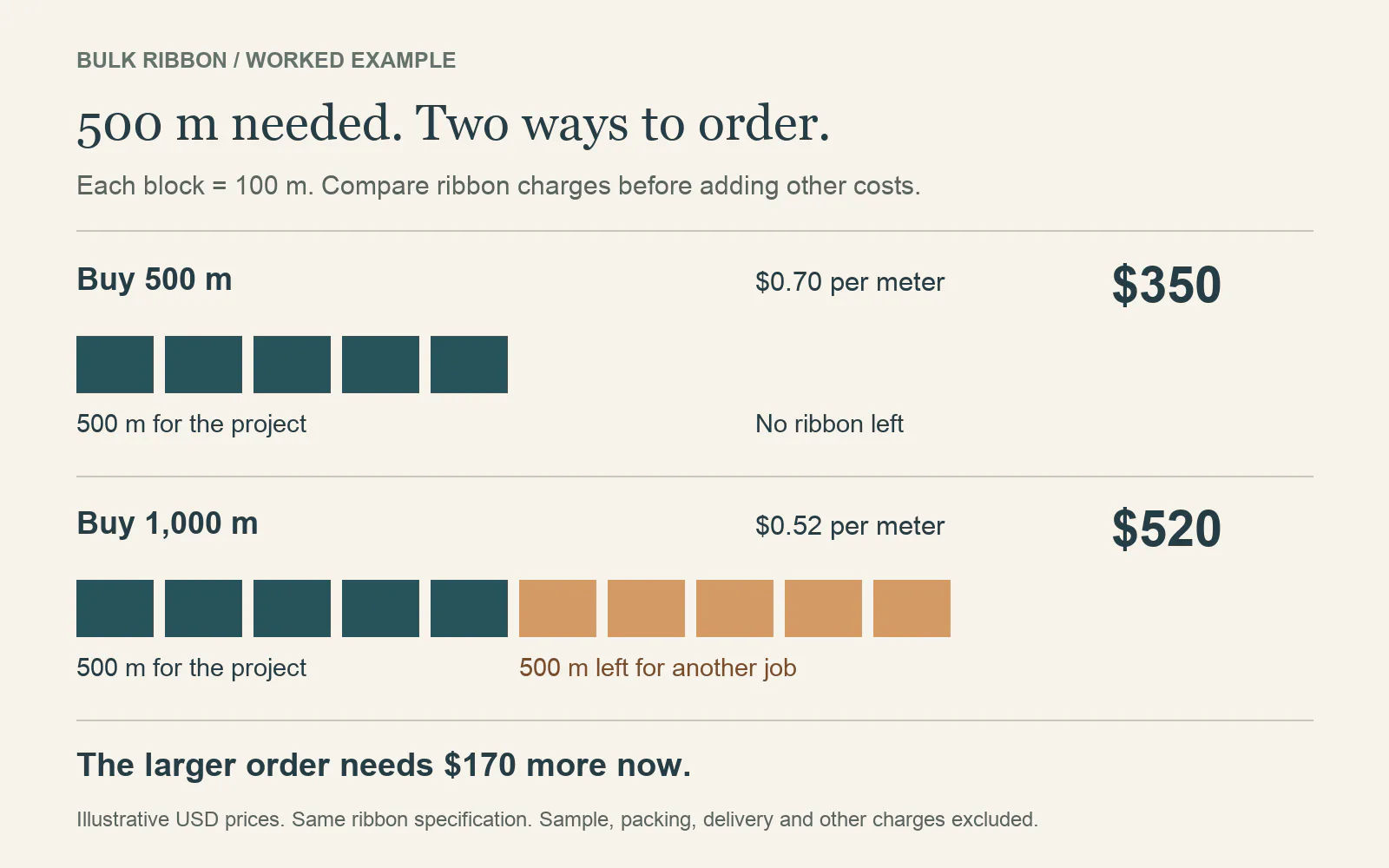
Each block represents 100 m. The comparison shows ribbon charges only; all prices are illustrative.
Everyday packaging has a different use for the surplus
A bakery using plain mustard grosgrain on its regular gift boxes consumes about 125 m a month. At that pace, 500 m covers four months and 1,000 m covers eight. If the boxes will stay the same and the bakery has storage and budget, the larger order has a clear use. If a packaging redesign is planned in three months, buy less: the low price is tied to stock that may soon be unwanted.

Everyday packaging illustration with ribbed grosgrain. Use your own consumption records to judge whether another batch has a likely use.
Names and dates can limit what you do with the remainder
Ribbon printed with wedding names, a graduation year or a one-off campaign date has less room for a later use. Here, the smaller order can be the better purchase even at a higher unit price. If its minimum is still too large, compare stock ribbon with a personalized tag, or use printed ribbon only on the pieces where the wording matters most.
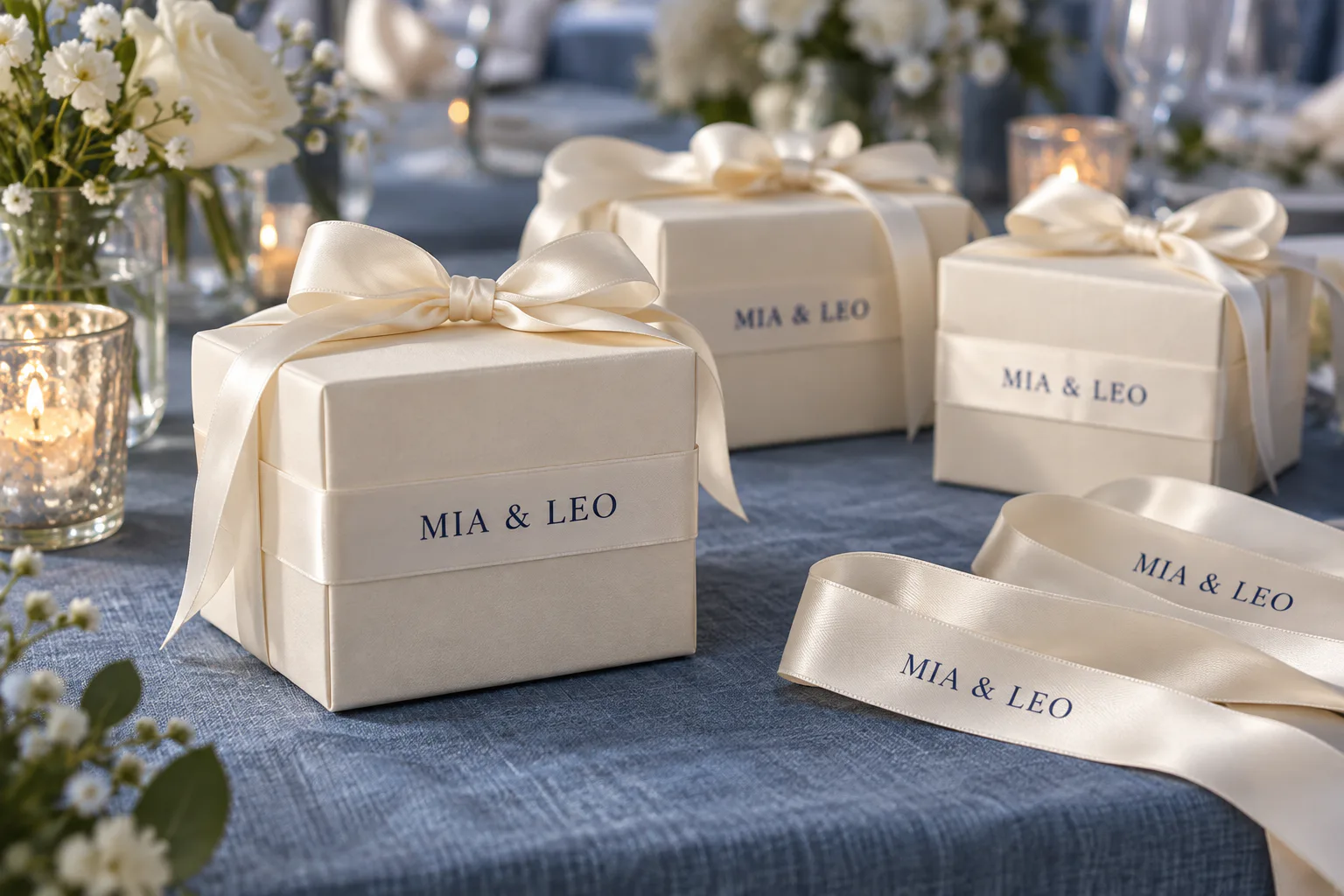
Personalized wedding illustration with smooth satin. Names specific to one event can limit the use of leftover printed lengths.
“Bulk” can mean buying several existing rolls; it does not always require a new production run. Choose the available service whose quantity, appearance and delivery fit the job.
Are the roll prices based on the same length?
Two matching rolls each cost $10, but one contains 25 yd and the other 25 m. The 25-yard roll contains 22.86 m and costs about $0.4374/m; the 25-meter roll costs $0.40/m. Use 1 yd = 0.9144 m to put both prices in the same unit. A roll is a package, not a standard length.
Length is only the first check. A quotation for a narrower ribbon, single-faced satin instead of double-faced satin, or one printed side instead of two covers a different product. Keep a proposed substitution on its own line. If you still need to choose between widths or surfaces, use the width guide or ribbon types guide before fixing the specification for price comparison.
Should you pay for cut lengths or prepare them yourself?
A hotel needs 600 prepared satin ties, each 0.6 m long: 360 m in the finished pieces. It can order those pieces or buy rolls and prepare them itself. Compare enough usable material for all 600 ties, including roll rounding and cutting loss, then compare the preparation.
Suppose a trial takes 20 seconds per piece for cutting, finishing and sorting. At an assumed $18/hour, the comparison is:
In-house preparation | Cost or time |
|---|---|
600 pieces × 20 seconds | 200 minutes / 3 hours 20 minutes |
Staff time at $18/hour | $60 |
Consumables | $12 |
Preparation total | $72 |
Use a trial that includes the preparation and checking your team will actually do.
A supplier charging $45 for the same preparation and bundling is $27 lower on this part of the job. If material and delivery costs are equal, prepared lengths are the cheaper option in this example. The staff time may be time freed for other work rather than a cash wage saving; either way, use the same basis for both options.
The $45 must cover the required dimensions, end finish and packing. A pile of cut strips still needs tying; finished bows and bows already attached to gifts are further services. Price the stage your team actually wants to receive.
What does the quoted total include?
For a 2,000 yd printed-ribbon order, compare the same ribbon, artwork, finish, roll packing and sample service, with delivery to the same destination. The example below includes the listed charges only; taxes and import charges are excluded.
Cost item | Quote A | Quote B |
|---|---|---|
Ribbon price | $0.42/yd | $0.38/yd |
Ribbon charge for 2,000 yd | $840 | $760 |
Artwork or setup | $80 | $160 |
Sample and sample delivery | $40 | $60 |
Packing | $20 | $20 |
Bulk transport to the stated destination | $160 | $220 |
Total of listed charges | $1,140 | $1,220 |
Quote B saves $80 on ribbon but adds $160 elsewhere, making its listed total $80 higher. Quote A is cheaper for the services shown. Spread the totals across 2,000 yd and the comparison comes to $0.57/yd for A and $0.61/yd for B; these figures include the listed extras, unlike the ribbon-only prices at the top of the table.
Leave “freight to be confirmed” unresolved; entering $0 makes an incomplete quote look cheaper. Identify the delivery point, excluded charges and who pays them. For different currencies, label USD, CAD or AUD explicitly and use one dated exchange-rate assumption for the comparison.
Sample fees also need a like-for-like comparison. A color swatch, a printed-sample photograph and a physical custom sample are different services. Count a sample credit only when its amount and conditions are confirmed. The sample guide explains what each sample can help you decide.
For regular orders, separate first-order fees from recurring ones. WR Display’s printed satin terms, for example, distinguish an initial or changed-logo plate and artwork charge from a setup charge on every order. Get a separate repeat-order estimate if you expect to buy the same ribbon again.
What changes when you buy a range or deliver to several locations?
A small trial range can become a much larger order
A craft shop wants eight colors in two widths, with two rolls of each combination. That is 8 × 2 × 2 = 32 rolls across 16 separate items. If the offer requires four rolls of every combination, the purchase becomes 64 rolls. Ask whether the minimum is per item or per mixed case, and whether a mixed case contains the quantities you want. A case with equal quantities may leave too much of a slow-selling color.
If 64 rolls tie up too much stock, start with fewer colors or widths. A mixed case is another option only if its assortment is useful to the shop. Compare the actual mix, not just the number of rolls.
Shared ribbon does not always mean shared printing costs
A Canadian conference may need English and French welcome ribbons; a university may need three department names. One base ribbon can carry several artwork versions, with separate preparation charges or quantity tiers. List each version and its quantity in the quote. Use the design guide to settle those versions before pricing.
One large order can still need several deliveries
Six shops needing 300 m each make a total of 1,800 m. Compare one central delivery plus your own redistribution with six labeled deliveries from the supplier. If part of the order will be held for later release, include storage, payment timing and responsibility for that stock in the offer. Those services can change which total is lower.
What should you confirm before accepting the quote?
Keep the decision tied to the order you can place now. Treat next year’s possible demand as a forecast, not a commitment hidden inside this year’s discount. Before accepting, compare the following points alongside quote validity, payment dates and the approvals that start the schedule.
Keep in the final comparison | What it lets you decide |
|---|---|
Product and artwork version | Whether you are comparing the same item |
Required and quoted quantity for each line | How much extra you would buy |
Unit, roll length and ordering increment | What the quantity and price actually cover |
Itemized charges and confirmed credits | How the stated total is calculated |
Excluded or unresolved charges | What you still need before comparing full costs |
Packing, preparation and delivery scope | What work and transport remain for your team |
Quote validity, payments and timing conditions | Whether the offer fits the project |
Reorder fees and conditions, if relevant | What to ask again on the next purchase |
A focused clarification is often more useful than sending the whole brief again. For the florist example, you could write:
“We need 600 m ivory, 300 m sage and 100 m pink in the agreed 25 mm satin. Your quote includes 300 m pink. Please quote a smaller stock option for that line separately, if available. Also confirm quantity-price grouping, delivery to our address and any sample-fee credit.”
A sound choice covers the planned work and includes the preparation your team needs. Any surplus should have a use you can name. Take that specification into sample approval, then check the ribbon order timeline against the day packing or installation begins.
To discuss a bulk ribbon order with YiTuo, send the quantity needed for each color, width and design, together with the destination and required arrival date. If a quoted minimum exceeds your use, tell us the quantity you actually need so the available options can be discussed against that requirement.
Discuss a real requirement
Turn the reading into a practical next step.
Send a short note, product reference, photograph, swatch or tech pack. Technical feasibility, sampling, documentation and production terms are confirmed after review.
Related products: Festive Nutcracker Grosgrain Ribbon for Holiday Decoration · Durable Printed Grosgrain Ribbon for Holiday Crafts and Gift Wrapping · Factory Direct Gold Snowflake Velvet Ribbon for Holiday Decor and Gift Wrapping
Start an inquiry